

Custom-Built Website vs AI-Generated Website: Which Is Better for Your Business in 2026?
Choosing between a custom-built website and an AI-generated website depends on what your business needs today and how you expect it to grow in the future. Both approaches can help establish an online presence, but they differ in the level of control, customization, technical flexibility and ongoing development they offer.
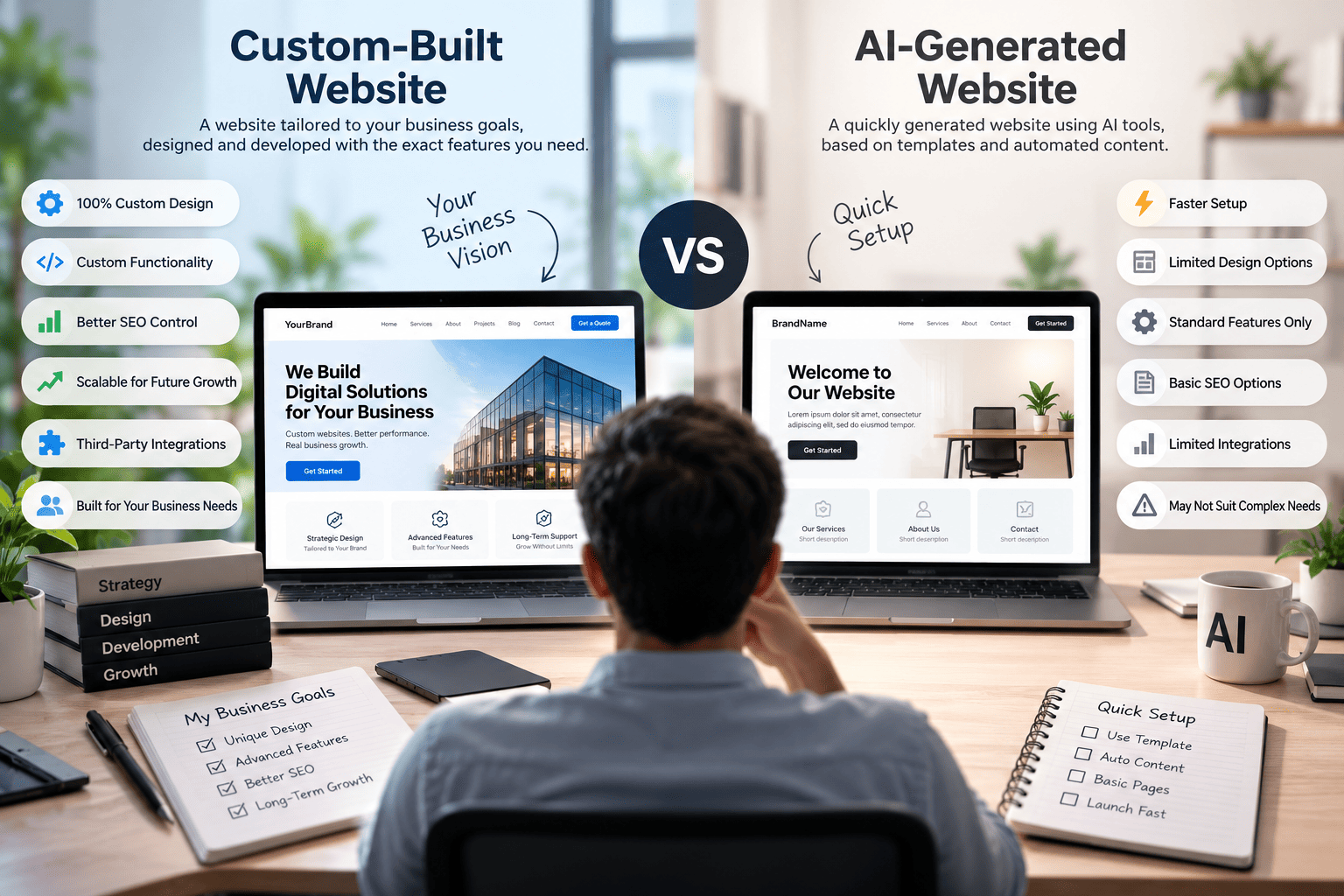
An AI website builder can be useful when you need a website quickly with standard pages and basic functionality. A custom-built website is a better fit when your business requires specific features, unique workflows, third-party integrations or greater control over how the website operates.
Instead of choosing based only on development time or initial cost, consider how well each option supports your actual business requirements.
Explore Our Work: Our projects
Custom-Built Website vs AI-Generated Website: Feature Comparison
| Feature | Custom-Built Website | AI-Generated Website |
| Development approach | Developed according to the business requirements | Created using AI tools, prompts and available components |
| Design flexibility | Layouts and interactions can be tailored to the project | Customization depends on the builder's capabilities |
| Business-specific features | Can be developed to suit specific workflows | Usually limited to supported features and integrations |
| Development time | Depends on the scope and complexity | Often faster for standard websites |
| Content and page structure | Pages and content layouts can be planned around business goals | Initial structure is generated from the information provided |
| Third-party integrations | Can be built around supported APIs and technical requirements | Depends on the platform's integration options |
| Future modifications | Can be extended by developers when the architecture supports it | Changes may be limited by the platform or subscription plan |
| Source code control | Depends on the technology, ownership agreement and project setup | Varies by platform; some builders restrict code access |
| SEO implementation | Technical SEO elements can be configured according to requirements | SEO options depend on the builder's available settings |
| Maintenance | Requires appropriate technical maintenance and updates | Platform may handle some infrastructure and maintenance |
| Scalability | Can be planned for expected growth, with suitable architecture | Depends on platform limits and available upgrade options |
| Best suited for | Businesses needing specific functionality and long-term flexibility | Individuals and businesses needing a simple website quickly |
Neither option is automatically better for every business. A small business that needs only a few informational pages may be well served by an AI website builder. A business that needs a customer portal, booking workflow, quotation system or specialized integrations may benefit more from custom development.
What Can Be Implemented in a Custom-Built Website?
A website may look simple on the screen, but several technical components work together to deliver the final result. The visible pages are only one part of the system. Behind them, developers may configure data storage, form processing, security controls, integrations and other functionality according to the project's requirements.
With custom development, these components can be selected and implemented based on the purpose of the website rather than being restricted entirely to a predefined set of features.
1. Business-Specific Pages and Layouts
Every business communicates differently. A logistics company may need separate service pages for air freight, sea freight, road transport and warehousing. A software company may need product pages, feature comparisons, pricing information and enquiry forms.
A custom-built website allows developers to organize pages around the business's services, target audience and customer journey. The design can also be adapted for different screen sizes and user interactions.
Learn More: Business website
2. Call Follow-Up Software
Businesses that receive enquiries regularly need a reliable way to track customer conversations and follow-up activities. A custom-built call follow-up software can help teams organize customer details, record call updates, schedule follow-up dates and manage pending enquiries from a centralized dashboard.
Depending on the business requirements, the system can include customer records, call history, follow-up reminders, employee assignments, enquiry status tracking and reports to monitor team activities. Access permissions can also be configured so managers and employees can view or update the information relevant to their roles.
Unlike a basic contact management tool, custom call follow-up software can be designed around a company's existing sales process and internal workflow. Additional features can be introduced as the business grows, making it a practical example of how custom web development can address specific operational needs.
3. Database and Dynamic Content
Some websites need more than fixed information pages. They may need to display products, services, articles, customer records or other information that changes regularly.
A database-backed website can store and retrieve this information dynamically. For example, a product catalogue can display items from a database, while an administrative dashboard can allow authorized staff to update selected content without editing the source code directly.
The exact functionality depends on the project's architecture and requirements.
4. Login Systems and User Permissions
A custom website or web application can include login functionality when users need access to private information or specific features.
For example, a customer portal may allow customers to view their enquiries, download documents or check order details. An administrative area may allow staff to manage records, while different user roles can be assigned different permissions.
These features require suitable authentication, authorization and security controls. They are not necessary for every website, but they can be valuable when a business needs restricted access.
View Our Latest projects: Admin Login
5. Third-Party API Integrations
Businesses sometimes need their websites to exchange information with external services. Depending on the provider's API and access permissions, a website can integrate with payment gateways, booking platforms, shipping services, email systems or other business software.
For instance, an ecommerce website may connect to a payment gateway, while a travel website may connect to an external booking engine. The integration must be designed around the third party's technical requirements and limitations.
6. Search Engine Optimization Controls
A custom-built website can be developed with technical SEO requirements in mind. These may include page-specific title tags and meta descriptions, canonical URLs, structured data, XML sitemaps, image alternative text, redirect handling and suitable page-loading practices.
These elements help search engines understand and access the website. However, custom development alone does not guarantee higher rankings. Search visibility also depends on content quality, competition, website performance, backlinks and other factors.
7. Admin Dashboard and Content Management
When a business frequently updates its website, an administrative interface can make routine tasks easier. Depending on the project, authorized users may be able to manage blog articles, service details, product listings, images, enquiries or other records.
The dashboard can be designed around the team's actual workflow, helping reduce the need to contact a developer for every routine content change.
View Our Dynamic Websites
8. Additional Features as the Business Grows
A website may begin with a small set of requirements and later need additional functionality. A suitable custom architecture can make it possible to introduce features such as customer dashboards, advanced search, online payments, reporting, subscription management or automated notifications.
However, adding new features is not always a simple process. The existing architecture, database design, security requirements and integration dependencies must be evaluated before extending the system.
Does Custom Development Mean Every Feature Must Be Built from Scratch?
No. Custom development does not necessarily mean writing every component from the beginning.
Developers can use established frameworks, libraries, APIs and other suitable tools to reduce development time and improve reliability. The custom work lies in selecting, configuring and combining these components to meet the specific requirements of the business.
Similarly, AI-generated websites are not always limited to basic pages. Some platforms provide advanced integrations, custom code options and additional functionality. Their capabilities vary from one platform to another.
The important difference is the degree of control available over the implementation, rather than whether AI or existing software tools are used at all.
How Should You Choose the Right Option?
Before selecting an approach, list the pages, features and integrations your business actually needs. Consider your available budget, expected launch date, maintenance arrangements and plans for future changes.
If you need a straightforward informational website with standard pages, an AI website builder may be sufficient. If your requirements include specialized business processes, custom data handling or functionality that must evolve over time, custom development may be worth considering.
The best choice is the one that meets your current requirements without creating unnecessary cost or complexity.
Why Choose Jayam Web Solutions for Your Website Development?
Jayam Web Solutions provides website development and custom web application development services for businesses with different requirements.
Our approach focuses on understanding the project scope, planning the required pages and functionality, and selecting a suitable implementation approach.
Depending on the project, the proposed work can include:
- Custom homepage and internal page layouts.
- Individual service pages and landing pages.
- Responsive website development.
- Enquiry forms and relevant integrations.
- Portfolio and blog implementation.
- On-page SEO configuration.
- Performance and functionality testing.
- Additional features based on the approved scope.
For businesses that require more than an informational website, we can also evaluate requirements for customer portals, dashboards, business workflows and custom web applications.
The recommended technology, development timeline and cost depend on the project's requirements. Before implementation, the scope should clearly identify the included features, exclusions, deliverables and support arrangements.
Our objective is to develop a website that serves a defined business purpose and provides a foundation for future improvements where required.
Frequently Asked Questions
1. Is a custom-built website better than an AI-generated website?
A custom-built website can be a better fit when the business needs specific functionality, greater implementation control or a tailored user experience. An AI-generated website can be suitable for businesses that need a simple website quickly. The right choice depends on requirements, budget and future plans.
2. Can I create a professional website using AI without coding?
Yes. Many AI website builders allow users to generate and edit websites without writing code. However, more advanced features, specialized integrations or changes beyond the platform's capabilities may require technical assistance.
3. How long does custom website development take?
A small custom informational website may take approximately one to three weeks, while more complex websites can take several weeks or longer. The actual timeline depends on page count, functionality, content readiness, integrations, revisions and testing.
4. Can an AI-generated website be customized later?
Yes, depending on the platform. Some builders provide extensive editing and integration options, while others restrict access to the underlying code or hosting environment. Check the platform's customization and export capabilities before committing to it.
5. Which website is better for SEO in 2026?
Neither approach automatically ranks better. Both custom-built and AI-generated websites can perform well when they provide useful content, accessible pages, appropriate technical SEO and a good user experience.
6. Can I add new features to my website in the future?
Yes, provided the existing architecture or platform supports the required changes. Custom websites can be designed with planned extensions in mind, but substantial new functionality may require additional development and cost.
7. Can a custom website connect to a database or external API?
Yes. A custom website or web application can connect to a database or supported external API when the requirements, technology and security considerations permit it. A basic informational website may not need these capabilities.
8. Is a custom-built website more secure than an AI-generated website?
Not automatically. Security depends on the implementation, platform, configuration, authentication, updates, hosting and maintenance. Both approaches need appropriate security measures for their intended use.
9. Can I move an AI-generated website to another hosting provider?
It depends on the platform. Some services support code export or external deployment, while others use proprietary hosting and restrict migration. Check portability and data export options before selecting a builder.
10. Does a custom-built website include maintenance?
Maintenance depends on the development agreement. Hosting, security updates, backups, content changes, bug fixes and new features may be covered by different support arrangements. Confirm these terms before the project begins.
11. Should a small business choose an AI website builder or a web development company?
An AI builder may be sufficient for a small business with standard website requirements and limited customization needs. A development company may be more suitable when the business requires tailored layouts, integrations, custom workflows or technical guidance. Compare the capabilities against your actual needs before deciding.
12. Can a custom-built website help my business appear in AI search results?
A custom-built website can provide control over page structure, technical implementation and content presentation. However, AI search visibility is not guaranteed by the development method. Helpful content, clear business information, discoverability and overall website quality remain important.
13. Can I start with a basic website and expand it later?
Yes. A phased approach can help a business launch with essential pages and functionality before investing in additional features. Future expansion should be considered during initial planning, although the cost and feasibility depend on the chosen architecture and later requirements.
14. How much does a custom-built website cost in India?
There is no single price for every custom website. The cost depends on the number of pages, design requirements, content, integrations, functionality and support arrangements. Share your requirements with a development company to obtain a meaningful estimate.
Conclusion: Choose a Website That Fits Your Business
AI website builders offer a fast way to create websites, especially when the requirements are simple and standard. Custom-built websites offer a different advantage: the ability to plan and implement design, functionality and technical structure around specific business needs.
Neither option is the right choice for every business. Before deciding, consider the features you need today, the changes you may require in the future, the total cost and the technical limitations of the chosen approach.
If your business needs a website that reflects its specific requirements or plans to introduce additional functionality over time, a custom development approach may be worth evaluating.
Planning a new website or considering improvements to your existing one?
Contact Jayam Web Solutions to discuss your business requirements, explore suitable implementation options and request a proposed scope of work.