

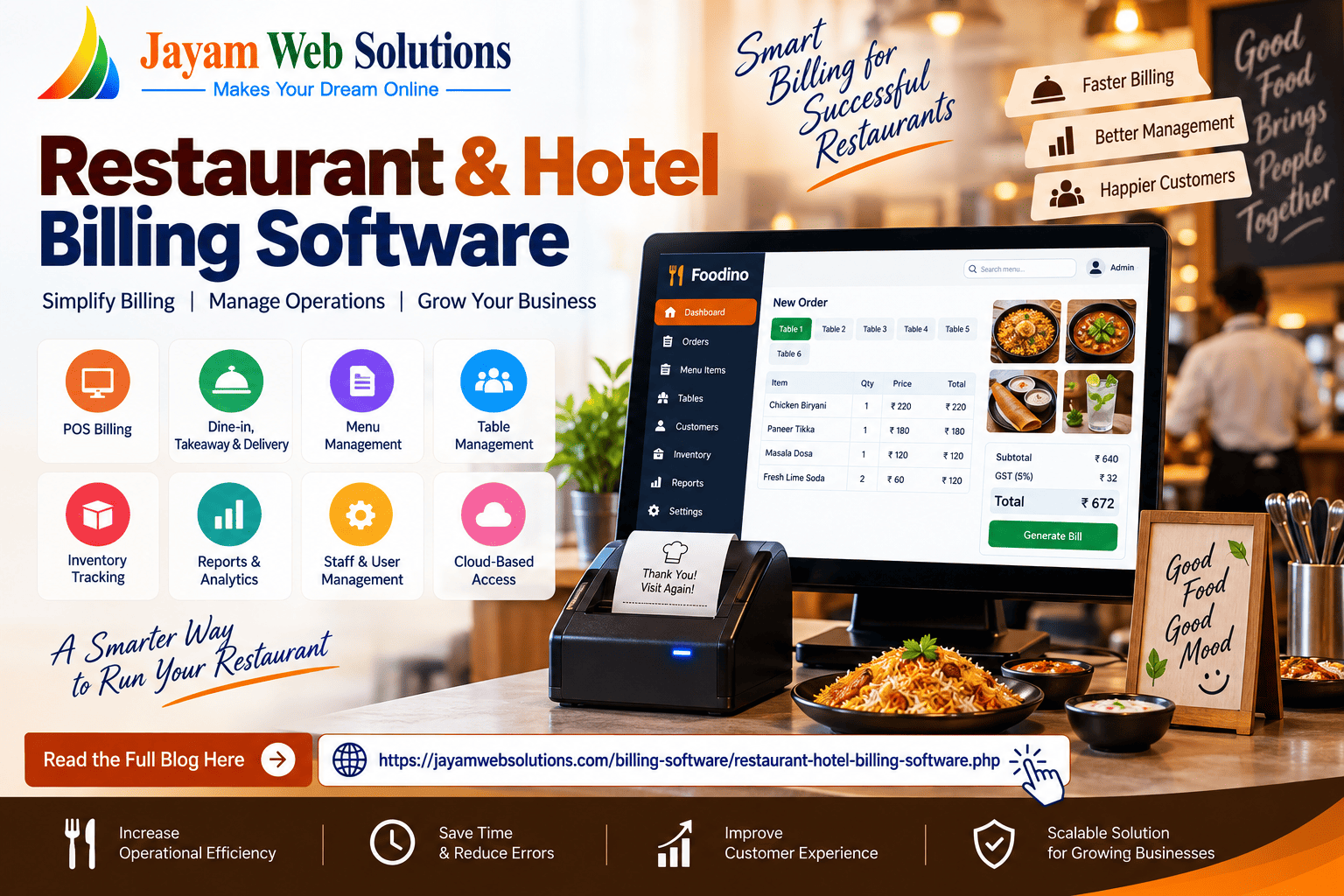
Restaurant & Hotel Billing Software: Complete Guide to Smarter Business Management
Running a restaurant or hotel involves much more than serving customers. Business owners and managers have to manage food orders, room bookings, payments, invoices, employees, customer information, sales, and daily financial records. When these activities are handled manually, even a small mistake can affect billing accuracy, customer service, and business profitability.
This is where restaurant and hotel billing software becomes valuable.
A modern billing system brings essential billing and operational activities into one centralized platform. Restaurants can manage food orders and generate bills, while hotels can manage room reservations, guest charges, and final invoices. Businesses can also track payments and generate reports that provide a clearer picture of daily performance.
Modern restaurant POS systems increasingly combine billing with features such as GST invoicing, inventory, kitchen operations, QR ordering, payment tracking, and analytics.
What Is Restaurant & Hotel Billing Software?
Restaurant and hotel billing software is a digital business management solution designed to simplify billing and transaction management for restaurants, cafés, hotels, lodges, resorts, and other hospitality businesses.
Instead of depending on handwritten bills, spreadsheets, calculators, or multiple disconnected applications, businesses can use one system to manage important transactions.
For restaurants, the software can help manage:
- Food orders
- Menu items
- Item quantities
- Discounts
- Taxes
- Customer bills
- Cash, card and UPI payments
- Sales reports
- Payment reports
For hotels and accommodation businesses, it can help manage:
- Room reservations
- Room availability
- Guest details
- Room charges
- Stay-related billing
- Payments
- Final invoices
- Business reports
The result is a more organized billing process with better visibility into business transactions.
Why Do Restaurants and Hotels Need Billing Software?
Hospitality businesses handle a large number of transactions every day. During busy hours, manually calculating bills can become difficult and time-consuming.
A dedicated billing system helps reduce repetitive work and gives staff a structured workflow.
1. Faster Billing
Customers expect quick service, especially during busy restaurant hours. Billing software allows staff to select items, enter quantities, apply discounts or taxes, and generate the final bill without performing calculations manually.
2. Fewer Billing Errors
Manual calculations can result in incorrect totals, discounts, taxes, or payment amounts. Automated calculations help improve billing accuracy.
3. Better Payment Tracking
Restaurants and hotels may receive payments through cash, UPI, cards, and other payment methods. A billing system can organize these transactions and make it easier to understand how collections were received.
4. Improved Business Visibility
Management needs to know how the business is performing. Sales and payment reports can provide useful information about daily, weekly, and monthly performance.
5. Better Customer Experience
Faster order processing and checkout can reduce waiting time and create a smoother customer experience.
Key Features of Restaurant Billing Software
A restaurant billing system should support the everyday requirements of food businesses.
Food Order Management
Staff can create customer orders by selecting menu items and quantities. The system can automatically calculate the subtotal, discounts, taxes, and final amount.
This is particularly useful during peak hours when multiple orders need to be processed quickly.
Menu Management
Restaurant owners can maintain their menu digitally by adding:
- Food categories
- Food items
- Prices
- Variations
- Add-ons
- Item details
When menu prices change, authorized users can update the information from the system.
Restaurant POS Billing
A restaurant POS system provides a centralized interface for creating and managing bills.
A typical workflow can include:
Select Items → Add Quantity → Apply Discount → Calculate Tax → Generate Bill → Collect Payment
This reduces unnecessary manual work and makes the billing process more consistent.
Multiple Payment Methods
Modern restaurant billing systems should support different payment methods such as:
- Cash
- UPI
- Credit/Debit Card
- Other digital payment methods
Tracking payments by method can also make end-of-day reconciliation easier.
Hotel Billing Software Features
Hotels have additional billing requirements because a guest's final invoice may include accommodation and other charges.
Room Booking Management
Hotel billing software can help staff manage room reservations and availability.
The system can maintain information about:
- Room availability
- Guest reservations
- Check-in details
- Check-out details
- Room charges
Room Charges
When a guest stays at a hotel, the billing process may involve accommodation charges and additional services. A centralized system makes it easier to organize these charges before generating the final bill.
Modern hotel billing systems can connect room charges, guest folios, payments, POS transactions, and reporting into a more connected workflow.
Guest Billing
At checkout, the system can calculate applicable charges and generate the final invoice.
This helps hotel staff avoid manually combining different charges and reduces the possibility of missing transactions.
GST Billing and Tax Management
For businesses operating in India, tax calculation and invoice accuracy are important parts of billing operations.
Restaurant and hotel billing software can be configured to handle applicable tax calculations and display the tax breakup on invoices.
Depending on the business and transaction, GST treatment can vary, so businesses should configure the software according to their applicable tax requirements and verify current rules with a qualified tax professional.
GST-ready restaurant POS systems commonly provide automated CGST/SGST/IGST calculations and structured GST invoices.
Dashboard and Business Reports
Billing software should not only generate invoices. The transaction data can also help management understand business performance.
A dashboard can provide an overview of:
- Total sales
- Number of orders
- Number of bills
- Payment collections
- Food sales
- Room bookings
- Popular products
- Payment methods
Reports can help identify trends and support better business decisions.
Sales Reports
Sales reports can show business performance over different periods, such as:
- Daily sales
- Weekly sales
- Monthly sales
Item-Wise Sales Reports
Restaurants can identify their best-selling food items and categories.
For example, management can compare which dishes generate the highest number of orders or revenue.
Payment Reports
Payment reports can help businesses understand collections by:
- Cash
- UPI
- Card
- Other payment methods
This can make daily reconciliation easier.
User and Staff Management
Not every employee needs access to every part of the billing system.
Role-based access can help businesses control what different users can view or manage.
For example:
Administrator
Can manage system settings, users, reports, and overall business configuration.
Manager
Can monitor sales, business performance, reports, and operational activities.
Cashier
Can focus on order entry, billing, and payment collection.
Role-based access is especially useful as a business grows and more employees begin using the system.
Benefits of Restaurant & Hotel Billing Software
Saves Time
Automated calculations and structured billing workflows can reduce the amount of time employees spend creating bills.
Improves Accuracy
Automatic calculation of totals, discounts, and configured taxes can reduce common manual calculation mistakes.
Simplifies Payment Management
Businesses can maintain clearer records of collections across different payment methods.
Supports Better Decision-Making
Sales and payment reports provide management with useful information for understanding business performance.
Improves Operational Control
Different user roles can be assigned according to responsibilities, helping businesses control system access.
Supports Business Growth
A scalable billing solution allows businesses to start with essential features and add more capabilities as their requirements increase.
How Restaurant & Hotel Billing Software Works
A typical billing workflow is straightforward:
Step 1: Login
Authorized staff access the billing system.
Step 2: Create an Order or Booking
Restaurant staff create a food order, while hotel staff create or manage a room reservation.
Step 3: Add Items or Charges
Food items, room charges, or other applicable services are added.
Step 4: Review the Transaction
Staff verify quantities, prices, discounts, and applicable taxes.
Step 5: Generate the Bill
The system automatically calculates the final amount and generates the invoice or receipt.
Step 6: Collect Payment
The payment is recorded using the applicable payment method.
Step 7: Review Reports
Management can monitor sales, payments, orders, bookings, and other business information through reports.
Who Can Use Restaurant & Hotel Billing Software?
A flexible billing system can be useful for many hospitality businesses, including:
- Restaurants
- Cafés
- Hotels
- Resorts
- Lodges
- Bakeries
- Fast-food outlets
- Food courts
- Cloud kitchens
- Small accommodation businesses
- Multi-service hospitality businesses
Businesses can select the features that match their operational requirements rather than using unnecessary functionality.
How to Choose the Right Billing Software
Before selecting a restaurant or hotel billing system, businesses should evaluate several factors.
Ease of Use
The interface should be simple enough for cashiers, managers, and administrators to learn quickly.
Billing Features
Check whether the system supports the billing workflows your business actually uses.
Payment Support
Make sure the system can record your preferred payment methods.
Reporting
Look for sales, payment, item-wise, and other reports that are useful for management.
User Management
Role-based permissions are important when several employees use the software.
Scalability
Choose software that can support your business as transaction volume, employees, or outlets increase.
Support and Updates
Technical support and regular improvements can be important for long-term usage.
The Future of Restaurant and Hotel Billing
Billing software is moving beyond simple invoice generation. Modern hospitality platforms increasingly connect billing with inventory, kitchen operations, online ordering, customer management, analytics, and multi-outlet management.
This means restaurant and hotel businesses can gradually move toward a more connected digital management environment.
For smaller businesses, the priority may simply be fast and accurate billing. Growing businesses may need reports, staff permissions, inventory, customer management, and multi-branch capabilities.
The right solution should therefore be flexible enough to grow with the business.
Conclusion
Restaurant and hotel billing software can simplify one of the most important parts of hospitality operations: managing transactions accurately and efficiently.
From food order billing and menu management to room reservations, guest billing, payments, dashboards, and reports, a centralized system can reduce manual work and improve operational visibility.
For businesses looking to modernize their billing process, the right software should be easy to use, scalable, secure, and aligned with their specific restaurant or hotel requirements.
A well-designed billing system is not just an invoice-generation tool. It can become an important part of the daily business workflow, helping owners and managers save time, reduce errors, monitor performance, and make better operational decisions.
Visit us at www.jayamwebsolutions.com to get started!
Kindly Reach us / Call us +91 9677876445.