

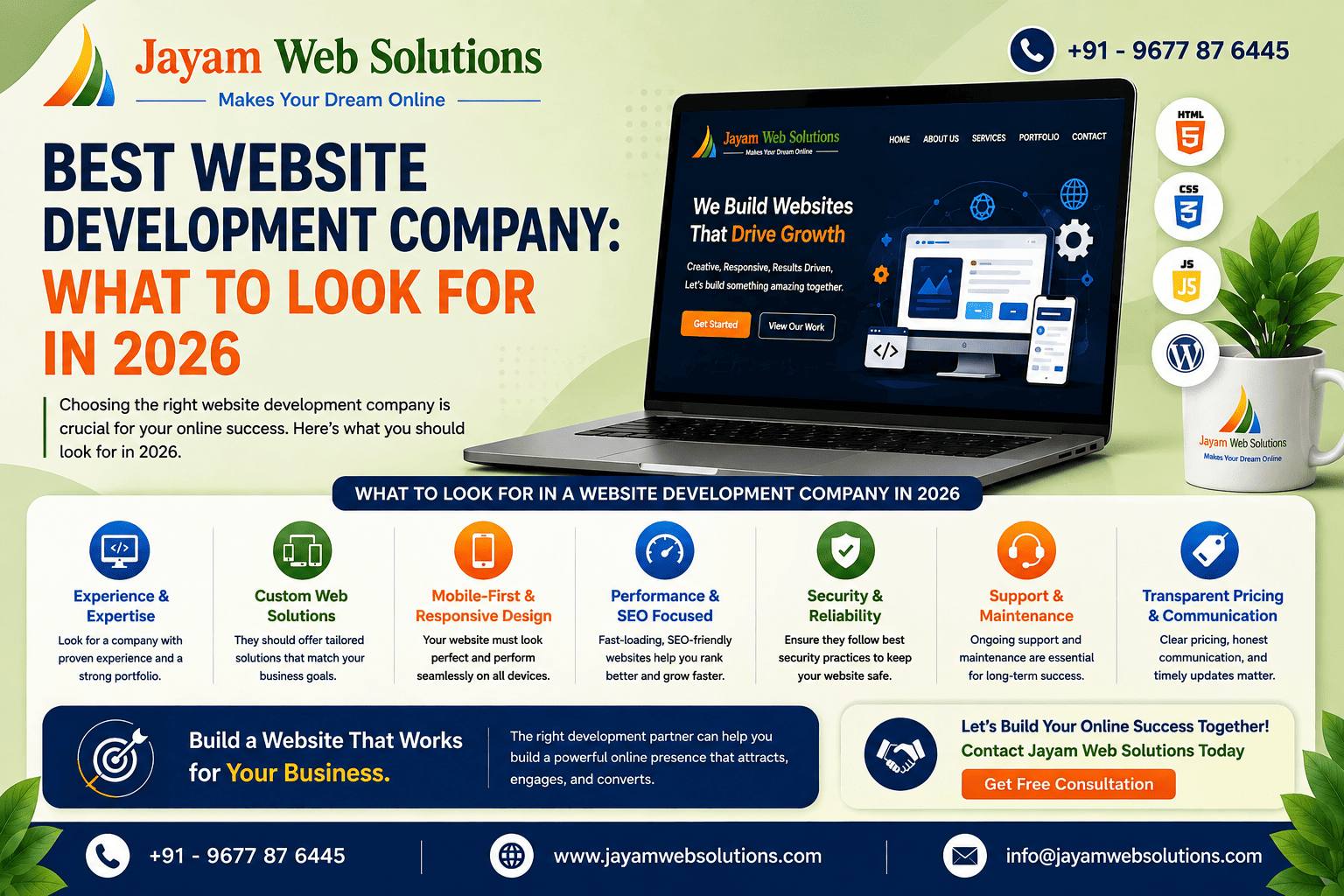
Best Website Development Company: What to Look For in 2026
A website is no longer just an online presence for a business. It can act as a digital storefront, marketing channel, lead-generation platform, customer communication tool, and information hub.
Because of this, choosing the right website development company is an important business decision. The company you select can influence your website's design, functionality, performance, security, search visibility, scalability, and long-term maintenance.
However, finding the right development partner can be challenging. Many companies offer similar services, technologies, and packages. A professional-looking portfolio alone does not necessarily tell you how well a company will handle your project.
The better approach is to evaluate a website development company based on its experience, relevant portfolio, development process, technical expertise, communication, project scope, security practices, SEO awareness, pricing transparency, and post-launch support.
So, what should you look for before choosing a website development company?
Let's explore the most important factors.
1. Understand Your Website Requirements First
Before searching for a development company, define what you actually need.
A business website could be:
- Corporate website
- Service-based website
- E-commerce website
- Booking website
- Educational website
- Portfolio website
- Membership website
- Web application
- Customer portal
- Business management platform
Your requirements will determine the type of development team you need.
For example, a simple company website may require a CMS and basic content management, while an e-commerce platform may require product management, payment integration, order processing, customer accounts, and inventory functionality.
Having a clear requirement document makes it easier to compare development companies accurately.
2. Check Their Real Portfolio
One of the first things to examine is the company's previous work.
Don't look only at attractive screenshots. If possible, visit actual websites developed by the company.
Look at:
- Website loading speed
- Mobile responsiveness
- Navigation
- Design consistency
- Content presentation
- Forms
- Functionality
- User experience
- Overall performance
A screenshot can show how a website looks, but a live website gives you a better understanding of how it actually works.
Recent industry guidance also recommends checking live portfolio websites instead of relying only on screenshots.
3. Look for Relevant Industry Experience
Experience matters, but relevant experience can matter even more.
A company may have built many websites, but you should check whether it has experience with projects similar to yours.
For example, if you operate an online store, ask whether the company has experience with:
- E-commerce development
- Product management
- Payment gateways
- Shopping carts
- Order management
- Customer accounts
- Inventory systems
Similarly, a professional services business may require:
- Service management
- Lead forms
- Appointment booking
- Customer portals
- CRM integration
- Content management
Relevant experience can help a development team understand common requirements and potential challenges.
4. Evaluate Their Technical Expertise
Technology should match the requirements of the project.
A professional website development company should be able to explain why a particular technology is suitable instead of simply recommending a technology because it is popular.
Depending on the project, technologies may include:
- HTML
- CSS
- JavaScript
- React
- Node.js
- PHP
- Laravel
- WordPress
- MySQL
- MongoDB
- APIs
- Cloud platforms
The important question isn't "Which technology is the latest?"
The better question is:
"Which technology is appropriate for this project's requirements, budget, performance needs, and future growth?"
5. Check Their Website Development Process
A structured development process can make project execution easier.
A typical process may include:
Requirement Analysis
Understanding the business, users, objectives, and functionality.
Planning
Creating the sitemap, feature list, technology plan, and project scope.
UI Development
Creating the visual structure, interface, responsive layouts, and user experience.
Development
Building the frontend, backend, database, integrations, and required functionality.
Testing
Checking functionality, responsiveness, forms, integrations, security, and performance.
Deployment
Moving the completed website to the production environment.
Maintenance
Providing updates, fixes, monitoring, and ongoing support.
A company that clearly explains its process gives you a better understanding of how your project will be managed.
6. Don't Ignore UI Development and User Experience
A website can have excellent technology and still provide a poor experience if its design is confusing.
A professional development company should consider:
- Simple navigation
- Clear call-to-action buttons
- Readable typography
- Consistent design
- Mobile-friendly layouts
- Logical page structure
- Easy-to-use forms
- Accessible content
The goal should not simply be to make a website look attractive.
The website should help visitors find information quickly and take the intended action easily.
7. Make Sure the Website Is Mobile-Friendly
A large portion of website traffic can come from mobile devices.
Therefore, your website should work properly across:
- Smartphones
- Tablets
- Laptops
- Desktop computers
Check whether:
- Text is readable
- Buttons are easy to tap
- Images fit the screen
- Menus work correctly
- Forms are usable
- Pages load efficiently
Responsive design should be considered during development rather than added as an afterthought.
8. Ask About Website Performance
Website performance affects user experience.
A slow website can make visitors leave before they explore your services or products.
Ask the development company about:
- Image optimization
- Code optimization
- Caching
- Hosting environment
- Database performance
- Mobile performance
- Page loading
- Performance testing
You can also test live portfolio websites using performance tools before making a decision.
9. Consider SEO From the Beginning
SEO should not be treated as something to add after the website has been completed.
The development team should consider technical SEO during development.
Important areas include:
- SEO-friendly URLs
- Page titles
- Meta descriptions
- Heading structure
- Image alt text
- Internal linking
- Mobile responsiveness
- Website performance
- Crawlability
- Structured data where appropriate
Good SEO also requires useful content and a website that serves visitors effectively. Therefore, development and content strategy should work together.
10. Check Website Security
Security is especially important for websites that collect customer information, process payments, or provide user accounts.
Ask about:
- HTTPS
- Secure authentication
- User permissions
- Password protection
- Software updates
- Database security
- Backup systems
- Security monitoring
If the website uses third-party plugins, libraries, or integrations, these should also be maintained properly.
11. Ask About CMS and Content Management
If your business regularly updates website content, a Content Management System (CMS) can make everyday management easier.
A CMS may allow your team to:
- Add pages
- Edit content
- Publish blogs
- Update services
- Upload images
- Manage products
- Update banners
- Manage users
Before choosing a platform, make sure it matches your team's technical ability and business requirements.
12. Check API and Third-Party Integration Experience
Many modern business websites need to communicate with other systems.
A development company may need to integrate:
- Payment gateways
- CRM systems
- Email services
- SMS APIs
- WhatsApp services
- Maps and location APIs
- ERP systems
- Analytics tools
- Shipping platforms
- Customer management systems
Ask whether the company has experience handling APIs and third-party integrations similar to the ones required for your project.
13. Understand the Pricing Clearly
Price is important, but the cheapest quotation may not always provide the best value.
Compare quotations based on:
- Number of pages
- Features
- Design
- Development
- CMS
- Integrations
- Hosting
- Domain
- SEO
- Testing
- Maintenance
- Support
- Future enhancements
A clear quotation should explain what is included and what is excluded.
This reduces misunderstandings later.
14. Check Ownership and Access
This is an important point that businesses sometimes overlook.
Before starting the project, clarify:
- Who owns the website?
- Who owns the domain?
- Who controls the hosting?
- Who owns the source code?
- Who has administrator access?
- Can the business access its website files?
- What happens if the company changes its development partner?
These details should ideally be documented in the project agreement.
15. Communication Is Extremely Important
Even a technically strong company can become difficult to work with if communication is poor.
Check whether the company provides:
- Regular project updates
- Clear communication channels
- Requirement documentation
- Task tracking
- Demo sessions
- Feedback management
- Testing updates
- Launch coordination
Good communication helps reduce confusion and keeps the project aligned with the original requirements.
16. Ask About Testing and Quality Assurance
A website should not be launched immediately after development without proper testing.
Testing may include:
Functional Testing
Checking whether features work correctly.
Responsive Testing
Testing different screen sizes.
Browser Testing
Checking compatibility across commonly used browsers.
Form Testing
Checking contact forms, enquiry forms, registration forms, and other submissions.
Integration Testing
Checking APIs and third-party services.
Performance Testing
Checking page speed and overall performance.
Security Testing
Identifying common security issues.
Quality assurance can help identify problems before customers encounter them.
17. Don't Forget Post-Launch Support
Website development doesn't necessarily end when the website goes live.
You may need support for:
- Bug fixes
- Content updates
- Security updates
- Performance improvements
- Plugin updates
- Backup monitoring
- New features
- Technical issues
Ask the company what support is included after launch and whether maintenance is available separately.
18. Look for Scalability
Your website should be capable of supporting future business growth.
Today, you may need only:
10 products → 100 products → 1,000 products
Or:
5 employees → 50 employees → 500 employees
Your development architecture should be planned according to realistic future requirements.
Scalability can involve:
- Database design
- Hosting
- Code architecture
- CMS structure
- API architecture
- Performance
- Security
Planning ahead can reduce the need for expensive redevelopment later.
19. Check Reviews and Testimonials Carefully
Reviews can provide useful information about a development company's communication, support, and project experience.
However, don't rely on reviews alone.
Try to evaluate multiple sources:
- Google reviews
- Client testimonials
- Portfolio
- Case studies
- Live websites
- Business history
The goal is to build a complete picture before making your decision.
20. Choose Value Instead of Just the Lowest Price
One of the biggest mistakes businesses make is selecting a development company solely because it offers the lowest quotation.
A cheaper website may initially seem attractive, but additional costs can appear later through:
- Missing features
- Poor performance
- Redesign requirements
- Security problems
- Limited support
- Difficult maintenance
Instead of asking:
"Who can build my website for the lowest price?"
Ask:
"Who can build the right website for my business and provide long-term value?"
Questions to Ask Before Hiring a Website Development Company
Before finalizing your development partner, ask:
- Can you show live websites you have developed?
- Have you worked on projects similar to mine?
- Which technology do you recommend and why?
- What is included in the quotation?
- What is the estimated timeline?
- How will project updates be shared?
- Who will manage the project?
- How many revisions are included?
- Who owns the website and source code?
- Will I receive administrator access?
- How will SEO be handled?
- How will the website be tested?
- What security measures will be implemented?
- What happens after the website goes live?
- Is maintenance and support available?
These questions can help you compare companies based on evidence rather than marketing claims.
Conclusion
Choosing the right website development company is about much more than comparing attractive designs or low prices.
The right development partner should understand your business objectives, recommend suitable technology, create a user-friendly experience, build a secure and scalable website, consider SEO and performance, communicate clearly, and provide support after launch.
Before making your decision, review real portfolio projects, understand the development process, clarify ownership, compare the complete scope, and ask detailed questions about support and maintenance.
A successful website should not simply look good. It should support your business goals, serve your customers effectively, perform reliably, and provide a strong foundation for future growth.
At Jayam Web Solutions, we develop professional websites and custom web solutions based on individual business requirements.
Visit us at www.jayamwebsolutions.com to get started!
Kindly Reach us / Call us +91 9677876445