

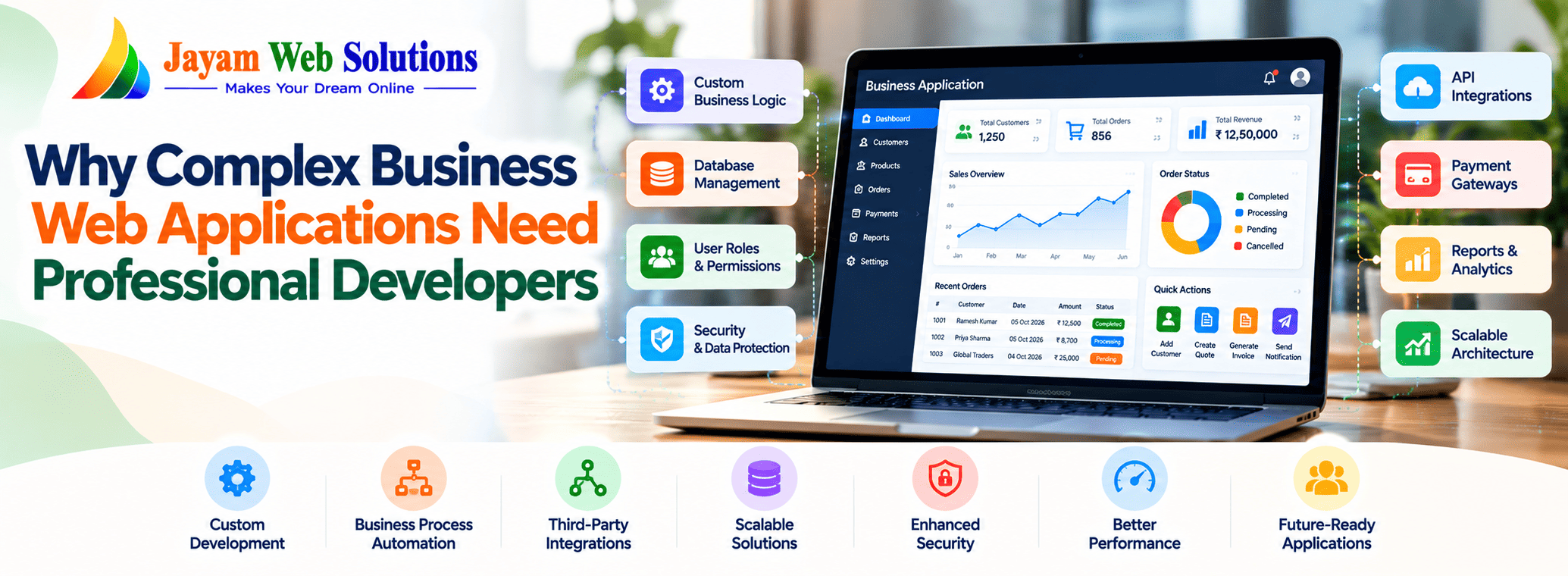
Why Complex Business Web Applications Need Professional Developers
A business website and a business web application are not the same thing.
A conventional website mainly helps visitors learn about a company, its products, services, locations and contact details. A web application, on the other hand, can become part of the company's daily operations.
It may handle customer records, quotations, orders, invoices, payments, employee activities, bookings, inventory, reports, subscriptions and many other processes.
As the number of functions increases, simply creating screens and connecting them together is no longer enough. The application needs a carefully planned technical foundation so that different parts of the system continue to work correctly as the business grows.
This is where professional web application development becomes important.
AI tools, website builders and ready-made platforms can be useful for many types of projects. They can help create prototypes, simple websites and even assist developers with coding. But a complex business application requires much more than generating code.
It requires someone who understands how the business operates and how that operation should be converted into a reliable software system.
What Makes a Business Web Application Complex?
Complexity does not necessarily mean that an application has hundreds of pages.
Even a relatively small application can become technically complicated when it contains several interconnected processes.
For example, a business application might have:
- Customer registration
- Employee accounts
- Different access permissions
- Product or service management
- Quotation creation
- Order processing
- Invoice generation
- Online payments
- Email and SMS notifications
- Reports
- Document uploads
- Third-party integrations
- Automated workflows
- Multiple branches
- Subscription management
The difficulty comes from the relationship between these functions.
Changing one process can affect several other areas of the application.
For example, changing the status of an order could automatically affect inventory, invoice generation, payment records, customer notifications and reporting.
That is why complex applications need proper planning before development begins.
1. The Application Must Reflect the Company's Actual Working Process
Every business has its own way of handling operations.
A software application should therefore be designed around the company's actual workflow rather than forcing the company to follow a generic system.
Consider a quotation management application.
The business may require a process such as:
Enquiry → Customer Selection → Product Selection → Pricing → Discount Approval → Quotation → Customer Response → Order → Invoice
Another organisation may have a completely different process.
A professional development team first studies these operational requirements and then determines how they should be represented within the application.
This requirement analysis stage is extremely important because a technically impressive application can still fail if it does not match the way the business actually works.
2. Custom Business Rules Need Careful Implementation
Businesses often have rules that are specific to their operations.
For example:
- Certain customers may receive special pricing.
- Some quotations may require manager approval.
- Different branches may have different tax settings.
- Employees may have limits on discounts.
- Certain orders may require advance payment.
- Some products may need additional approval before dispatch.
- Subscription customers may have access to different features.
These are not simply design elements.
They are business rules that influence what the software is allowed to do.
The development team has to translate those rules into reliable application logic.
If a rule is implemented incorrectly, the problem may not immediately appear on the screen. It could instead result in incorrect invoices, wrong reports, unauthorised actions or inconsistent business data.
That is why business logic deserves careful attention during application development.
3. Different Users May Need Completely Different Access
A business application commonly serves more than one type of user.
For example, a system could include:
- Administrator
- Manager
- Sales employee
- Accountant
- Customer
- Vendor
- Partner
- Support staff
They should not all receive identical access.
A sales employee might be allowed to create a quotation but not modify tax settings.
An accountant might need access to invoices and payments but not employee management.
A customer may only be able to view their own orders and documents.
This requires a properly designed authentication and permission system.
Professional developers need to determine not only what appears in the interface, but also what each account is permitted to perform at the application and server levels.
4. Connecting Different Services Requires Technical Planning
A modern business application frequently depends on services outside the main application.
For example, a booking platform might use:
- A payment service for online transactions
- An SMS service for alerts
- An email service for confirmations
- A maps service for location information
- A WhatsApp service for communication
An ecommerce platform could additionally connect with shipping and inventory services.
The important part is that these services do not always behave in exactly the same way.
An external service might:
- Temporarily stop responding
- Return an error
- Change its API
- Reject a request
- Take longer than expected
- Return incomplete information
The application therefore needs appropriate handling for these situations.
Developers have to plan how information travels between the systems, how authentication is managed, how failures are handled and what should happen if an external service is unavailable.
5. Data Design Determines How Well the Application Can Grow
A complex application can generate a considerable amount of business information over time.
Imagine a system containing:
Customers → Products → Orders → Payments → Invoices → Reports
Each part is connected to other information.
If the underlying data structure is poorly planned, problems can appear later:
- Repeated information
- Incorrect relationships
- Slow searches
- Difficult reporting
- Complicated updates
- Data inconsistencies
- Performance problems
Professional developers therefore plan the data model according to the application's actual operations.
They also consider how the database will behave when the number of customers, transactions and records increases.
Good database planning is often invisible to the end user, but it has a major effect on the reliability and maintainability of the application.
6. Security Has to Be Built Into the Application
A business application can contain information that should not be publicly accessible.
This could include:
- Customer records
- Employee information
- Financial information
- Internal documents
- Business reports
- Login credentials
- Transaction records
Security therefore cannot be treated as something to be added just before launch.
A professional development process should consider areas such as:
- Secure login
- Permission control
- Session management
- Input validation
- API protection
- Secure file handling
- Data protection
- Access restrictions
- Error handling
- Activity logging
- Backup and recovery
The application should also be reviewed as a complete system rather than checking only the visible website pages.
7. Performance Becomes More Important as Data Increases
A newly developed application may initially contain only a small amount of data.
After several years, it could contain:
- Thousands of customers
- Large product catalogues
- Thousands of orders
- Multiple years of invoices
- Large document collections
- Extensive transaction history
A function that appears fast with 100 records may behave differently with 100,000 records.
This is why developers need to consider:
- Database queries
- Search mechanisms
- Data loading
- API response times
- File handling
- Caching
- Background processing
- Server resources
Performance should be considered as part of the architecture rather than treated only as a final optimisation exercise.
8. A Business Application Must Handle Unexpected Situations
Real business operations do not always follow the ideal workflow.
Consider an online payment.
The customer may complete the payment, but the browser could close before the application receives the confirmation.
Or an external API may temporarily become unavailable while an order is being processed.
Or a user may accidentally click the same button twice.
A reliable application needs to determine what should happen in these situations.
Developers may need to implement mechanisms for:
- Validation
- Duplicate prevention
- Transaction management
- Failure recovery
- Error reporting
- Retry processing
- Status verification
The objective is to ensure that an unusual situation does not create incorrect business records.
9. Reporting Requires More Than Displaying Database Records
Business applications often need meaningful reports rather than simple lists.
For example:
- Monthly sales
- Outstanding payments
- Customer activity
- Product movement
- Employee performance
- Booking statistics
- Revenue analysis
- Inventory status
Reports may require information from multiple parts of the database.
The application needs to retrieve and process that information efficiently.
As reporting requirements become more sophisticated, database structure, query design and application architecture become increasingly important.
10. Testing Becomes More Difficult When Modules Are Connected
Testing a simple contact form is relatively straightforward.
Testing a business application is different.
Suppose an application contains:
Customer → Quotation → Order → Payment → Invoice
A change made to the quotation module could potentially affect the order and invoice processes.
Therefore, developers and testers need to verify not only individual features but also the relationships between them.
Testing may include:
- Functional testing
- API testing
- Integration testing
- Permission testing
- Database testing
- Responsive testing
- Security testing
- Performance testing
- Regression testing
- User acceptance testing
The more interconnected the application becomes, the more important systematic testing becomes.
11. Future Changes Should Be Considered During Initial Development
Business requirements rarely remain unchanged.
A company may initially request:
Customer Management + Quotation + Invoice
After a year, it may want:
Payment Integration + Mobile Access + Reports + WhatsApp Notifications + Subscription Management
If the original application has been designed without future expansion in mind, adding new functionality can become unnecessarily difficult.
Professional developers therefore try to create a structure where additional modules can be introduced without disturbing the entire application.
This does not mean predicting every future requirement.
It means avoiding an architecture that makes reasonable future changes unnecessarily difficult.
12. AI Can Accelerate Development, But Engineering Decisions Still Matter
AI has become an important part of modern software development.
Developers can use AI to help with:
- Code suggestions
- Debugging
- Documentation
- Test creation
- Code explanation
- Prototyping
- Repetitive programming tasks
- Refactoring
This can save development time.
However, producing code is only one stage of creating a business application.
Someone still has to determine:
- What the business actually needs
- How the modules should interact
- How information should be stored
- Who should have access
- How external services should be connected
- How failures should be handled
- How the system should be secured
- How the application should be deployed
- How future changes should be introduced
AI can assist with implementation, but the technical decisions and validation of the finished system remain critical.
13. AI-Generated Code Needs Human Validation
Code generated with AI may appear correct when viewed individually.
The real question is whether it works correctly within the entire application.
For example, generated code could make assumptions about:
- Database structure
- Authentication
- API responses
- User permissions
- Error handling
- Business rules
Those assumptions may not match the actual project.
A professional developer can review generated code, test its behaviour and modify it to fit the application's architecture.
This makes AI-assisted development different from simply asking AI to create an entire application without technical supervision.
14. Choosing Technology Should Start With the Requirement
There is no single technology stack that is automatically best for every business application.
Depending on the project, developers may evaluate:
- Frontend framework
- Backend technology
- Database
- API architecture
- Hosting environment
- Authentication method
- Storage requirements
- Third-party services
- Expected traffic
- Future scalability
For example, a small internal tool and a large subscription-based SaaS platform may have completely different technical requirements.
The technology should therefore follow the problem being solved, rather than the other way around.
15. Deployment Is Part of Development
Building the application on a developer's computer is only one stage.
The finished application has to operate in a real environment.
Deployment may involve:
- Server configuration
- Domain configuration
- SSL
- Environment variables
- Database setup
- File storage
- API credentials
- Email configuration
- Backup procedures
- Monitoring
- Application updates
A development team with deployment experience can identify infrastructure requirements early rather than discovering them immediately before launch.
16. Maintenance Continues After the Application Goes Live
A business application should not be considered finished simply because it has been launched.
Over time, businesses may require:
- New modules
- New reports
- New integrations
- Workflow changes
- Security updates
- Performance improvements
- UI changes
- Additional user roles
- Mobile functionality
- AI-based features
External services can also change their APIs.
The application therefore needs a development structure that can be maintained and extended without creating unnecessary technical problems.
17. Custom Development Gives Businesses Greater Control
A business may eventually discover that a ready-made platform does not support a particular requirement.
At that stage, it may need workarounds, additional plugins or alternative services.
In some situations, businesses may eventually decide to move to a custom application.
That migration can involve:
- Data conversion
- User migration
- API replacement
- Workflow recreation
- Infrastructure changes
- Testing
- Training
When a business's processes are already known to be unique or likely to evolve significantly, custom development may provide greater control from the beginning.
AI Tools, Ready-Made Platforms or Custom Development?
There is no universal answer.
AI Website Builders Can Be Useful For
- Basic company websites
- Landing pages
- Simple promotional websites
- Early prototypes
- Basic online presence
Ready-Made Software Can Be Useful For
- Standard business processes
- Common requirements
- Businesses that can work within predefined workflows
Custom Web Applications Can Be Appropriate For
- Unique business processes
- Complex workflows
- Multiple user types
- Custom databases
- Advanced integrations
- Business automation
- Special reporting requirements
- SaaS platforms
- Applications expected to evolve over time
The correct choice depends on the complexity and uniqueness of the business requirement.
Professional Developers and AI Are Not Opposing Choices
The conversation around AI sometimes creates the impression that a business must choose between AI and developers.
That is not necessarily the case.
A professional development team can use AI as part of its workflow while still taking responsibility for:
- Requirement analysis
- System architecture
- Database planning
- Application security
- API integration
- Code review
- Testing
- Deployment
- Maintenance
In this model, AI becomes a productivity tool rather than a replacement for the complete software engineering process.
When Should a Business Consider Custom Web Application Development?
A business should seriously consider custom development when several of these conditions apply:
Your workflow is unique
Your employees follow processes that standard software cannot easily accommodate.
Several systems need to communicate
Your application needs multiple external APIs or business systems.
Different users require different permissions
Customers, employees, managers and administrators need separate access.
Your data is central to operations
The application needs to process significant amounts of business information.
Automation is important
You want software to reduce repetitive manual work.
The application will continue growing
You expect new modules, users and integrations in the future.
Security is important
The system handles sensitive business or customer information.
You need control over the application
You want flexibility over functionality, infrastructure and future development.
Questions to Ask Before Starting a Complex Web Application
Before selecting a development approach, businesses should ask:
- What exact business problem will the application solve?
- Which processes should be automated?
- Who will use the application?
- What information needs to be stored?
- What permissions will each user have?
- Which external services need to be connected?
- What reports are required?
- How many users are expected initially?
- How might the application grow?
- Who will maintain the application after launch?
- What are the backup and recovery requirements?
- What level of source-code and infrastructure control is required?
Answering these questions before development can prevent many avoidable problems later.
The Real Value of Professional Web Development
Professional development is not simply about writing more code.
Its value lies in converting a business requirement into a structured, reliable and maintainable digital system.
A professional team should be able to look beyond individual screens and understand:
Business Process → Application Architecture → Data → Security → Integrations → Testing → Deployment → Future Expansion
That broader perspective becomes increasingly important as the application becomes part of everyday business operations.
FAQs
What is a complex business web application?
It is a web-based software system designed to manage one or more business operations, such as customer management, billing, quotations, bookings, inventory, payments, reporting or workflow automation.
Can AI build a business web application?
AI can assist in creating application code and prototypes. However, complex projects still require requirement analysis, architecture, integration, security, testing and human validation.
Why do businesses choose custom web application development?
Businesses may choose custom development when their processes, workflows or functionality cannot be effectively handled by standard software or ready-made platforms.
Is custom web application development suitable for small businesses?
Yes. The decision should be based on the complexity of the business requirement rather than company size. A small business can still have highly specialised workflows that require custom software.
What is AI-assisted web development?
AI-assisted development is an approach where professional developers use AI tools to accelerate tasks such as coding, testing, debugging and documentation while developers remain responsible for the application's architecture and quality.
How long does it take to develop a complex web application?
There is no standard duration. The timeline depends on the number of modules, workflows, integrations, user roles, database requirements, testing requirements and deployment environment.
What should I provide to a web application development company?
Ideally, provide your business workflow, user types, required features, reports, integrations, existing software or data, and any specific security or hosting requirements. A professional team can then convert those requirements into a technical plan.
Conclusion
Complex business web applications are essentially digital versions of business operations.
They may manage customers, employees, quotations, orders, payments, inventory, bookings, reports and many other processes. Because these functions are interconnected, the application needs more than an attractive interface or automatically generated code.
It needs thoughtful planning, appropriate architecture, reliable data handling, secure access, integration management, testing and ongoing maintenance.
AI can certainly contribute to modern development and help developers work faster. Ready-made platforms can also be the right choice for standard requirements.
But when a business has unique workflows, complex rules, multiple integrations, sensitive data or long-term expansion plans, professional web application development can provide the level of control and engineering oversight required.
The objective should not simply be to create an application quickly.
The objective should be to create a system that supports the business reliably today and remains capable of adapting tomorrow.
🌐 www.jayamwebsolutions.com
📧 marketing@jayamwebsolutions.com
📧 jayamwebsolutionspvtltd@gmail.com
📞 +91 96778 76445 | +91 98405 99789 | +91 88708 39789
Jayam Web Solutions – Makes Your Dream Online.