

Hotel Billing Software: Features, Benefits and a Complete Guide for Hotels
Managing a hotel involves several daily activities, including room reservations, guest check-ins, restaurant orders, billing, payment collection, and financial reporting. When these activities are handled using separate systems or manual records, hotel staff may spend more time coordinating information and correcting billing errors.
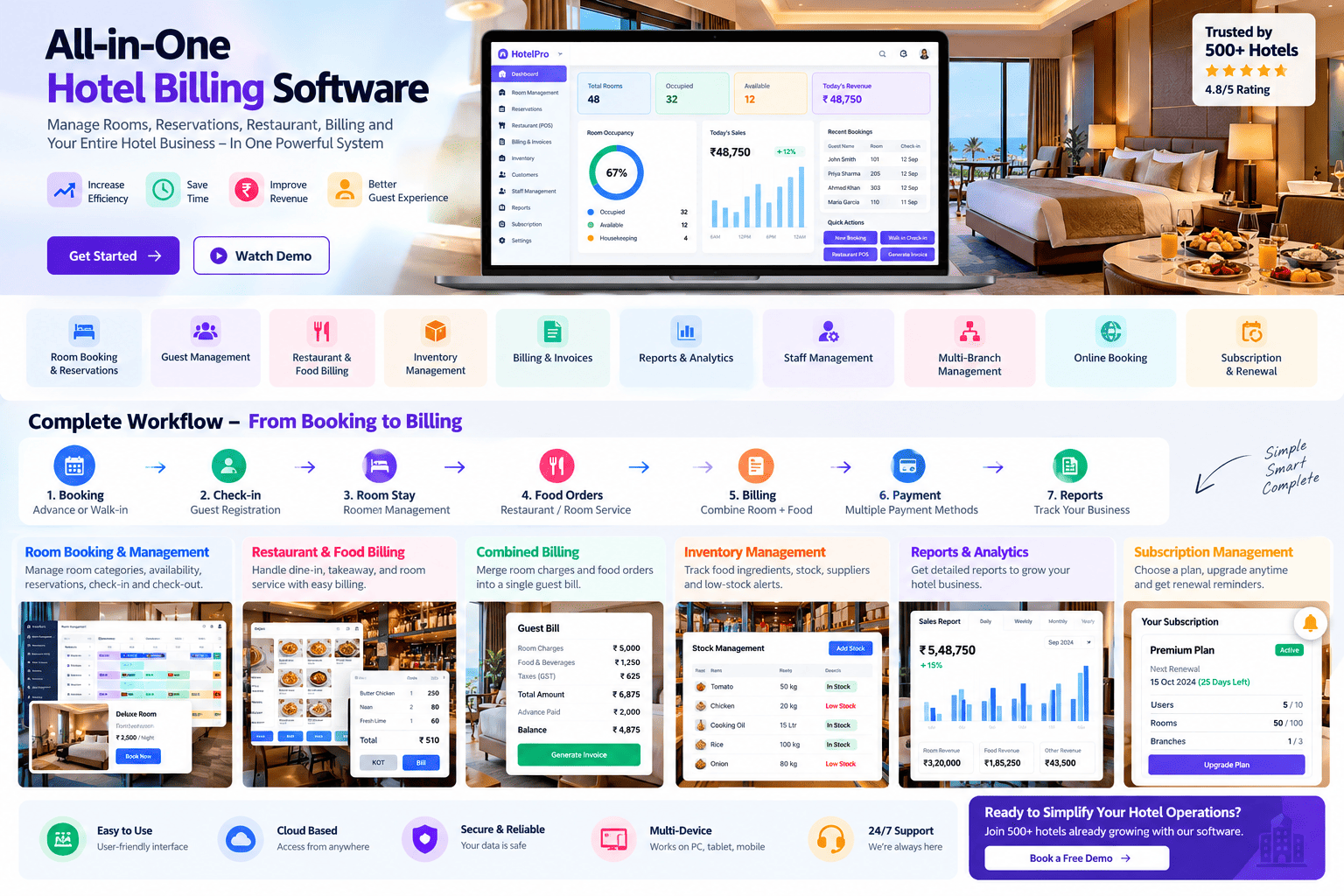
Hotel billing software helps simplify these operations by bringing essential hotel billing and management activities into a centralized system. Depending on its features, the software can support room booking, guest management, restaurant billing, invoice generation, payment tracking, and business reporting.
For hotels that provide both accommodation and food services, an integrated hotel billing system can make it easier to manage room charges and restaurant transactions together.
In this guide, we explore the important features of hotel billing software, how different modules work, and what hotel owners should consider when choosing a suitable solution.
What Is Hotel Billing Software?
Hotel billing software is a digital application that helps hotels manage guest charges, room reservations, invoices, and payment records. Depending on the system, it may also include restaurant point-of-sale (POS) billing, inventory management, staff permissions, and operational reports.
Instead of maintaining separate records for every activity, hotel staff can use an integrated platform to organize information and process transactions more efficiently.
Hotel billing software can be useful for:
- Hotels and lodges
- Business hotels
- Resorts and holiday properties
- Hotels with in-house restaurants
- Guest houses and accommodation businesses
- Hospitality businesses managing room and food services
The most suitable system depends on the size of the property, its daily operations, and the features it requires.
1. Room Booking and Reservation Management
Room booking is one of the most important functions of a hotel management system. Reception staff need accurate information about room availability, reservation dates, room categories, and guest arrivals.
A room booking module can help organize these activities in one place.
Important room booking features
- Room category and tariff configuration
- Room availability tracking
- Advance reservation management
- Walk-in guest bookings
- Reservation date and duration management
- Booking modification and cancellation records
- Room allocation
- Check-in and check-out processing
- Room status updates
With a clear reservation overview, staff can identify available rooms, review upcoming arrivals, and coordinate guest stays more efficiently.
2. Guest Management and Check-In
Guest information is an essential part of hotel operations. Staff need to record booking details, identify the correct reservation, and prepare the guest's bill when the stay ends.
Guest management features can help maintain organized customer records and link them to room reservations.
Depending on the system, these features may include:
- Guest profile management
- Contact and identification details
- Reservation history
- Check-in records
- Check-out records
- Stay duration and room allocation
- Guest billing history
An organized guest management process helps reception staff retrieve information quickly and coordinate room-related transactions.
Hotels should also ensure that guest information is collected, stored, and accessed according to applicable privacy and security requirements.
3. Restaurant Billing and Food Order Management
Hotels with restaurants, cafes, or in-room dining services must manage food orders alongside their accommodation operations.
Restaurant billing software helps staff record orders, calculate charges, generate bills, and track food sales.
Restaurant and POS features
- Food menu and category management
- Item pricing configuration
- Order entry
- Table-wise order management
- Dine-in billing
- Takeaway orders
- Room-service orders
- Kitchen order tracking, where supported
- Restaurant invoices
- Food sales reports
A restaurant POS module can help reduce repetitive manual calculations and organize food transactions throughout the day.
For properties offering room service, connecting restaurant orders to the relevant guest or room can also help staff maintain accurate billing records.
4. Combined Room and Restaurant Billing
One useful capability for hotels with restaurant facilities is the ability to manage accommodation charges and food expenses within the same guest account.
For example, consider a guest who stays for two nights and orders meals from the hotel restaurant.
The guest's charges might include:
- Room charges: ₹5,000
- Food and beverages: ₹1,250
- Applicable taxes: ₹625
- Total bill: ₹6,875
These figures are illustrative examples, not actual software pricing.
If the application supports combined billing, staff can review the room and food charges together and generate a consolidated invoice where appropriate.
This can help simplify checkout, improve visibility into the guest's outstanding balance, and reduce the need to reconcile separate paper bills.
The exact workflow depends on whether restaurant orders can be linked to a room or guest account in the software.
5. Invoice Generation and Payment Management
Accurate invoices help hotels communicate charges clearly and maintain reliable financial records.
Hotel billing software can automate calculations and organize payment information, depending on the billing module.
Common billing features
- Invoice generation
- Room tariff calculations
- Food and beverage charges
- Configurable discounts
- Applicable tax calculations
- Advance payment records
- Partial payment handling
- Outstanding balance tracking
- Payment receipts
- Payment history
- Daily collection summaries
The system should be configured according to the hotel's billing rules and applicable tax requirements. Available payment methods may include cash, cards, UPI, and other configured options.
A well-organized billing process helps staff review transactions and reduces the risk of calculation mistakes.
6. Inventory and Stock Management
For hotels that operate restaurants, tracking ingredients and consumables can be an important part of cost control.
An inventory module can help record stock received, stock used, purchases, and available quantities.
Depending on the available features, inventory management may include:
- Food ingredient records
- Stock entry and adjustment
- Supplier details
- Purchase records
- Stock availability
- Low-stock alerts
- Stock movement history
- Inventory reports
- Ingredient consumption tracking
For example, a restaurant can monitor quantities of rice, vegetables, cooking oil, and other ingredients.
If the software supports recipe-based stock deduction, ingredient consumption can be linked to food sales. Otherwise, staff may need to record stock usage separately.
Regular inventory tracking can help hotel managers identify shortages and maintain better control over restaurant supplies.
7. Hotel Reports and Business Analytics
Reports help hotel owners understand daily activities and review business performance.
Instead of manually combining booking registers, restaurant sales records, and payment details, a reporting module can present information in a more organized format.
Useful hotel management reports
Room and reservation reports
- Room availability
- Occupancy summaries
- Booking records
- Check-in and check-out summaries
- Reservation cancellations
Restaurant reports
- Daily food sales
- Item-wise sales
- Category-wise sales
- Order summaries
Financial reports
- Daily and monthly collections
- Invoice summaries
- Outstanding balances
- Payment method summaries
- Expense reports, where supported
Management reports
- Revenue summaries
- Date-wise performance
- Branch-wise comparisons, if multi-branch management is available
These reports can help managers review operations, identify trends, and make informed business decisions.
The accuracy of reports depends on the quality of the recorded data and the reporting features implemented in the application.
8. Staff Management and Role-Based Access
Hotel employees perform different tasks depending on their responsibilities. Receptionists manage bookings, cashiers process payments, restaurant staff record orders, and managers review reports.
Role-based access control allows the application administrator to assign permissions according to each employee's role.
Possible user roles include:
- Hotel owner or administrator
- Hotel manager
- Receptionist
- Cashier
- Restaurant staff
- Accountant
- Other authorized employees
The application can restrict access to selected modules and sensitive operations based on configured permissions.
For example, a receptionist may need access to reservations and check-in records, while a manager may also require access to reports and financial summaries.
Appropriate access control helps maintain operational discipline and reduces unnecessary access to business information.
9. Multi-Branch Hotel Management
Hospitality businesses operating more than one property may need a centralized way to manage their operations.
Where multi-branch functionality is available, the system can help administrators manage individual properties while maintaining a broader view of the business.
Possible capabilities include:
- Branch profile management
- Branch-wise room records
- Staff assignment
- Branch-specific transactions
- Separate operational reports
- Consolidated revenue summaries
- Centralized administration
For example, a hotel group operating two properties may want to review each property's revenue separately while also checking the overall business performance.
Multi-branch access and reporting should be verified against the selected software plan.
10. Subscription-Based Hotel Billing Software
Subscription-based hotel billing software allows businesses to access an application through a recurring payment plan.
For software providers, a subscription model can make it easier to offer different packages to hotels with different operational requirements.
A subscription management module may include:
- Monthly, quarterly, half-yearly, and annual plans
- Plan selection and activation
- Subscription start and expiry dates
- Renewal management
- Payment history
- Invoice generation
- Plan upgrades
- Subscription expiry reminders
- Configurable user or room limits
- Plan-based feature access
For example, a smaller property may require room booking and basic billing, while a larger hotel may need additional staff accounts, advanced reports, or multi-branch access.
Different subscription plans can help accommodate these requirements.
Hotels should review the plan comparison carefully to understand the included modules, usage limits, renewal terms, and any additional charges.
Benefits of Using Hotel Billing Software
The value of hotel billing software depends on how well its features match the property's daily requirements.
Reduced manual work
Automated calculations and organized digital records can reduce repetitive data entry and manual bill preparation.
More organized room operations
Reservation and room availability records can help reception staff coordinate bookings and guest arrivals.
Better restaurant billing
A restaurant billing module can help record food orders and maintain transaction histories.
Clearer guest invoices
Integrated billing can make it easier to review room charges, food expenses, taxes, and payments.
Improved financial visibility
Sales and collection reports can help owners review revenue and outstanding balances.
Better coordination between teams
A centralized system can help authorized staff access the information they need for their responsibilities.
More structured business management
Digital records and reports can support routine reviews and operational planning.
How to Choose the Right Hotel Billing System
Before selecting hotel billing software, hotel owners should consider the following questions:
- Does the software support room reservations and room availability?
- Can it manage guest check-in and check-out?
- Does it support restaurant billing and room-service orders?
- Can room charges and food expenses be combined on a guest invoice?
- Are the required taxes, discounts, and payment methods supported?
- Does it include the necessary inventory and reporting features?
- Can user roles and permissions be configured?
- Does the selected plan support the required number of rooms, users, and branches?
- What data backup, security, training, and technical support arrangements are available?
- What are the subscription fees, renewal terms, and additional charges?
Comparing these requirements with the actual software features can help businesses select a system that fits their operations.
Frequently Asked Questions
What is the main purpose of hotel billing software?
Hotel billing software helps hotels manage room-related charges, invoices, payments, and financial records. Depending on the application, it may also support reservations, restaurant billing, guest management, and operational reports.
Can hotel billing software manage room booking and restaurant billing together?
Yes, some systems support both accommodation and restaurant operations. Combined guest billing is possible when the software supports linking restaurant orders to the relevant guest or room account.
Is hotel billing software suitable for small hotels?
Yes. Small hotels can benefit from organized reservations, billing, payment records, and reports. The best solution depends on the property's size, workflow, and budget.
Does hotel billing software support inventory management?
Some applications include inventory management for ingredients, consumables, purchases, and stock levels. Recipe-based ingredient deduction may be available in selected systems.
Can hotel billing software generate invoices?
Most billing-focused hotel applications provide invoice generation and payment recording. The supported invoice formats, taxes, discounts, and payment methods vary by application.
What is subscription-based hotel billing software?
It is software provided through a recurring payment plan, such as monthly or annual billing. Depending on the provider, the subscription may determine access to features, user accounts, rooms, branches, and other limits.
What should I check before purchasing hotel billing software?
Check the room booking workflow, restaurant billing, combined invoicing, reports, staff permissions, subscription limits, data security, support, and total cost.
Conclusion
Hotel billing software can help hospitality businesses organize room reservations, guest records, restaurant orders, invoices, payments, and business reports within a centralized application.
For hotels that provide both accommodation and food services, choosing a system with suitable room management, restaurant billing, and guest invoicing features can simplify daily workflows.
Before selecting a solution, hotel owners should evaluate their requirements, compare available modules, and confirm that the software supports their operational needs.
Looking for a hotel billing solution for your business? Explore the available features, compare subscription plans, and choose a system that matches your hotel's room management, restaurant billing, and reporting requirements.