

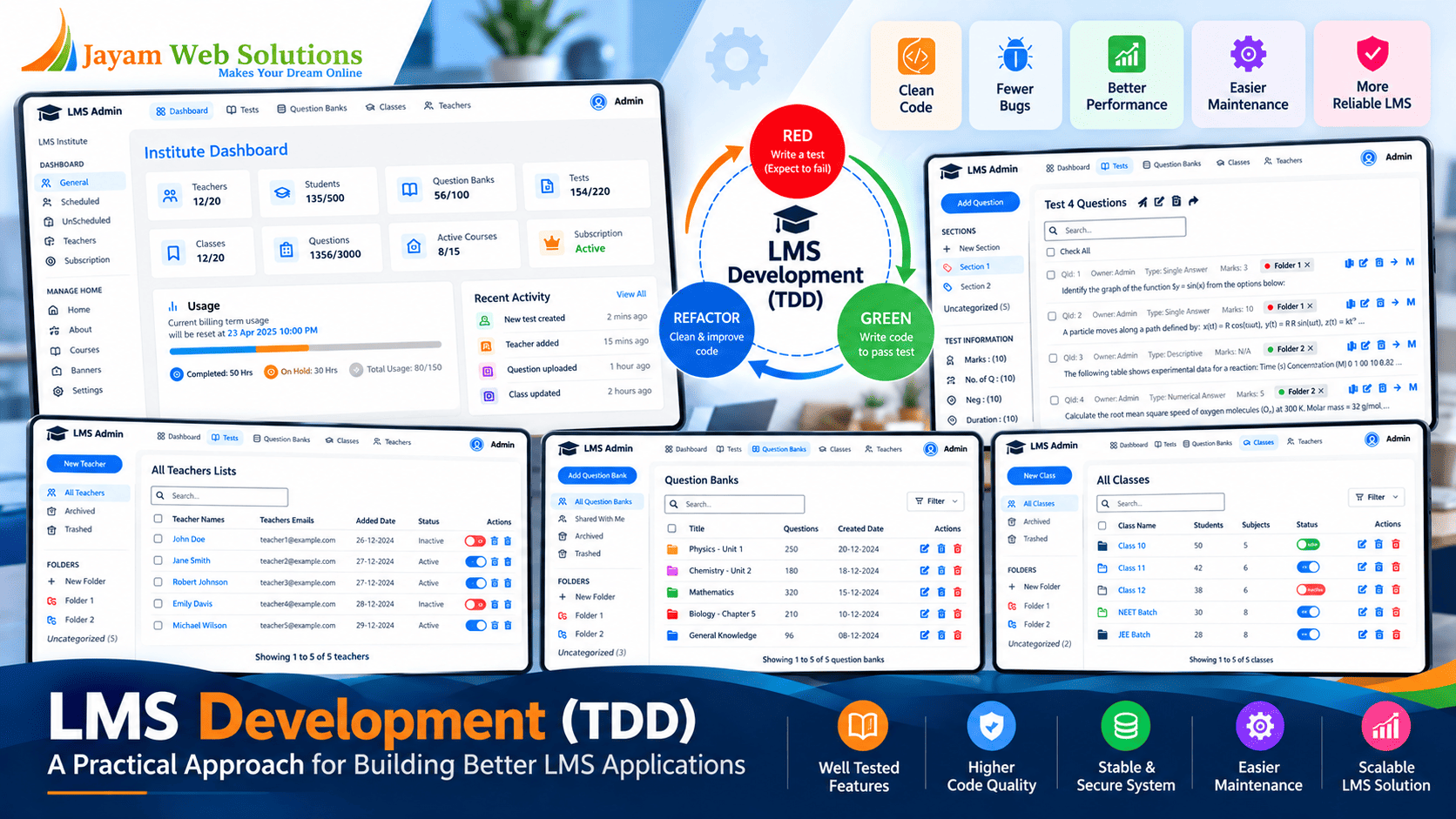
What Is a SaaS Learning Management System? Features, Benefits and How It Works
Introduction
Managing an educational institution involves more than delivering lessons. Institutions must organise student records, coordinate teachers, manage batches and subjects, conduct examinations and monitor academic performance. When these activities are handled through separate tools or manual processes, managing information can become complicated as the institution grows.
A SaaS Learning Management System (LMS) provides a centralized digital platform for managing learning-related activities. It allows educational institutions to organise users, coordinate academic operations and manage online examinations through a software platform accessed over the internet.
For schools, colleges, coaching centres and training organisations, choosing a suitable LMS can improve the way academic activities are organised and monitored.
In this guide, we will explore what a SaaS Learning Management System is, how it works, its essential features, its benefits for educational institutions and what to consider before selecting an LMS solution.
What Is a SaaS Learning Management System?
A SaaS Learning Management System is a cloud-based software platform that helps educational institutions manage learning activities, users, academic information and examinations through an online system.
SaaS stands for Software as a Service. Instead of installing and maintaining software independently on every computer, users access the platform through the internet, subject to the provider's hosting, subscription and access arrangements.
An LMS brings different academic management activities together in one platform. Depending on the software, administrators can manage institutions, teachers, students, batches, subjects, question banks and examinations.
For example, an educational organisation operating multiple institutes may use a multi-institute LMS to manage different institutions through a shared platform while maintaining separate user access and academic records.
In simple terms: A SaaS LMS helps educational institutions organise their learning and examination management activities through a centralized online software platform.
How Does a SaaS LMS Work?
A SaaS Learning Management System generally follows a structured workflow. The exact process depends on the platform and its available features.
1. Institution Setup
The institution is registered or configured within the LMS. An administrator can set up the institution's basic information and required academic structure.
2. User Management
The administrator manages the users who need access to the platform. These may include institute administrators, teachers and students.
3. Batch and Subject Organisation
Students can be organised into batches, and academic subjects can be configured according to the institution's requirements.
4. Question Bank Management
Teachers or authorised users can organise questions for different subjects and examinations. A structured question bank makes it easier to maintain examination-related content.
5. Online Examination Management
The platform can be used to organise and conduct online examinations based on its available examination features.
6. Student Participation
Students access the platform using their assigned login credentials and participate in the academic activities and examinations made available to them.
7. Performance Monitoring
Administrators and teachers can review available examination results and performance information to understand student progress.
This workflow helps bring important academic activities into a more organised digital environment.
8 Important Features of a SaaS Learning Management System
When evaluating LMS software, educational institutions should consider features that support their actual academic and administrative requirements.
1. Multi-Institute Management
Multi-institute management is useful for educational organisations that operate more than one institute or learning centre.
A multi-institute LMS can provide a common platform for managing multiple institutions while supporting separate access and management arrangements.
This can help organisations maintain a more structured approach to academic administration.
2. Student and Teacher Management
Student and teacher management is an essential part of an LMS.
The platform should help authorised users organise student information, teacher details and their respective academic responsibilities.
A centralized system can make it easier to access and manage relevant academic records without depending entirely on disconnected spreadsheets or manual documents.
3. Online Examination Management
Online examination management allows educational institutions to organise assessments through a digital platform.
Depending on the available functionality, institutions can create and manage examinations, organise questions and provide students with access to online tests.
This is particularly useful for institutions that conduct regular assessments or need to manage examinations across different batches.
4. Question Bank Management
A question bank helps organise examination questions based on subjects and other relevant categories.
Teachers and authorised administrators can maintain a structured collection of questions for examination-related activities.
A well-organised question bank can reduce repeated manual work when preparing assessments.
5. Batch and Subject Management
Educational institutions often manage students across different batches, courses and subjects.
An LMS with batch and subject management capabilities helps organise these academic structures within one platform.
This makes it easier for authorised users to manage academic information according to the institution's setup.
6. Performance Analytics
Monitoring student performance is important for understanding academic progress.
An LMS can provide examination results and performance-related information to help teachers and administrators review student outcomes.
These insights can support academic discussions and help institutions identify areas that may require additional attention.
7. Role-Based Access Management
Different users require different levels of access to an LMS.
A role-based structure can provide separate access according to responsibilities.
Common user roles may include:
- Super Admin: Manages overall platform-level administration.
- Marketing Executive: Handles the responsibilities assigned to the marketing role.
- Institute Admin: Manages institution-level academic and administrative activities.
- Teacher: Accesses assigned teaching and examination-related functions.
- Student: Accesses permitted student-level learning and examination activities.
The exact permissions should be configured according to the software's available access-control settings.
8. LaTeX Editor Support
Mathematical and technical questions often require special symbols, equations and formatted expressions.
A LaTeX editor can help users prepare mathematical content in a structured format.
For institutions conducting mathematics, science or other technical examinations, this capability can be useful when preparing question-bank content.
Benefits of Using a SaaS LMS for Educational Institutions
A suitable Learning Management System can support institutions in several ways.
Centralized Academic Management
Instead of maintaininginformation across multiple disconnected systems, institutions can organise supported academic activities through a common platform.
Better Organisation of Student Information
Centralized student management can make academic records easier for authorised users to access and maintain.
Structured Examination Processes
Online examination management helps institutions organise assessment activities digitally and maintain examination-related information in a structured manner.
Improved Administrative Coordination
A platform with separate user roles can help distribute responsibilities between administrators, teachers and students.
Easier Performance Monitoring
Available examination results and analytics can help teachers and administrators review student performance.
Support for Growing Educational Organisations
Institutions operating multiple learning centres may benefit from multi-institute management capabilities, depending on the platform's design and configuration.
The actual benefits depend on the institution's requirements, the LMS features available and how effectively the platform is implemented.
SaaS LMS vs Traditional LMS: What Is the Difference?
Both SaaS and traditional LMS solutions help manage learning activities, but their delivery and maintenance models can differ.
| Comparison | SaaS LMS | Traditional or Self-Hosted LMS |
| Access | Usually accessed through the internet | Depends on the installation and hosting setup |
| Installation | Generally provided as an online service | May require independent installation |
| Maintenance | Often handled by the service provider | May require internal or external technical support |
| Updates | Managed according to the provider's release process | Depends on the organisation's maintenance process |
| Infrastructure | Uses the provider's hosting arrangement | May use the organisation's own infrastructure |
| Pricing | Often subscription-based | Can involve licensing, hosting or maintenance costs |
Not every traditional LMS follows the same model, and some self-hosted platforms also support online access. Institutions should compare the actual deployment, ownership, maintenance and pricing terms before choosing a solution.
Who Can Benefit from a SaaS Learning Management System?
A SaaS LMS can be useful for different types of educational and training organisations.
Schools and Colleges
Institutions can use suitable LMS features to organise student information, academic activities and assessments.
Coaching Centres
Coaching centres can benefit from organised batch management, subject management and online examination capabilities.
Training Institutes
Training organisations can use an LMS to manage learners, trainers and available assessment activities.
Online Education Providers
Organisations delivering online education can use an LMS to coordinate supported digital learning and examination workflows.
Multi-Branch Educational Organisations
Institutions operating several learning centres can consider multi-institute functionality to manage their academic operations through a common platform.
How to Choose the Right SaaS LMS Software?
Selecting an LMS is an important decision because the platform should support the institution's current needs and future plans.
Before choosing a solution, consider the following points:
1. Institution Requirements: Identify the number of institutions, students, teachers and administrators who need access.
2. User Roles: Check whether the software supports the required roles and permission levels.
3. Examination Features: Review question-bank management, online examination workflows and result-related capabilities.
4. Academic Organisation: Check whether batches, subjects and student records can be managed according to your requirements.
5. Reporting and Analytics: Understand what performance information and reports are available.
6. Security and Access: Review authentication, permissions, data protection and backup arrangements.
7. Scalability: Consider whether the platform can support the organisation's expected growth.
8. Pricing and Support: Understand subscription costs, included services, technical support and any additional charges.
9. Product Demonstration: Request a demonstration and test the workflows that are important to your institution.
Choosing software based on actual requirements is more effective than selecting a platform based only on the number of advertised features.
How Jayam's SaaS LMS Supports Educational Management
Jayam's SaaS Learning Management System is designed to support educational and examination management through a structured online platform.
The solution includes capabilities identified in its product portfolio, such as multi-institute management, student and teacher management, batch and subject organisation, online examination management, question-bank management and performance analytics.
It also supports different user roles, including Super Admin, Marketing Executive, Institute Admin, Teacher and Student, according to the platform's role structure.
For institutions looking to organise academic information and examination activities through a digital system, these capabilities provide a foundation for managing supported workflows in one place.
Educational organisations can explore the available LMS functionality and evaluate whether it matches their academic and administrative requirements.
Looking for an LMS solution for your educational institution?
Explore Jayam's software solutions and request a product demonstration to understand the available features and workflows.
Frequently Asked Questions About SaaS Learning Management Systems
1. What is a SaaS Learning Management System?
A SaaS Learning Management System is an online software platform that helps educational institutions manage learning activities, users, academic information and examinations through a centralized system.
2. How does SaaS LMS software work?
SaaS LMS software is accessed through the internet. Depending on the platform, administrators can manage users and academic structures, teachers can access assigned functions, and students can participate in available learning and examination activities.
3. What is the difference between SaaS LMS and traditional LMS?
A SaaS LMS is generally delivered as an online service, with hosting and maintenance managed according to the provider's service model. A traditional or self-hosted LMS may require the institution to manage its own installation, hosting and maintenance.
4. Can multiple educational institutions use one LMS platform?
Yes. A multi-institute LMS can support multiple educational institutions through a shared platform with appropriate separation of user access and institutional information. The exact arrangement depends on the software.
5. Does an LMS support online examinations?
Many LMS platforms include online examination capabilities. Available functions may include examination creation, question-bank management, student participation and result management.
6. What are the common user roles in an LMS?
Common roles include Super Admin, Institute Admin, Teacher and Student. Some platforms also provide additional roles, such as Marketing Executive. Access permissions vary by system.
7. Can an LMS manage student performance?
An LMS may provide examination results, reports and performance analytics that help authorised teachers and administrators review student progress.
8. How much does SaaS LMS software cost?
The cost depends on the provider, subscription model, number of users, available features, hosting requirements and support arrangements. Institutions should request a quotation based on their requirements.
9. Is a SaaS LMS suitable for coaching centres?
Yes. A suitable LMS can help coaching centres organise students, batches, subjects and online assessments, depending on the features provided by the platform.
10. What should institutions check before selecting an LMS?
Institutions should evaluate user management, examination capabilities, academic organisation, reporting, security, scalability, pricing and technical support before making a decision.
Conclusion
A SaaS Learning Management System provides educational institutions with a digital way to organise academic activities, manage users and coordinate examination workflows.
From multi-institute management and student records to question banks and performance analytics, the right LMS can help institutions create a more structured approach to educational administration.
Before selecting a platform, institutions should understand their requirements, compare available features and evaluate the software through a practical demonstration.
Jayam's LMS solution brings together several capabilities for educational and examination management. Explore the available features to understand how the platform may support your institution's digital requirements.