

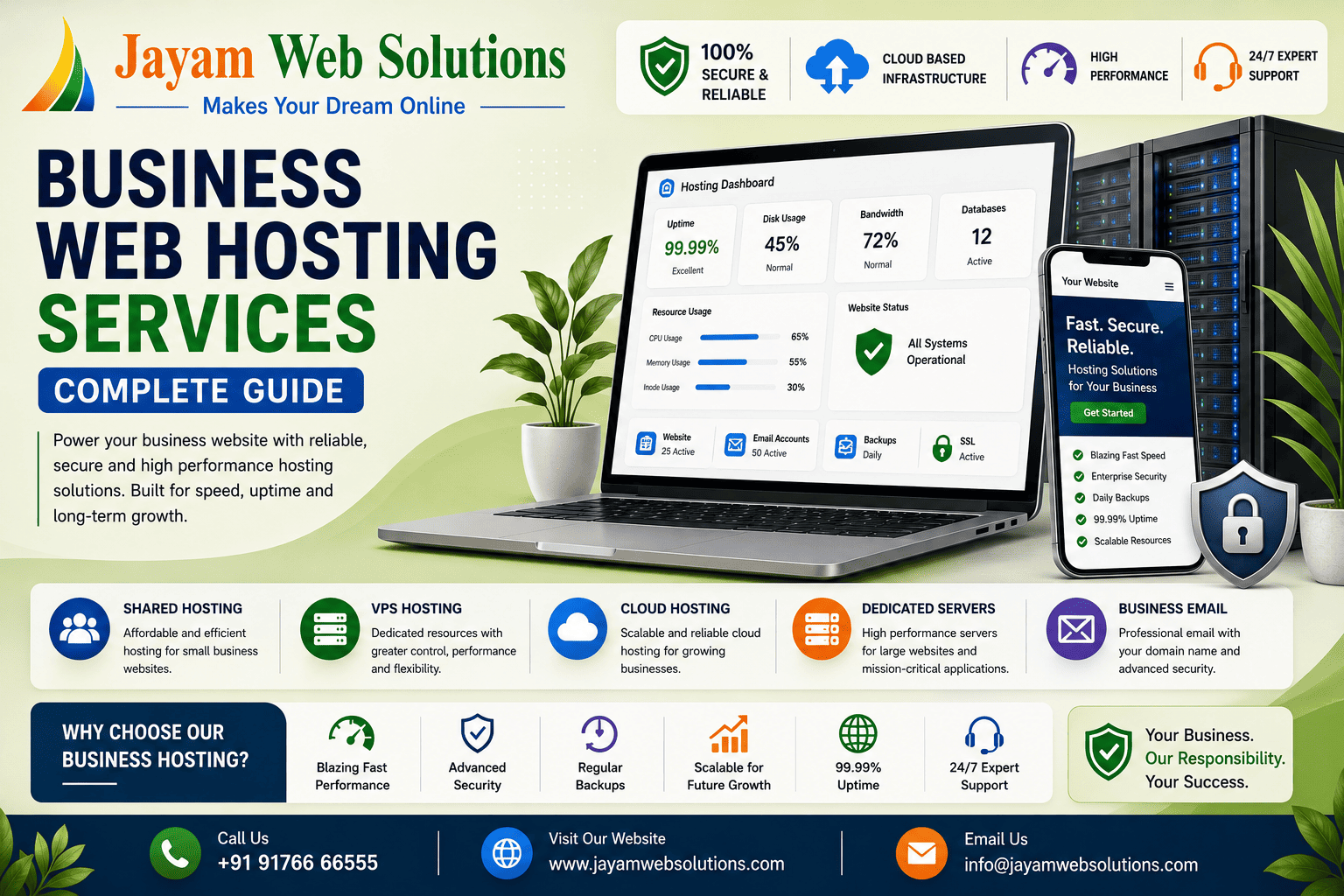
Business Web Hosting Services: Complete Guide for Businesses
A business website is an important part of modern digital operations. It may generate enquiries, showcase products and services, accept orders, provide customer support, or act as the primary online presence of a company.
However, even a professionally designed website needs a reliable hosting environment to perform effectively.
Business web hosting services provide the server infrastructure required to store website files, databases, applications, emails, and other online resources and make them accessible to users through the internet.
Choosing a hosting service based only on price can create performance, security, and scalability problems later. Businesses should instead evaluate hosting based on their website requirements, expected traffic, security needs, technical architecture, and future growth.
What Is Business Web Hosting?
Business web hosting is a hosting service designed to support websites and online applications used for commercial purposes.
Compared with basic hosting plans intended for small personal websites, business hosting may provide greater resources, reliability, security features, backup options, technical support, and scalability.
Depending on the provider and hosting environment, business hosting can include:
- Website storage
- Database support
- SSL certificates
- Email hosting
- Server resources
- Backup systems
- Security monitoring
- Control panel access
- Application support
- Server management
- Performance optimization
- Technical support
The exact features depend on the hosting plan and infrastructure.
Why Is Web Hosting Important for a Business?
Hosting directly affects the environment in which your website operates.
A poor hosting setup can contribute to:
- Slow page loading
- Website downtime
- Security vulnerabilities
- Limited resources
- Database performance problems
- Difficult scalability
- Poor customer experience
A reliable hosting environment, on the other hand, can provide a stronger foundation for website performance and business continuity.
How to Choose the Right Business Web Hosting Service
There is no single hosting solution that is ideal for every business.
The right choice depends on several factors.
1. Understand Your Website Requirements
Before selecting a hosting plan, identify what your website actually needs.
Consider:
- Type of website
- Number of visitors
- Storage requirements
- Database requirements
- Technology stack
- Number of websites
- Email requirements
- Application requirements
- Expected traffic growth
- Security requirements
2. Website Performance
Website speed is important for both user experience and business performance.
A hosting environment with suitable CPU, memory, storage, and server configuration can help websites handle requests more efficiently.
Performance can also depend on:
- Server location
- Web server technology
- Caching
- Database optimization
- Website code
- Image sizes
- CDN usage
- Traffic levels
Hosting is only one part of overall website performance, but it provides the foundation on which the website operates.
3. Server Resources
Hosting plans typically provide different levels of resources.
Important resources include:
- CPU
- RAM
- Storage
- Bandwidth
- Database resources
- Concurrent connections
Businesses should select resources based on actual usage rather than choosing the smallest available plan simply because it is cheaper.
4. Security
Website security should be a major consideration when selecting business hosting.
A hosting environment should support appropriate security measures such as:
- SSL/HTTPS
- Firewall protection
- Malware monitoring
- Secure server configuration
- Regular backups
- Access control
- Software updates
- Security monitoring
For websites that handle customer accounts or transactions, additional application-level security measures are also important.
5. Backup and Recovery
A backup can become extremely valuable when something goes wrong.
Businesses should understand:
- How frequently backups are taken
- How long backups are retained
- Where backups are stored
- Whether restoration is available
- Whether backups are automated
It is also useful for businesses to maintain an independent backup strategy for critical websites and data.
6. Uptime and Reliability
A business website should remain accessible whenever customers need it.
Frequent downtime can result in:
- Lost enquiries
- Lost sales
- Customer frustration
- Reduced credibility
- Operational disruption
Businesses should therefore evaluate the provider's infrastructure, monitoring, redundancy, maintenance procedures, and support capabilities rather than relying solely on an advertised uptime percentage.
7. Technical Support
Technical support can become especially important when the website experiences an unexpected problem.
A good hosting provider should provide a clear support process and assistance for infrastructure-related issues.
Businesses should consider:
- Support availability
- Response times
- Technical expertise
- Support channels
- Server monitoring
- Escalation procedures
- Types of Business Web Hosting
Different websites require different hosting environments.
Shared Hosting
Shared hosting places multiple websites on the same server environment.
It can be suitable for:
- Small business websites
- Basic corporate websites
- Low-traffic websites
- Startup websites
Its main advantage is affordability, but available resources are generally more limited than higher-level hosting environments.
VPS Hosting
A Virtual Private Server provides a more isolated hosting environment with dedicated resource allocations depending on the plan.
VPS hosting can be suitable for:
- Growing businesses
- High-traffic websites
- Web applications
- Custom software
- Websites requiring greater server control
- Cloud Hosting
Cloud hosting distributes infrastructure across a cloud environment and can provide flexibility for businesses with changing resource requirements.
It can be useful for applications that need:
- Scalability
- Flexible resources
- High availability
- Distributed infrastructure
- Dedicated Server Hosting
A dedicated server provides an entire physical server for a single customer.
It may be suitable for businesses requiring:
- High resource availability
- Greater server control
- Specialized configurations
- High-performance infrastructure
- Business Web Hosting vs Basic Web Hosting
The difference is not simply about the price of the hosting plan.
Web Hosting for E-commerce Websites
E-commerce websites generally require more attention because they handle products, customers, orders, payments, and databases.
An e-commerce hosting environment should be evaluated for:
- Server performance
- Database performance
- Security
- SSL
- Backup
- Traffic handling
- Scalability
- Payment security
- Monitoring
A sudden increase in visitors during a promotion or seasonal sale can put additional pressure on hosting resources.
Web Hosting for Web Applications
Web applications may have significantly different requirements from traditional websites.
For example, a custom web application may require:
- Node.js
- PHP/Laravel
- React
- MySQL
- MongoDB
- API services
- Background processes
- Dedicated resources
Businesses should confirm that their hosting environment supports the required technology stack before purchasing a plan.
Website Hosting and SEO
Hosting does not directly guarantee search engine rankings, but it can contribute to factors that influence website performance and user experience.
A reliable hosting environment can support:
- Faster website loading
- Better availability
- Stable server performance
- HTTPS
- Consistent website accessibility
SEO should therefore be considered alongside website development, content, technical optimization, and performance.
Website Hosting and Email Hosting
Many businesses also require professional email addresses such as:
info@yourcompany.com
Depending on the hosting arrangement, website hosting and email hosting may be provided together or through separate services.
Businesses should consider:
- Mailbox storage
- Email reliability
- Spam filtering
- SPF
- DKIM
- DMARC
- Email backup
- Webmail access
- IMAP/SMTP support
Separating website hosting and email hosting can sometimes provide greater flexibility and reliability.
Scalability for Growing Businesses
A hosting solution that works today may not be sufficient as the business grows.
Website traffic, database size, customer accounts, product catalogues, and application usage can increase over time.
A scalable hosting strategy allows businesses to upgrade resources when required without completely rebuilding their infrastructure.
This is particularly important for:
- E-commerce platforms
- SaaS applications
- Customer portals
- Booking platforms
- Membership systems
- High-traffic websites
- Common Business Hosting Mistakes
- Choosing Hosting Only Based on Price
The cheapest hosting plan may not provide sufficient resources or support for a business-critical website.
Ignoring Backup Policies
Businesses sometimes assume backups exist without checking their frequency or restoration process.
Not Checking Technology Compatibility
A hosting plan should support the programming language, database, server environment, and application architecture required by the website.
Underestimating Future Traffic
Hosting should be selected with reasonable growth expectations in mind.
Ignoring Security
Security should be considered before the website goes live, not only after a problem occurs.
No Monitoring
Businesses should have a way to identify downtime, resource issues, and unusual activity quickly.
How Much Does Business Web Hosting Cost?
Business hosting costs vary depending on the hosting environment and resources required.
Pricing can be influenced by:
- CPU
- RAM
- Storage
- Bandwidth
- Server location
- Control panel
- Backup requirements
- Security features
- Managed services
- Technical support
- Operating system
- Dedicated resources
A small corporate website may require a relatively simple hosting plan, while an e-commerce platform or web application may require VPS, cloud, or dedicated infrastructure.
How to Select a Business Hosting Provider
Before selecting a provider, compare:
- Server infrastructure
- Available resources
- Reliability
- Security
- Backup policy
- Support
- Scalability
- Control panel
- Server location
- Pricing and renewal costs
- Technology compatibility
- Migration support
Businesses should also understand what is included in the hosting package and what services may involve additional charges.
Why Professional Hosting Management Matters
For businesses that do not have an internal server administration team, professionally managed hosting can reduce the technical burden associated with server maintenance.
Depending on the service, management may include:
- Server configuration
- Security updates
- Monitoring
- Backup management
- Performance optimization
- Application deployment
- Troubleshooting
- Migration assistance
This allows the business team to focus more on its core operations.
Conclusion
Business web hosting is an important part of a company's digital infrastructure. The right hosting environment can support website speed, security, reliability, scalability, and overall user experience.
Rather than selecting a hosting plan based only on price, businesses should evaluate their website technology, traffic, storage requirements, security needs, expected growth, backup requirements, and technical support expectations.
Whether you operate a corporate website, e-commerce store, or custom web application, choosing the right business web hosting service can provide a stable foundation for your online presence.
Jayam Web Solutions provides website hosting and server solutions designed to support business websites and web applications with a focus on performance, reliability, security, and scalable infrastructure.