

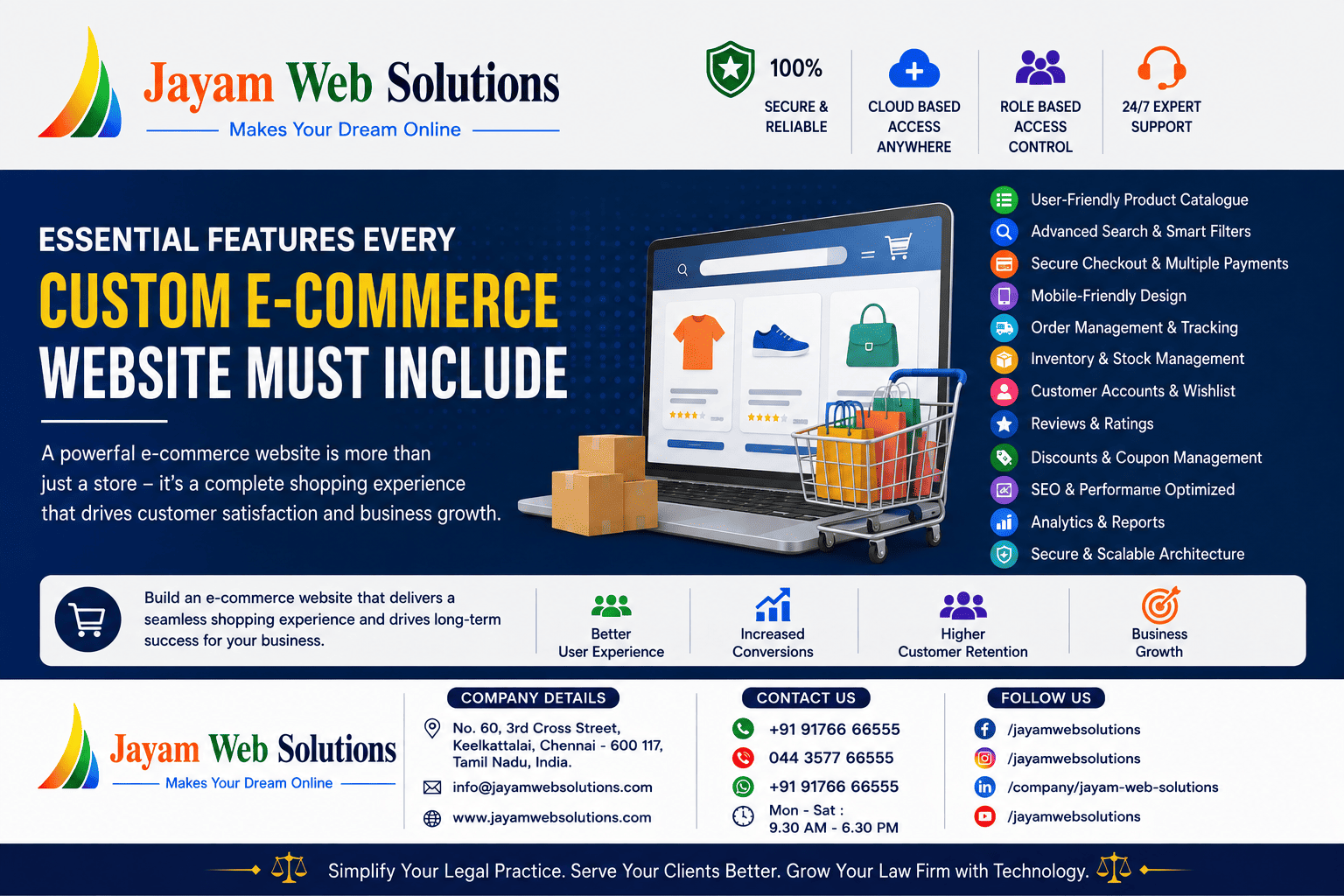
Essential Features Every Custom E-commerce Website Must Include
Introduction
Starting an online store is no longer simply about displaying products on a website and adding a payment button. Customers expect a complete digital shopping experience. They want to discover products quickly, compare options, understand pricing, make secure payments, track their orders, and receive timely updates—all from a website that works smoothly across different devices.
This is where Custom E-commerce Website Development can make a significant difference.
Unlike a basic template-based store, a custom e-commerce website can be designed around the specific products, customers, business processes, integrations, and future growth plans of a company.
In 2026, businesses should focus not only on attractive design but also on performance, mobile usability, security, personalization, search visibility, flexible integrations, and efficient administration.
So, what features should a custom e-commerce website include?
1. User-Friendly Product Catalogue
The product catalogue is one of the most important parts of an online store.
Customers should be able to browse products without confusion.
A well-structured catalogue can include:
- Product categories
- Subcategories
- Product images
- Product descriptions
- Product specifications
- Pricing
- Discounts
- Availability
- Product variations
- Customer reviews
- Related products
Products should be organized logically so customers can move from category to product without unnecessary steps.
2. Advanced Product Search
A large e-commerce store may contain hundreds or thousands of products.
A basic search box may not be enough.
An advanced search feature can help customers find products using:
- Product name
- Brand
- Category
- Product type
- Price
- Specifications
- Availability
Search suggestions and relevant results can make the shopping experience faster and more convenient.
3. Smart Product Filters
Filters allow customers to narrow down products according to their requirements.
Depending on the business, filters can include:
- Price range
- Brand
- Size
- Colour
- Material
- Rating
- Availability
- Category
- Product specifications
For businesses with a large product catalogue, effective filtering can significantly improve product discovery.
4. Mobile-Friendly Shopping Experience
Customers increasingly use smartphones for online shopping.
Therefore, a custom e-commerce website should provide a consistent experience across:
- Smartphones
- Tablets
- Laptops
- Desktop computers
Important mobile features include:
- Responsive layouts
- Touch-friendly buttons
- Easy navigation
- Mobile-friendly filters
- Simple checkout
- Fast-loading product pages
- Optimized images
The mobile experience should be considered during development rather than treated as an afterthought.
5. Shopping Cart
A reliable shopping cart is essential for an e-commerce website.
Customers should be able to:
- Add products
- Remove products
- Change quantities
- Review prices
- Apply discounts
- View shipping charges
- Check estimated totals
The cart should update calculations automatically whenever customers make changes.
6. Simple and Secure Checkout
A complicated checkout process can cause customers to abandon their purchases.
A custom e-commerce website should aim for a straightforward checkout process.
It can include:
-
Customer information
-
Shipping address
-
Delivery method
-
Billing details
-
Payment method
-
Order review
-
Order confirmation
Businesses can also consider guest checkout where appropriate so that customers are not forced to create an account before purchasing.
7. Multiple Payment Options
Customers may prefer different payment methods.
Depending on the target market and business requirements, an e-commerce website can integrate:
- Credit cards
- Debit cards
- UPI
- Net banking
- Digital wallets
- Bank transfers
- Cash on delivery
- Other supported payment methods
Payment gateway integration should be implemented using secure and trusted providers.
8. Secure User Accounts
Customer accounts can provide a personalized shopping experience.
Users may be able to:
- View previous orders
- Manage addresses
- Update profile information
- Track orders
- Save products
- Manage preferences
- Download invoices
For sensitive accounts, businesses should implement appropriate authentication and security measures.
9. Wishlist Feature
A wishlist allows customers to save products they are interested in purchasing later.
This is especially useful when customers are:
- Comparing products
- Waiting for discounts
- Planning future purchases
- Browsing without an immediate purchase decision
A wishlist can also provide valuable insight into customer interests.
10. Product Reviews and Ratings
Reviews can help potential customers understand products from other buyers' experiences.
An e-commerce website can support:
- Star ratings
- Written reviews
- Verified-purchase indicators
- Product questions and answers
- Review moderation
Businesses should have appropriate moderation processes to reduce spam and misleading content.
11. Personalised Product Recommendations
A modern e-commerce website can recommend products based on customer interactions.
Examples include:
“You may also like”
“Frequently bought together”
“Similar products”
“Recently viewed”
Personalization can make product discovery more relevant while potentially increasing engagement and sales.
However, businesses should use customer data responsibly and provide appropriate privacy controls.
12. Inventory Management
Inventory management is essential for businesses selling physical products.
The admin system should allow authorized users to manage:
- Stock quantity
- Product availability
- Low-stock alerts
- Out-of-stock status
- Product variations
- Inventory updates
When an order is completed, the inventory can be updated automatically according to the business workflow.
13. Order Management
An e-commerce admin panel should provide a clear overview of orders.
Administrators may need to:
- View orders
- Confirm orders
- Update order status
- Process cancellations
- Manage returns
- Generate invoices
- Track payments
- Update shipping information
A well-designed order management system can reduce manual work for business teams.
14. Order Tracking
Customers want to know what is happening after placing an order.
An order-tracking system can show stages such as:
Order Placed → Confirmed → Packed → Shipped → Out for Delivery → Delivered
Depending on the courier integration, the website can also provide tracking information.
This helps reduce uncertainty and unnecessary customer enquiries.
15. Shipping and Delivery Management
Shipping requirements vary from business to business.
A custom e-commerce website can support different delivery rules based on:
- Location
- Product type
- Weight
- Order value
- Delivery method
- Shipping zone
Businesses may also integrate courier or logistics services through APIs where required.
16. Discount and Coupon Management
Promotional campaigns are an important part of e-commerce.
The admin panel can provide options for:
- Percentage discounts
- Fixed discounts
- Coupon codes
- Seasonal offers
- Product-specific discounts
- Category-based offers
- Minimum-order discounts
- Limited-time promotions
Automating these rules can make campaign management easier.
17. Tax and Invoice Management
Depending on the business and applicable regulations, the website may need to calculate taxes and generate invoices.
The system can include:
- Tax calculation
- Billing address
- Shipping address
- Invoice number
- Product details
- Discount
- Tax amount
- Final amount
- Payment status
For businesses operating in India, GST-related requirements should be configured according to the business's actual tax and invoicing requirements.
18. Customer Notifications
Automated notifications can keep customers informed throughout the order journey.
Notifications may be sent for:
- Order confirmation
- Payment confirmation
- Order processing
- Shipping
- Delivery
- Cancellation
- Refund
- Password reset
Depending on the business requirements, notifications can be delivered through email, SMS, WhatsApp, or other supported channels.
19. Admin Dashboard
The admin dashboard should provide a clear overview of the online store.
Important information can include:
- Total orders
- Sales
- Customers
- Products
- Inventory
- Pending orders
- Completed orders
- Revenue
- Returns
- Enquiries
A well-organized dashboard allows business owners and administrators to monitor important activities from one place.
20. Role-Based Admin Access
Not every employee needs access to every part of an e-commerce system.
Role-based access can allow businesses to define permissions for different users.
For example:
Super Admin → Full Access
Sales Team → Orders & Customers
Inventory Team → Products & Stock
Content Team → Website Content & Blogs
Accounts Team → Payments & Invoices
This can improve operational control and reduce unauthorized access.
21. E-commerce SEO Features
A beautiful online store still needs to be discoverable.
Custom e-commerce development should consider SEO from the beginning.
Important features can include:
- SEO-friendly URLs
- Meta titles
- Meta descriptions
- Product schema
- Category optimization
- Internal linking
- Image optimization
- XML sitemap
- Canonical URLs
- Breadcrumb navigation
- Search-friendly product content
SEO should be treated as part of the website architecture rather than something added only after development.
22. Website Speed and Performance
Performance directly affects the shopping experience.
A slow product page can discourage customers from continuing their purchase.
Performance optimization can include:
- Image compression
- Caching
- Efficient code
- Optimized database queries
- Content delivery networks
- Lazy loading
- Optimized scripts
- Proper hosting infrastructure
A custom website should be designed to remain efficient as product and customer numbers grow.
23. Security Features
E-commerce websites handle valuable information, making security a major priority.
Security considerations can include:
- HTTPS
- Secure authentication
- Password protection
- Role-based permissions
- Secure payment integration
- Input validation
- API security
- Regular backups
- Access monitoring
- Security updates
Businesses should also work with appropriate payment providers and follow applicable security and privacy requirements.
24. CRM and Third-Party Integrations
A custom e-commerce website does not have to operate separately from other business systems.
It can integrate with:
- CRM systems
- ERP platforms
- Accounting software
- Payment gateways
- Shipping platforms
- Email marketing tools
- SMS services
- WhatsApp services
- Analytics platforms
- Inventory systems
These integrations can help automate repetitive business processes.
25. Analytics and Reports
Business owners need data to understand how their online store is performing.
Reports can provide insights into:
- Sales
- Best-selling products
- Customer activity
- Traffic
- Conversion rates
- Abandoned carts
- Revenue
- Product performance
- Marketing campaigns
These insights can help businesses make better decisions about products, pricing, marketing, and customer experience.
26. Abandoned Cart Management
A customer may add products to a cart without completing the purchase.
A custom e-commerce system can identify abandoned carts and, where appropriate and consented, send reminders.
For example:
Product Added → Cart Created → Checkout Started → Purchase Not Completed → Reminder
Businesses should implement such communications responsibly and in accordance with applicable privacy and marketing requirements.
27. Return and Refund Management
Returns are an important part of e-commerce operations.
A custom system can help manage:
- Return requests
- Return reasons
- Approval status
- Pickup information
- Refund status
- Replacement requests
- Completed returns
This provides both customers and administrators with better visibility into the process.
28. Scalable Architecture
A business may start with a small catalogue and later grow significantly.
The website should therefore be designed with future expansion in mind.
A scalable e-commerce platform can accommodate:
- More products
- More customers
- More orders
- Additional payment methods
- New delivery partners
- New business locations
- Mobile applications
- Customer portals
- Additional integrations
Planning for scalability early can reduce the need for expensive redevelopment later.
29. Why Custom E-commerce Development Is Valuable
Every business has a different sales process.
A manufacturer may require bulk ordering.
A fashion store may need size and colour variations.
A B2B business may require customer-specific pricing.
A distributor may need quotation requests before checkout.
A custom e-commerce platform can be designed around these specific requirements.
Instead of forcing the business to change its workflow to fit a generic system, the website can be developed around the actual business model.
30. What Business Owners Should Consider Before Development
Before starting a custom e-commerce project, business owners should clearly define:
- Target customers
- Product categories
- Pricing structure
- Payment methods
- Shipping requirements
- Tax requirements
- Customer account requirements
- Inventory process
- Return policy
- Required integrations
- Admin roles
- Marketing requirements
- Future expansion plans
Clear requirements can help developers build a system that is practical and scalable.
Conclusion
A successful e-commerce website is more than a collection of product pages.
It needs to provide a smooth journey from product discovery to checkout and post-purchase support.
Essential features such as product search, filters, shopping carts, secure checkout, payment integration, inventory management, order tracking, customer accounts, SEO, analytics, security, and third-party integrations can create a strong foundation for an online business.
For businesses with unique workflows or ambitious growth plans, custom e-commerce website development can provide the flexibility needed to create a digital shopping platform around their actual requirements.
The goal should not simply be to build an online store.
The goal is to build an e-commerce platform that makes shopping easier for customers and business operations more efficient for the company.
Visit us at www.jayamwebsolutions.com to get started!
Kindly Reach us or call us at +91 9677876445.