

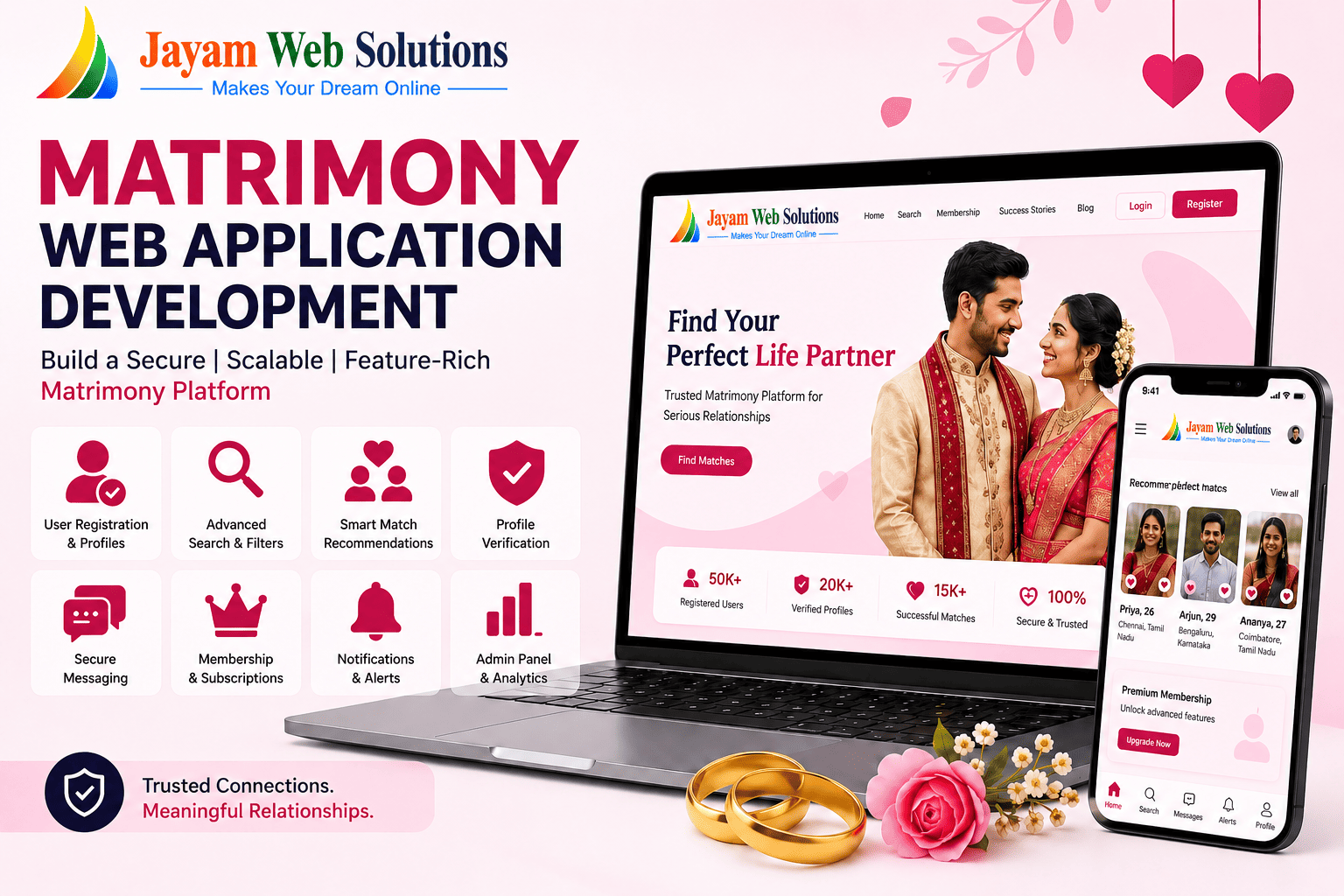
Matrimony Web Application Development: Features, Benefits & 2026 Guide
Finding a life partner has traditionally depended on family networks, personal references, and matrimonial bureaus. Today, technology has transformed this process into a more convenient and structured digital experience. Matrimony websites and matchmaking platforms allow individuals and families to discover profiles, define preferences, communicate securely, and move toward meaningful relationships from anywhere.
For businesses planning to enter the matchmaking industry, a custom matrimony web application can provide much more flexibility than a basic website. It can combine profile management, intelligent search, matchmaking, verification, communication, subscriptions, notifications, and administration into one centralized platform.
In 2026, users are increasingly looking for trustworthy profiles, privacy controls, relevant recommendations, and simple mobile-first experiences. This makes a well-designed matrimony web application development strategy important for businesses that want to build a reliable and scalable matchmaking platform.
What Is a Matrimony Web Application?
A matrimony web application is an online platform designed specifically for people searching for marriage partners. Unlike a simple informational website, it provides interactive functionality for users, administrators, and matchmaking teams.
Users can create detailed matrimonial profiles, upload photographs, specify partner preferences, search for suitable profiles, express interest, communicate with other members, and manage their account.
The administrator can control registrations, verify profiles, manage subscriptions, monitor activities, handle reports, publish content, and analyze platform performance.
A custom solution can also be designed according to a specific business model, such as:
- Community-based matrimony
- Regional matrimony
- Religion-based matrimony
- Professional matrimony
- NRI matrimony
- Premium matchmaking services
- Family-assisted matchmaking
- International matrimonial platforms
This flexibility is one of the biggest advantages of custom matrimony website development.
Why Build a Custom Matrimony Web Application?
A ready-made matrimonial script may provide standard features, but every matchmaking business has different requirements. A custom web application allows the platform to be designed around the exact workflow, audience, business model, and branding.
1. Complete Business Customization
A custom application can be developed according to your specific matchmaking process.
For example, a business may require:
- Different registration forms
- Community-specific profile fields
- Custom partner preferences
- Horoscope information
- Assisted matchmaking
- Relationship manager access
- Premium membership levels
- Customized verification workflows
These requirements can be incorporated into the application instead of forcing the business to work around a fixed system.
2. Better User Experience
Matrimony platforms contain a large amount of personal information. If the interface is confusing, users may leave before completing their profiles.
A custom application can provide a simple experience from registration to matchmaking.
The user journey can include:
Register → Verify → Create Profile → Add Preferences → Discover Matches → Shortlist → Express Interest → Communicate → Connect
A clean workflow makes the platform easier for both individuals and families to use.
3. Scalability
A successful matrimonial platform may start with a small number of users and eventually grow into a large matchmaking network.
Custom development makes it possible to plan the application architecture for future expansion. New features, integrations, user types, subscription plans, and mobile applications can be added as the business grows.
Essential Features of a Modern Matrimony Web Application
A successful matrimonial platform needs more than profile listings. Trust, relevance, privacy, and communication should be considered while designing every major feature.
1. User Registration and Login
The registration process should be simple while collecting the information required for matchmaking.
Possible registration methods include:
- Mobile number
- Email address
- OTP verification
- Secure password authentication
- Social login where appropriate
A multi-step registration process can also improve profile completion without overwhelming users with a large form.
2. Detailed Matrimonial Profiles
Profiles are the foundation of a matrimonial platform.
Depending on the target audience, profiles can contain:
- Name and age
- Gender
- Location
- Education
- Profession
- Income range
- Community
- Mother tongue
- Family information
- Lifestyle preferences
- About me
- Partner preferences
- Horoscope details
- Profile photographs
The application should allow users to update their information whenever required.
3. Advanced Partner Search
Search is one of the most important features of a matrimonial website.
Users should be able to discover relevant profiles using filters such as:
- Age
- Location
- Education
- Profession
- Community
- Religion
- Mother tongue
- Marital status
- Income
- Lifestyle preferences
Advanced filtering reduces irrelevant results and helps users find profiles that better match their requirements.
4. Smart Match Recommendations
Modern matchmaking platforms can go beyond basic search filters.
A recommendation engine can analyze profile information and preferences to suggest potentially relevant matches.
For example, the system can consider:
Age + Location + Education + Profession + Community + Preferences
A future-ready platform can also use AI-assisted recommendations to improve the relevance of suggested profiles. However, recommendations should remain transparent and give users control over their preferences.
5. Profile Verification
Trust is particularly important for matrimonial platforms.
A verification system can help reduce fake or misleading profiles.
Possible verification methods include:
- Mobile verification
- Email verification
- Photo verification
- Manual profile approval
- Identity verification where legally and operationally appropriate
Verified badges can help users distinguish profiles that have completed the platform's verification process.
6. Privacy Controls
Privacy should be designed into the platform rather than treated as an additional feature.
Users may want to control:
- Who can view their photographs
- Who can see contact details
- Whether their profile is searchable
- Whether specific information is visible
- Who can send communication requests
Features such as block, report, hide profile, and restricted photo visibility can further improve user confidence.
7. Interest and Shortlist System
Users may not be ready to communicate immediately.
An interest system allows them to express their intention without directly sharing personal contact information.
Useful actions can include:
- Send Interest
- Accept Interest
- Decline Interest
- Shortlist Profile
- Remove from Shortlist
- View Profile Visitors
This creates a structured matchmaking process.
8. Secure Communication
Once two users are interested in each other, the platform can provide controlled communication.
Depending on the business model, this may include:
- In-app messaging
- Message requests
- Notifications
- Contact request approval
- Number privacy
- Block and report options
Keeping communication inside the platform can provide better control and moderation.
9. Membership and Subscription Plans
Subscription models can help matrimonial businesses generate recurring revenue.
A platform can offer different plans such as:
- Free Membership
- Basic Membership
- Premium Membership
- Elite Membership
Premium features may include additional profile visibility, advanced searches, increased communication access, or other business-defined benefits.
Payment gateway integration can make subscription management convenient and automated.
10. Notifications
Timely notifications can bring users back to the platform.
Notifications may be triggered for:
- New match suggestions
- New interests
- Interest acceptance
- New messages
- Profile views
- Subscription expiry
- Payment confirmation
- Verification updates
Email, SMS, WhatsApp, or push notifications can be integrated according to the platform's requirements and applicable communication rules.
Admin Panel for Matrimony Platforms
The user interface is only one part of a matrimonial application. A powerful admin panel is equally important.
Administrators may need to manage:
User Management
- View registered users
- Approve profiles
- Edit profiles
- Block users
- Deactivate accounts
- Manage reported profiles
Profile Verification
Administrators can review profiles and verification requests before displaying approved information to other users.
Membership Management
The admin panel can manage:
- Subscription plans
- Pricing
- Active memberships
- Expired memberships
- Payment records
- Coupons and promotional offers
Content Management
A CMS can allow administrators to manage:
- Home page content
- About page
- FAQs
- Success stories
- Blog posts
- Terms and privacy pages
- Promotional banners
Reports and Analytics
Business owners can monitor important platform activity through dashboards and reports.
Examples include:
- New registrations
- Active users
- Verified profiles
- Membership conversions
- Interests sent
- Interests accepted
- Profile views
- Revenue
- Reported accounts
These insights can help the business understand user behavior and improve the matchmaking experience.
Why Security Matters in Matrimony Web Application Development
A matrimonial platform handles sensitive personal information, including photographs, family details, contact information, professional information, and preferences.
Therefore, security should be considered throughout the development lifecycle.
Important considerations include:
- Secure authentication
- Encrypted communication
- Role-based access control
- Secure password storage
- Privacy controls
- Data validation
- Secure file uploads
- Regular backups
- Monitoring and logging
- Protection against unauthorized access
The platform should also be designed with applicable privacy and data-protection requirements in mind.
Mobile-First Matrimony Experience
Many users access web applications through smartphones. Therefore, a matrimonial website should be responsive and easy to use on smaller screens.
Important mobile-first considerations include:
- Simple registration
- Fast profile browsing
- Touch-friendly buttons
- Easy image viewing
- Quick search filters
- Mobile-friendly messaging
- Clear notifications
- Fast page loading
A custom web application can also be developed with an architecture that supports future Android and iOS applications.
Custom Matrimony Website vs Ready-Made Software
The right development approach depends on the business requirements.
Ready-Made Matrimony Software
This can be suitable for businesses that want to launch quickly with standard features.
However, customization, workflow flexibility, and long-term scalability may be limited depending on the software.
Custom Matrimony Web Application
Custom development is more suitable when a business requires unique functionality, specialized workflows, advanced integrations, or long-term scalability.
It can provide:
- Custom UI/UX
- Business-specific workflows
- Flexible matchmaking logic
- Custom admin dashboard
- Unique membership models
- Third-party API integrations
- Scalable architecture
- Future mobile app integration
For businesses planning to build a distinctive matchmaking brand, custom development can provide greater control over the product.
How to Develop a Matrimony Web Application
A structured development process helps reduce technical issues and creates a better user experience.
Step 1: Requirement Analysis
Identify the target audience, matchmaking process, business model, user roles, and required features.
Step 2: UI/UX Design
Create the user journey, wireframes, dashboard layouts, profile pages, search interfaces, and responsive designs.
Step 3: Application Development
Develop the frontend, backend, database, authentication, matchmaking functionality, admin panel, and required integrations.
Step 4: Testing
Test the application for:
- Functionality
- Security
- Performance
- Responsive design
- Browser compatibility
- User workflows
- Payment processing
Step 5: Deployment
Deploy the application on suitable hosting or cloud infrastructure and configure the domain, SSL, database, email services, and other integrations.
Step 6: Maintenance and Improvements
After launch, monitor application performance, fix issues, analyze user behavior, and introduce new features based on business requirements.
Future Trends in Matrimony Web Applications
The matrimony industry is becoming more technology-driven, but trust remains central to the experience.
Some important trends for 2026 and beyond include:
AI-Assisted Match Recommendations
AI can help identify patterns across profile preferences and recommend potentially relevant matches.
Stronger Profile Verification
As fake profiles and digitally manipulated content become greater concerns across online platforms, verification is becoming increasingly important. Recent industry developments show growing adoption of identity and face-verification approaches in online matchmaking environments.
Privacy-First Communication
Users increasingly expect control over their photographs, contact details, and communication.
Family-Friendly Matchmaking
Matrimony platforms can support workflows where individuals and family members participate in the partner-search process. This reflects the distinct role that families continue to play in India's matrimonial ecosystem.
Personalized Matchmaking
Instead of displaying thousands of generic profiles, platforms can focus on presenting fewer but more relevant recommendations based on user preferences.
Conclusion
A successful matrimony platform is not simply a website containing user profiles. It is a complete digital matchmaking ecosystem that brings together profile management, intelligent search, verification, privacy, communication, subscriptions, notifications, and administration.
For businesses planning to launch a new matrimonial service, custom matrimony web application development provides the flexibility to create a platform around their exact business requirements. From community-specific matchmaking to premium partner-search services, the application can be designed to support different audiences and revenue models.
As online matchmaking continues to evolve in 2026, platforms that combine technology with trust, privacy, personalization, and an easy user experience can support long-term user confidence.
A well-planned custom web application can therefore become the foundation for a scalable matrimony business, with the flexibility to expand into mobile applications, advanced matchmaking, analytics, and additional digital services as the platform grows.
Frequently Asked Questions
What is matrimony web application development?
Matrimony web application development is the process of building a web-based matchmaking platform where users can create matrimonial profiles, search for partners, receive match recommendations, communicate securely, and manage their preferences.
What features should a matrimony website have?
Important features include user registration, detailed profiles, advanced search, match recommendations, profile verification, privacy controls, interest management, secure messaging, subscriptions, notifications, and an admin dashboard.
Can a matrimony website be customized for a specific community?
Yes. A custom matrimonial web application can be designed for specific communities, regions, religions, professions, languages, or other target groups.
Can a matrimony web application support paid memberships?
Yes. Subscription plans and payment gateway integration can be included to support different membership levels and premium features.
Is it possible to add AI matchmaking?
Yes. AI-assisted recommendation functionality can be integrated into a custom platform to provide more personalized match suggestions based on defined profile information and preferences.
Can the matrimony website be converted into a mobile app later?
Yes. If the web application is built with a suitable architecture and API layer, Android and iOS applications can be developed as the platform grows.
How important is profile verification for a matrimonial platform?
Profile verification is highly important because matrimonial platforms handle personal information and depend heavily on user trust. Verification, moderation, privacy controls, and reporting mechanisms can help create a safer platform.
Visit us at www.jayamwebsolutions.com to get started!
Kindly Reach us / Call us +91 9677876445