

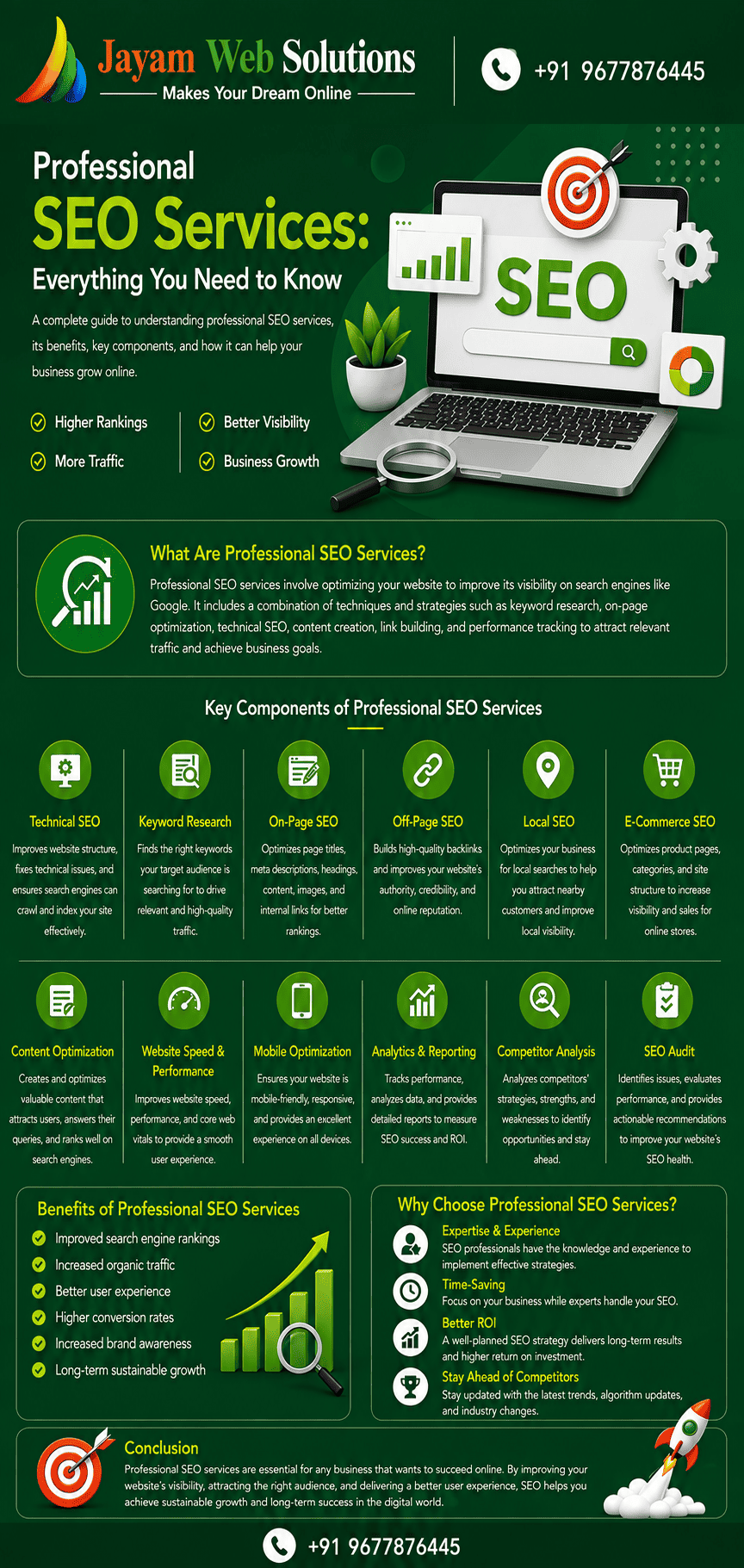
Professional SEO Services: Everything You Need to Know
Introduction
Having a website is only the first step toward building a successful online presence. Your website also needs to be discoverable when potential customers search for products, services, or information related to your business.
This is where Professional SEO Services become important.
Search Engine Optimization, commonly known as SEO, involves improving different aspects of a website so that search engines can better understand its content and users can find relevant pages more easily.
Professional SEO is not simply about adding keywords to website content. A complete SEO strategy can involve technical improvements, content optimization, website structure, local search optimization, performance monitoring, and continuous improvements based on search behavior and website data.
For businesses competing online in 2026, having a structured SEO strategy can help create a stronger foundation for long-term organic visibility.
What Are Professional SEO Services?
Professional SEO services are specialized services designed to improve a website's visibility in organic search results.
An SEO professional or SEO team may analyze a website, identify optimization opportunities, improve technical elements, optimize content, research relevant search terms, and monitor performance.
Depending on the business, SEO services may include:
- Technical SEO
- On-page SEO
- Off-page SEO
- Keyword research
- Content optimization
- Local SEO
- E-commerce SEO
- Website performance optimization
- SEO audits
- Competitor analysis
- Analytics and reporting
The exact strategy should depend on the website, industry, target audience, competition, and business objectives.
Why SEO Is Important for Businesses
People often begin their search for products and services online.
If your website is difficult for search engines to understand or does not provide useful content for your audience, it may struggle to attract relevant organic visitors.
A well-planned SEO strategy can help businesses:
- Improve organic visibility
- Reach relevant audiences
- Increase website traffic
- Improve website usability
- Build online credibility
- Generate potential leads
- Support long-term digital growth
SEO should therefore be viewed as an ongoing digital marketing process rather than a one-time website task.
1. Technical SEO
Technical SEO focuses on the technical foundation of a website.
Search engines need to be able to crawl, understand, and index website pages effectively.
Technical SEO may include:
- Website crawling analysis
- Indexing checks
- XML sitemap configuration
- Robots.txt review
- Canonical URL implementation
- Broken-link identification
- Redirect management
- Mobile usability
- Website security
- Structured data
- Page performance
A technically healthy website provides a stronger foundation for other SEO activities.
2. Keyword Research
Keyword research helps businesses understand what their target audience searches for.
Instead of selecting keywords based only on search volume, SEO professionals should consider factors such as:
- Search intent
- Relevance
- Competition
- Business value
- User expectations
- Geographic targeting
For example, a person searching for "website development company" may have a different intent from someone searching for "how to build a website."
Understanding this difference helps businesses create content that matches what users are actually looking for.
3. Search Intent Optimization
Search intent refers to the reason behind a user's search.
Common search intents include:
Informational
The user wants to learn something.
Example:
"What is technical SEO?"
Commercial
The user is researching options before making a decision.
Example:
"Best SEO services for small businesses."
Transactional
The user is ready to take an action or make a purchase.
Example:
"Buy SEO package for e-commerce website."
Navigational
The user is looking for a specific website or brand.
SEO content should be created according to the intent behind the target search terms.
4. On-Page SEO
On-page SEO focuses on elements directly present on website pages.
It may include:
- Page titles
- Meta descriptions
- Headings
- Content structure
- Keyword usage
- Internal links
- Image alt text
- URL structure
- Content readability
- Relevant multimedia
Good on-page optimization helps both users and search engines understand the purpose of each page.
5. High-Quality SEO Content
Content remains an important part of a successful SEO strategy.
Businesses should create content that provides genuine value instead of producing pages simply to target keywords.
Useful SEO content can include:
- Blog articles
- Service pages
- Product descriptions
- Industry guides
- FAQs
- Case studies
- Comparison articles
- Educational resources
Strong content should answer users' questions, demonstrate expertise, and provide information relevant to their needs.
6. Internal Linking
Internal links connect pages within the same website.
For example, a blog about e-commerce development can link to a relevant e-commerce service page.
A well-planned internal linking structure can help:
- Users discover related content
- Search engines understand website relationships
- Distribute internal authority between pages
- Improve website navigation
Internal links should be natural and genuinely useful to visitors.
7. Local SEO
Local SEO is particularly valuable for businesses that serve customers in specific locations.
A local SEO strategy may focus on:
- Business profile optimization
- Local search visibility
- Location-based website content
- Business information consistency
- Customer reviews
- Local landing pages
- Local keyword targeting
For example, a website development company serving a specific city may create useful location-focused pages for relevant services and audiences.
8. E-commerce SEO
Online stores often require a specialized SEO approach.
E-commerce SEO may include optimization of:
- Product pages
- Category pages
- Product titles
- Product descriptions
- Product images
- Filters
- Internal links
- Structured data
- Search-friendly URLs
Large online stores also need to manage issues such as duplicate pages, product variations, out-of-stock products, and crawl efficiency.
9. Mobile SEO
A significant portion of website traffic can come from mobile devices.
Therefore, websites should provide a smooth experience across different screen sizes.
Important considerations include:
- Responsive design
- Readable text
- Easy navigation
- Touch-friendly elements
- Fast loading
- Mobile-friendly forms
- Proper page layouts
Mobile usability should be considered as part of overall website development and SEO.
10. Website Speed and Core Performance
Users generally expect websites to load quickly and respond smoothly.
SEO professionals may analyze website performance and identify areas such as:
- Large images
- Unnecessary scripts
- Slow server responses
- Render-blocking resources
- Poor caching
- Inefficient code
Improving performance can provide benefits for both user experience and website efficiency.
11. Off-Page SEO
Off-page SEO focuses on activities outside the website that can contribute to its online authority and visibility.
This may include:
- Relevant backlinks
- Digital PR
- Business citations
- Industry publications
- Brand mentions
- Outreach
- Partnerships
The focus should be on earning relevant, trustworthy references rather than simply collecting large numbers of links.
12. SEO for Website Structure
A clear website structure makes it easier for visitors to navigate and helps search engines understand how different pages relate to one another.
A typical structure could look like:
Home → Services → SEO Services → Technical SEO
or:
Home → Products → Category → Product
Important pages should be accessible through logical navigation and internal links.
13. Competitor SEO Analysis
Competitor analysis can help businesses understand the search landscape within their industry.
An SEO team may analyze competitors':
- Target topics
- Website structure
- Content strategy
- Search visibility
- Backlink profiles
- Service pages
- Keyword opportunities
The purpose should not be to copy competitors but to identify opportunities to create better and more useful resources.
14. SEO Audit
An SEO audit provides an overview of the current condition of a website.
An audit may examine:
- Technical SEO
- Indexing
- Website structure
- Metadata
- Content
- Internal links
- Broken links
- Mobile usability
- Performance
- Structured data
- Local SEO
- Search visibility
The findings can then be converted into an SEO action plan.
15. Analytics and SEO Performance Tracking
SEO requires ongoing measurement.
Important metrics may include:
- Organic traffic
- Search impressions
- Click-through rate
- Search positions
- Indexed pages
- Conversions
- Leads
- Engagement
- Landing-page performance
Tracking these metrics helps businesses understand what is working and where improvements may be required.
16. Google Search Console Monitoring
Google Search Console can provide valuable information about how a website performs in Google Search.
It can help website owners monitor areas such as:
- Search performance
- Indexing
- Search queries
- Website pages
- Technical issues
- Mobile usability
- Search enhancements
Regular monitoring can help identify potential SEO problems before they become larger issues.
17. SEO for New Websites
SEO should ideally begin during website planning and development rather than after the website is launched.
For a new website, businesses should consider:
- SEO-friendly architecture
- Search-friendly URLs
- Page hierarchy
- Mobile responsiveness
- Website speed
- Metadata
- Content structure
- Internal linking
- XML sitemap
- Search engine accessibility
Building the SEO foundation early can reduce the need for major corrections later.
18. SEO for Existing Websites
Existing websites may already have valuable content and search visibility.
An SEO professional can first evaluate the current website before recommending changes.
Possible improvements include:
- Updating outdated content
- Fixing technical issues
- Improving page titles
- Optimizing underperforming pages
- Strengthening internal links
- Improving page speed
- Removing or consolidating unnecessary pages
- Expanding useful content
The goal should be to improve the website without unnecessarily disrupting pages that already perform well.
19. How Professional SEO Services Differ from Basic SEO
Basic SEO may focus on a limited number of tasks such as keyword placement and metadata.
Professional SEO services typically take a broader approach.
They may combine:
Technical SEO + Content + Search Intent + Website Experience + Local SEO + Authority Building + Performance Tracking
This integrated approach allows businesses to address multiple aspects of organic search visibility.
20. How to Choose the Right SEO Service Provider
Businesses should carefully evaluate SEO providers before starting a project.
Consider asking:
- What SEO process do you follow?
- Will you conduct an SEO audit?
- How do you select keywords?
- How do you measure success?
- What type of reports will be provided?
- How often will progress be reviewed?
- What technical SEO work is included?
- How will content be handled?
- What experience do you have in my industry?
Businesses should also be cautious about anyone promising guaranteed search rankings.
SEO performance can be influenced by many factors, including competition, search behavior, website quality, and search engine changes.
21. How Long Does SEO Take?
SEO is generally a long-term process.
The timeline can vary depending on:
- Website age
- Website quality
- Competition
- Industry
- Target keywords
- Technical condition
- Content quality
- Existing authority
- SEO resources
Some improvements can be visible relatively quickly, while meaningful organic growth may require consistent effort over a longer period.
Therefore, SEO should be approached as an ongoing investment rather than a quick-ranking solution.
22. Common SEO Mistakes Businesses Should Avoid
Some common mistakes include:
- Keyword stuffing
- Publishing low-quality content
- Ignoring mobile users
- Neglecting technical SEO
- Using duplicate content
- Creating unnecessary pages
- Ignoring search intent
- Buying low-quality backlinks
- Forgetting internal links
- Not monitoring performance
- Expecting instant results
A sustainable SEO strategy focuses on users first while ensuring that search engines can properly access and understand the website.
23. The Future of Professional SEO
SEO continues to evolve as search technology and user behavior change.
Businesses should increasingly pay attention to:
- AI-assisted search experiences
- Conversational search
- Structured and well-organized content
- Entity understanding
- User experience
- Mobile-first experiences
- Helpful and original content
- Multimedia content
- Technical website quality
Rather than focusing only on traditional keyword rankings, businesses should build websites that provide clear, useful, trustworthy information across different search experiences.
Conclusion
Professional SEO Services involve much more than adding keywords to a website.
A strong SEO strategy combines technical website optimization, keyword research, search-intent analysis, quality content, internal linking, local SEO, performance optimization, authority building, analytics, and continuous improvement.
For businesses that want sustainable online visibility, SEO should be treated as an ongoing process that supports the overall digital strategy.
The most effective approach is to understand your audience, create genuinely useful content, maintain a technically healthy website, monitor performance, and continuously improve based on real data.
SEO is not simply about ranking higher. It is about helping the right people discover the right content at the right time.
At Jayam Web Solutions, we provide SEO and digital solutions designed around individual business requirements, with a focus on technical optimization, content, search visibility, and measurable improvement.
Visit us at www.jayamwebsolutions.com to get started!
Kindly Reach us / Call us +91 9677876445