

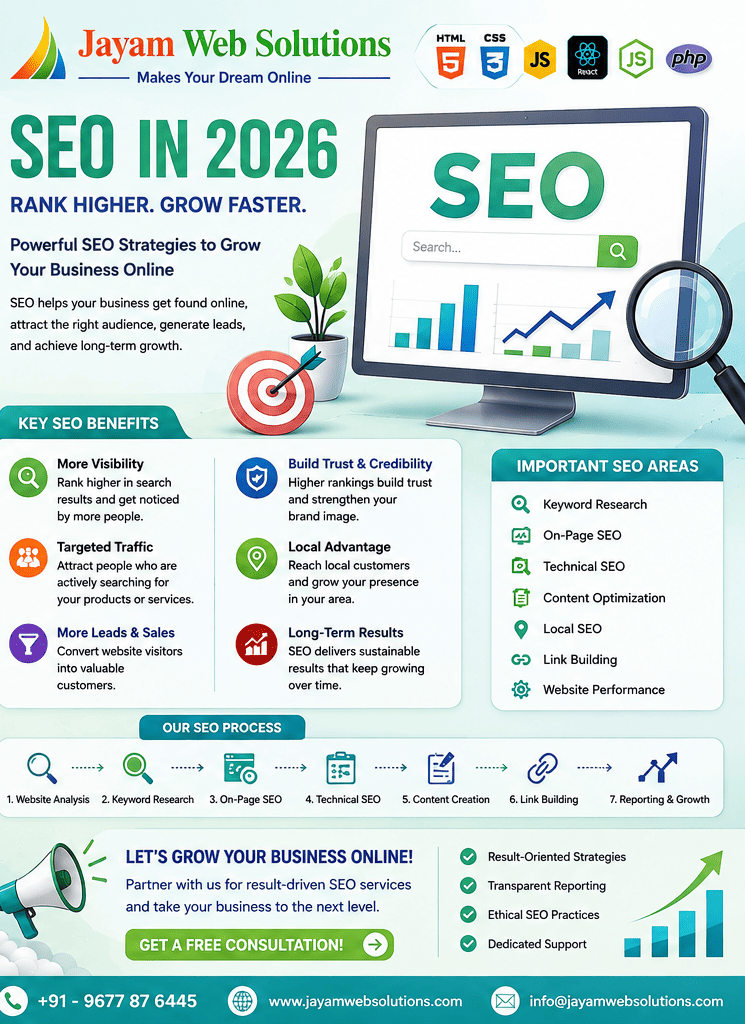
SEO in 2026: How Search Engine Optimization Helps Businesses Grow Online
Introduction
Having a website is no longer enough for a business to succeed online. With thousands of websites competing for attention, businesses need to make sure their websites can be discovered by the right audience.
This is where Search Engine Optimization (SEO) becomes important.
SEO helps businesses improve their website's visibility in search engines and attract people who are actively looking for their products, services, or information. When properly planned and maintained, SEO can become a long-term digital marketing strategy that supports traffic, leads, brand visibility, and business growth.
In 2026, SEO continues to evolve as search behaviour, technology, content consumption, and user expectations change. Businesses therefore need to focus not only on keywords but also on website quality, useful content, user experience, technical performance, and customer intent.
What Is SEO?
Search Engine Optimization is the process of improving a website so that search engines can better understand its content and users can find relevant information more easily.
SEO involves different activities, including:
- Keyword research
- Content optimization
- Technical optimization
- Website performance improvement
- Internal linking
- Local SEO
- Image optimization
- Mobile optimization
- Website structure
- Authority building
The overall goal is to make a website more useful, accessible, and relevant to both search engines and users.
Why Is SEO Important for Businesses?
1. Helps Customers Find Your Business
People often use search engines when they need a product, service, solution, or information.
For example, a customer may search for:
- Website development company
- Digital marketing services
- E-commerce website development
- Local restaurants
- Accounting services
- Online education platforms
If your website appears for relevant searches, potential customers have an opportunity to discover your business.
2. Brings Relevant Website Traffic
Not all website visitors have the same value.
SEO focuses on attracting people who are searching for topics, products, or services related to your business.
This means the traffic generated through relevant search queries can have a stronger connection to your target audience.
3. Supports Lead Generation
A well-optimized website can help turn search visitors into potential customers.
For example, visitors can:
- Submit an enquiry
- Call the business
- Request a quotation
- Book a service
- Sign up for updates
- Purchase a product
- Contact customer support
SEO can bring the right audience to your website, while a well-designed website helps guide them toward the next step.
4. Builds Long-Term Online Visibility
Paid advertising can provide immediate visibility, but the traffic generally depends on continued advertising investment.
SEO takes time and consistent effort, but successful optimization can help a website build organic visibility over the long term.
This makes SEO an important part of a sustainable digital marketing strategy.
5. Builds Brand Awareness
Even when users do not immediately purchase something, appearing in relevant search results can increase awareness of your brand.
Repeated visibility can help customers become familiar with a business and recognize it when they are ready to make a decision.
Important SEO Areas Businesses Should Focus on in 2026
1. Search Intent
One of the most important aspects of modern SEO is understanding search intent.
Search intent refers to the reason behind a user's search.
A person searching for "what is SEO" has a different intention from someone searching for "SEO company near me."
Common search intentions include:
- Informational
- Navigational
- Commercial
- Transactional
Businesses should create content that matches what users are actually trying to accomplish.
2. High-Quality Content
Content continues to play an important role in SEO.
However, simply producing large amounts of content is not enough. Businesses should focus on creating useful, accurate, original, and relevant information that answers real customer questions.
Good business content should:
- Solve customer problems
- Explain topics clearly
- Provide useful information
- Use relevant keywords naturally
- Be easy to read
- Reflect the business's expertise
3. On-Page SEO
These include:
- Page titles
- Meta descriptions
- Headings
- URLs
- Content
- Keywords
- Images
- Internal links
- Structured content
Proper on-page optimization helps search engines understand what each page is about.
4. Technical SEO
Technical SEO focuses on the technical foundation of a website.
Important areas include:
- Website speed
- Mobile responsiveness
- Crawlability
- Indexing
- Site architecture
- Broken links
- XML sitemaps
- HTTPS
- Canonicalization
- Structured data
A technically healthy website makes it easier for search engines to discover and understand its pages.
5. Mobile SEO
Customers increasingly use mobile devices to search for businesses, products, and services.
Therefore, websites should provide a consistent experience across different screen sizes.
A mobile-friendly website should have:
- Responsive design
- Easy navigation
- Readable text
- Touch-friendly buttons
- Fast-loading pages
- Simple forms
Mobile optimization is important for both user experience and overall website quality.
6. Local SEO
Local SEO is especially important for businesses that serve customers in specific locations.
For example:
- Restaurants
- Clinics
- Law firms
- Real estate businesses
- Service providers
- Retail stores
- Local agencies
Local SEO can involve optimizing business information, location pages, local content, and business profiles so that customers can discover the business when searching for nearby products or services.
7. Website Performance
Customers increasingly use mobile devices to search for businesses, products, and services.If pages take too long to load, visitors may leave before viewing the content or completing an enquiry.
Businesses should consider:
- Image optimization
- Efficient code
- Browser caching
- Reliable hosting
- Content delivery
- Lightweight page elements
A faster website can provide a smoother experience for visitors.
8. User Experience
A website may attract visitors through search engines, but if users cannot easily find what they need, the website may not generate meaningful results.
A good user experience should provide:
- Clear navigation
- Simple layouts
- Readable content
- Clear calls to action
- Easy contact options
- Consistent design
- Fast interaction
The objective is to make it easy for visitors to move from discovering your website to taking action.
Visit us at www.jayamwebsolutions.com to get started!
Kindly Reach us / Call us +91 9677876445.