

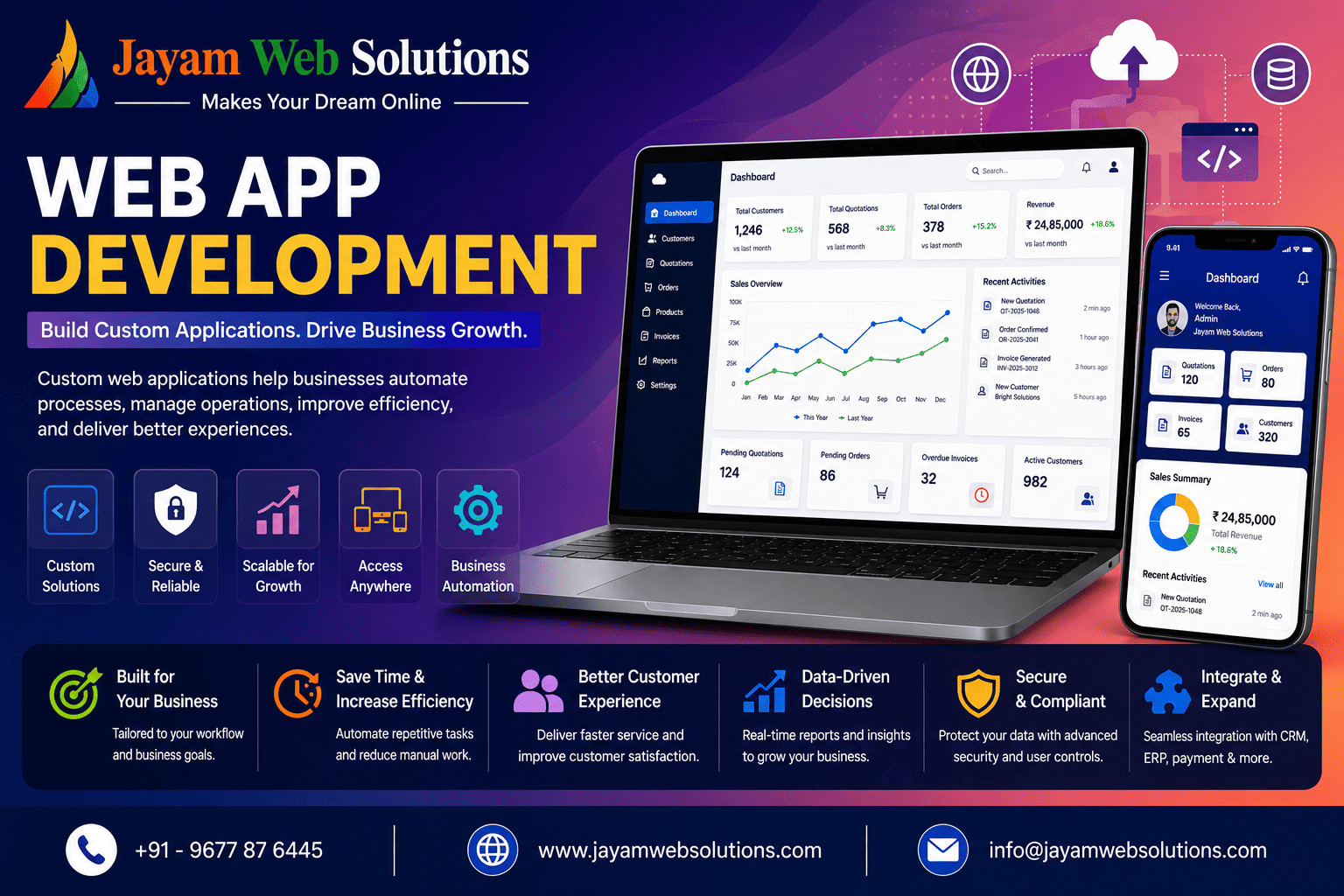
Web App Development: How Custom Web Applications Help Businesses Grow
In today's digital business environment, companies need more than just a professional website. As businesses grow, managing customers, employees, sales, documents, quotations, bookings, and daily operations manually can become increasingly difficult.
This is where web app development plays an important role.
A custom web application can help businesses bring important processes into one centralized system. Instead of depending on multiple spreadsheets, software tools, emails, and manual processes, businesses can use a secure web-based application designed specifically for their requirements.
What Is Web App Development?
Web app development is the process of creating software applications that can be accessed through a web browser.
Unlike a standard website, a web application allows users to perform actions, manage data, and interact with the system.
For example, a business website may provide information about products and services. A web application can allow users to:
- Log in securely
- Manage customer information
- Create quotations
- Track orders
- Generate reports
- Upload documents
- Manage employees
- Process bookings
- Monitor business activities
A web application can be developed specifically according to the workflow and requirements of a business.
Why Do Businesses Need Custom Web Applications?
Every business operates differently. While ready-made software may provide general features, it may not always match the exact workflow of an organization.
A custom web application can be developed around the way a business actually operates.
For example, a company may require a system that combines:
Customer Management + Quotation Generation + Approval Process + Reports
Another business may require:
Booking Management + Payments + Customer Records + Notifications
Custom web app development allows businesses to create a solution based on their specific requirements.
Key Benefits of Web App Development
1. Business Process Automation
One of the biggest advantages of a web application is automation.
Businesses can automate repetitive activities such as:
- Data entry
- Quotation generation
- Calculations
- Customer notifications
- Report generation
- Approval workflows
- Status updates
This can reduce manual work, minimize repetitive tasks, and improve operational efficiency.
2. Access From Anywhere
Because web applications can be accessed through an internet browser, authorized users can access the system from different locations.
This can be useful for businesses with:
- Multiple offices
- Remote employees
- Sales teams
- Field employees
- Multiple branches
Access controls can also be implemented based on user roles, allowing organizations to control which features and information different users can access.
3. Centralized Business Data
Many businesses manage information across different spreadsheets and software platforms.
A custom web application can centralize important business data.
Depending on the application, this may include:
- Customer information
- Sales records
- Employee data
- Quotations
- Orders
- Payments
- Documents
- Reports
Centralized data can make information easier to manage, search, update, and access.
4. Improved Customer Experience
A web application can also improve how businesses interact with customers.
For example, businesses can provide customer portals where users can:
- View information
- Download documents
- Check order status
- Make payments
- Submit requests
- Manage their accounts
This can create a more convenient digital experience while reducing the need for customers to depend on manual communication for routine activities.
5. Scalable for Business Growth
A well-developed web application can be expanded as a business grows.
New modules can be added based on future requirements.
For example, a business may initially develop a quotation management system and later add:
- CRM
- Invoicing
- Employee management
- Analytics
- Customer portals
- Notifications
- Payment integrations
This makes custom web applications suitable for businesses planning long-term digital growth.
Types of Business Web Applications
Web applications can be developed for many different industries and purposes.
Quotation Generation Applications
Businesses can create and manage professional quotations, automate calculations, apply discounts, and track quotation status.
A centralized quotation system can help businesses reduce manual calculations and maintain quotation records more efficiently.
CRM Applications
Customer relationship management systems help businesses manage leads, customers, follow-ups, sales activities, and customer communication.
A customized CRM can be designed according to the organization's sales process.
Management Applications
Custom management systems can help organizations manage employees, documents, projects, operations, and internal workflows.
These applications can provide dashboards and role-based access to help teams monitor daily activities.
E-Commerce Management Applications
Businesses can manage products, inventory, orders, customers, and payments through a centralized application.
A custom e-commerce management system can also be integrated with business-specific workflows and reporting requirements.
Booking Applications
Booking and reservation applications can be developed for businesses that manage appointments, rooms, services, or events.
Such systems can help businesses manage availability, bookings, customer information, notifications, and payment-related processes.
Custom Business Automation Applications
Organizations can digitize specific internal processes that are currently managed manually.
These applications can be designed around unique workflows, approval processes, calculations, reporting requirements, and business rules.
Custom Web Application vs Ready-Made Software
Ready-made software can be useful for common business requirements. However, it may also include unnecessary features or lack functionality required by a particular business.
A custom web application provides greater flexibility because the system can be developed according to the organization's workflow and requirements.
For example, a business may need a specific approval process, customized quotation format, unique dashboard, role-based access, or integration with an existing system. These requirements may not always be available in standard software.
Custom development can therefore provide businesses with greater control over functionality and future expansion.
How Custom Web Applications Support Business Growth
As organizations grow, their operational requirements also change.
A small business may initially manage customers and quotations using spreadsheets. As the customer base increases, manual management can become difficult.
A web application can help transition these processes into a structured digital system.
Businesses can gradually introduce modules such as:
- Customer management
- Lead management
- Quotation management
- Invoice management
- Employee management
- Project management
- Inventory management
- Booking management
- Reporting and analytics
- Customer portals
This modular approach allows businesses to build their digital infrastructure according to their current requirements while keeping future expansion in mind.
Important Features of a Modern Web Application
Depending on the business requirements, a custom web application may include:
- Secure user login
- Role-based access control
- Admin dashboard
- Employee dashboard
- Customer portal
- Data management
- Search and filtering
- Notifications
- Document management
- Reports and analytics
- Payment integration
- Third-party API integration
- Automated workflows
- Backup and security mechanisms
- Mobile-responsive interface
The exact features should be determined based on the business process, users, technical requirements, and future scalability needs.
Conclusion
Web app development helps businesses move from manual processes to centralized digital systems.
Whether the requirement is quotation generation, customer management, booking management, business automation, or a completely custom solution, a well-planned web application can improve efficiency and support future growth.
At Jayam Web Solutions, we develop custom web applications based on individual business requirements. Our solutions can include business process automation, dashboards, user management, quotation systems, CRM functionality, integrations, reporting, and scalable architecture.
Visit us at www.jayamwebsolutions.com to get started!
Kindly Reach us / Call us +91 9677876445