

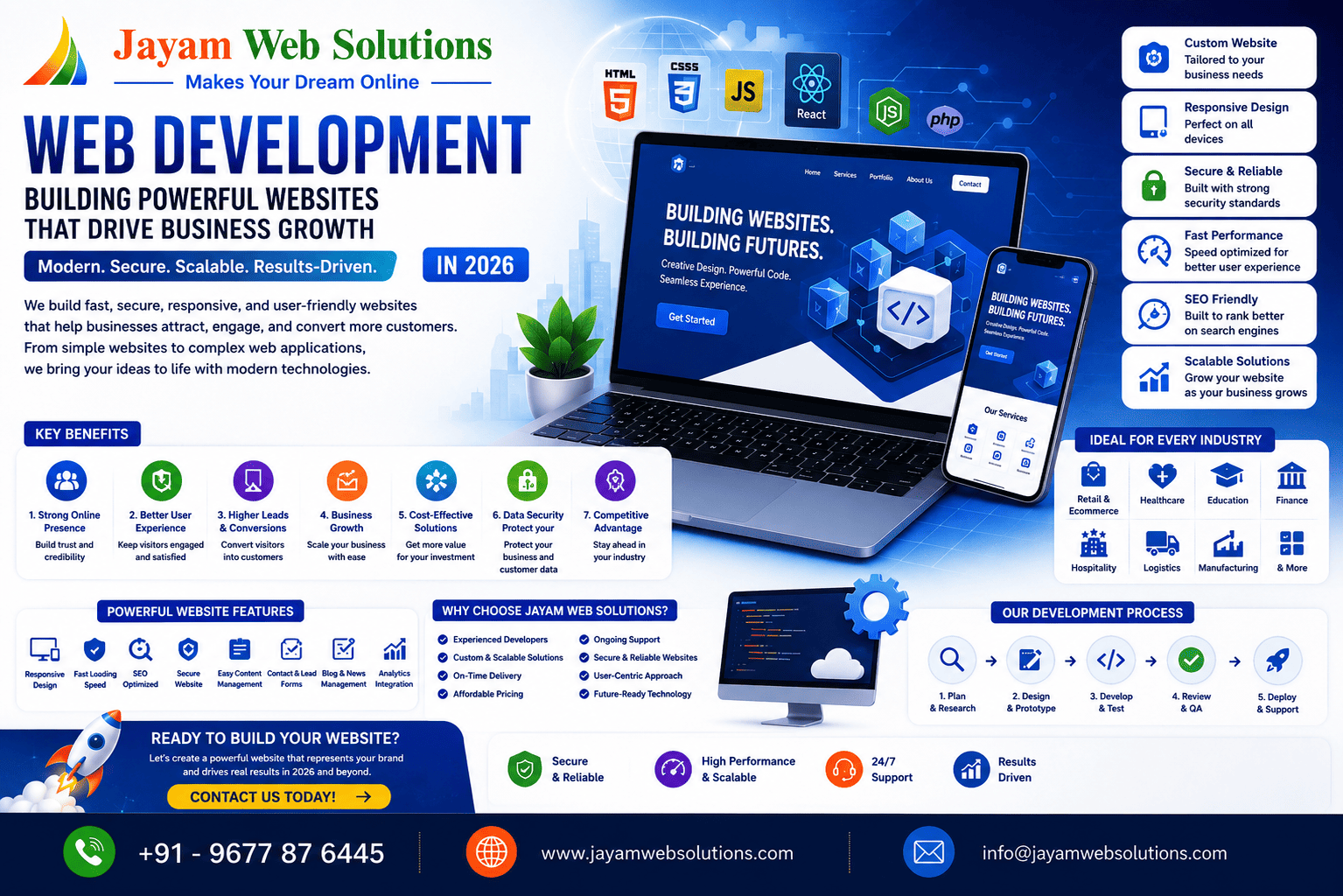
Web Development Trends in 2026: What Businesses Need to Know
Introduction
Web development continues to evolve as businesses become more dependent on digital platforms to connect with customers, generate leads, sell products, and manage their operations. A website is no longer just an online presence. It has become an important part of a business's overall digital strategy.
In 2026, businesses are looking for websites that are faster, more secure, easier to use, mobile-friendly, and capable of providing personalized experiences. At the same time, new technologies are changing how websites are designed, developed, maintained, and managed.
Understanding the latest web development trends in 2026 can help business owners make better decisions when building a new website or improving an existing one.
1. AI-Powered Web Development
Artificial intelligence is becoming an important part of modern web development. Developers can use AI-powered tools to assist with coding, testing, content-related tasks, troubleshooting, and website optimization.
For businesses, AI can also improve the way websites interact with visitors. AI-powered chat systems, recommendation features, automated support, and personalized content can help businesses provide faster customer service.
However, AI should support business goals rather than replace proper planning and professional development. Businesses still need a well-structured website, secure technology, and a clear user experience.
2. Mobile-First Website Development
Most customers access business websites using smartphones. Because of this, mobile-first development remains one of the most important trends in 2026.
A mobile-friendly website should provide:
- Easy navigation
- Readable content
- Fast loading
- Responsive layouts
- Touch-friendly buttons
- Simple forms
- Properly optimized images
A website that works well on mobile devices can provide a better customer experience and help businesses avoid losing potential customers.
3. Faster Website Performance
Website speed has become a major consideration for both users and businesses. Visitors generally expect websites to load quickly and respond smoothly.
Modern web development focuses on improving performance through optimized images, efficient code, caching, content delivery networks, and better hosting infrastructure.
For business owners, website performance matters because slow pages can create a poor user experience. A faster website can make it easier for visitors to browse services, explore products, submit enquiries, and complete important actions.
4. Improved Website Security
Cybersecurity is becoming increasingly important as businesses collect customer information and provide online services.
In 2026, businesses need to pay close attention to website security from the beginning of the development process. Secure authentication, data protection, regular updates, secure APIs, SSL/TLS, access controls, and monitoring can help reduce security risks.
Security should not be treated as an additional feature added after development. It should be considered throughout the website development lifecycle.
5. Personalized User Experiences
Customers expect websites to provide relevant and convenient experiences. Personalization allows websites to display information based on user behaviour, preferences, location, previous interactions, or other relevant data.
For example, an e-commerce website may recommend products based on previous browsing activity. A service-based business may provide different content depending on the visitor's requirements.
Personalization can help businesses make websites more engaging and improve the overall customer journey.
6. Progressive Web Applications
Progressive Web Applications, commonly known as PWAs, combine features of traditional websites and mobile applications.
PWAs can provide experiences such as fast loading, responsive interfaces, and certain app-like capabilities without requiring users to install a traditional mobile application.
For businesses that need a convenient digital experience across different devices, progressive web applications can be an option worth considering.
7. API-Based Development and Integrations
Modern businesses rarely operate with a website alone. They often use multiple systems such as CRM platforms, payment gateways, booking systems, accounting software, communication tools, and third-party services.
APIs allow different systems to communicate with each other.
In 2026, API integration continues to play an important role in business website development. A well-planned integration can reduce manual work and help businesses connect their website with existing business processes.
8. Headless and Flexible Architecture
Traditional websites often combine the frontend and backend into a single system. Modern development approaches can separate these layers, giving businesses greater flexibility.
Headless architecture allows content and business logic to be managed separately from the presentation layer. This can make it easier to deliver content across websites, mobile applications, digital platforms, and other interfaces.
This approach may be particularly useful for growing businesses that expect their digital requirements to expand over time.
9. Better Accessibility
Website accessibility is receiving more attention in modern web development. A business website should be usable by as many people as possible, including users with different accessibility needs.
Developers can focus on areas such as:
- Keyboard navigation
- Proper heading structures
- Alternative text for images
- Readable typography
- Sufficient contrast
- Accessible forms
- Meaningful links and buttons
Accessibility is not only about compliance. It also contributes to a better overall user experience.
10. Modern User Interface and User Experience
A visually attractive website is useful, but good design should also make the website easy to use.
In 2026, businesses are focusing on clean interfaces, simple navigation, clear calls to action, consistent branding, and smooth interactions.
A professional website should help visitors quickly understand:
- What the business offers
- Who the services are for
- Why the business is different
- How to contact the business
- What action they should take next
Good UX reduces confusion and helps visitors move through the website more naturally.
11. Voice and Conversational Interfaces
Voice technology and conversational interfaces are continuing to influence digital experiences. Businesses can explore voice-enabled features and conversational tools where they provide genuine value to customers.
For example, customers may use conversational interfaces to ask questions, find information, or receive assistance.
The important consideration is not simply adding new technology. Businesses should identify whether the feature solves a real customer problem.
12. Sustainable Web Development
Sustainability is becoming another consideration in digital development. Websites consume computing resources through servers, networks, data transfers, and user devices.
Developers can reduce unnecessary resource usage by optimizing images, reducing excessive scripts, improving code efficiency, and creating lightweight website experiences.
A more efficient website can also provide performance benefits, making sustainability and user experience closely connected.
13. Advanced Content Management Systems
Content management systems continue to evolve to provide businesses with easier ways to manage website content.
Modern CMS platforms can support structured content, multiple users, workflows, integrations, analytics, and personalized experiences.
For businesses that frequently update products, services, blogs, or other information, choosing the right CMS can make website management more efficient.
14. Cloud-Based Web Development
Cloud technologies continue to support scalable and flexible web applications. Cloud-based infrastructure can help businesses manage changing traffic levels and provide reliable access to digital services.
For growing businesses, scalability is especially important. A website should be able to support future growth instead of requiring a complete technical replacement whenever business requirements increase.
Visit us at www.jayamwebsolutions.com to get started!
Kindly Reach us / Call us +91 9677876445.