

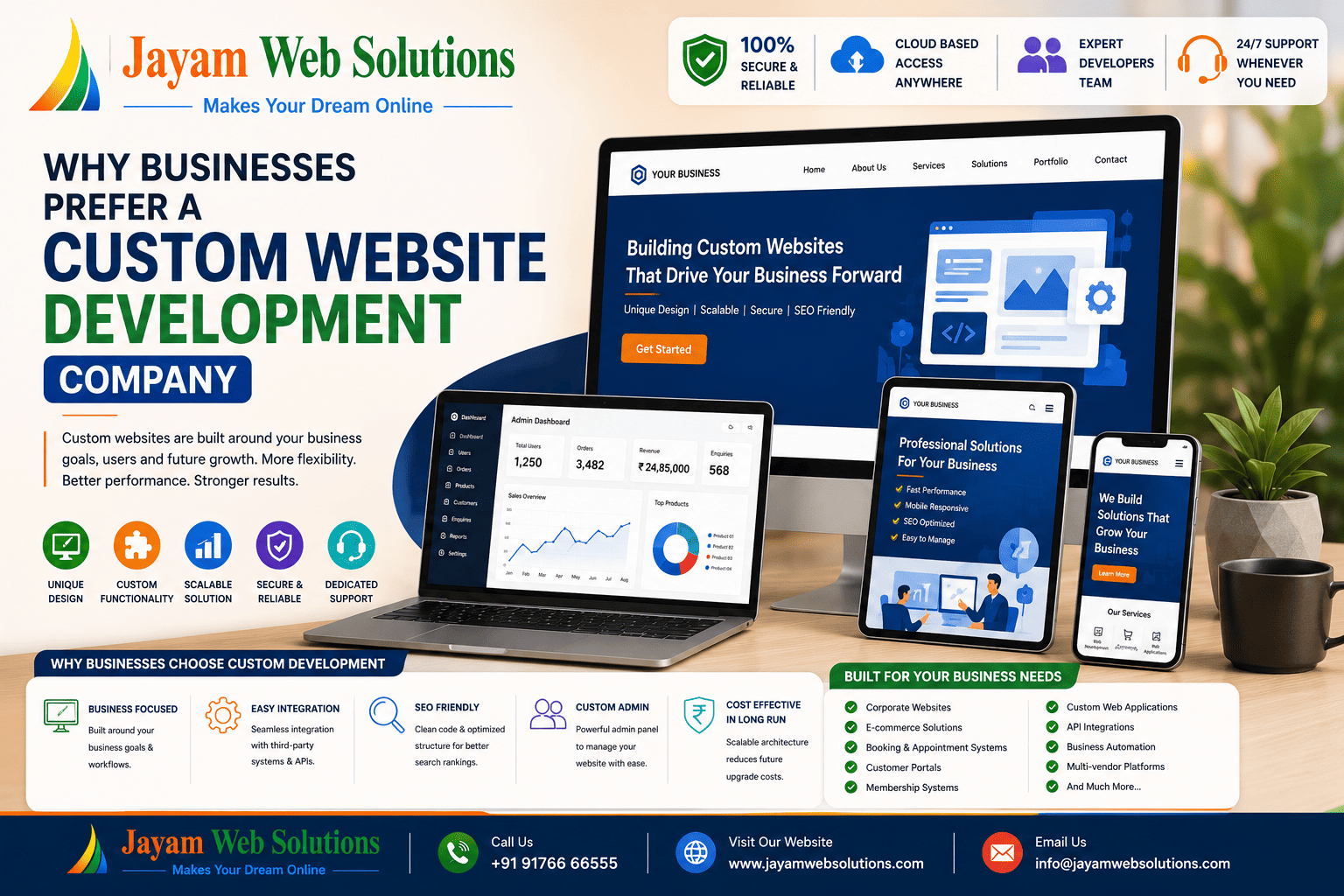
Why Businesses Prefer a Custom Website Development Company
A business website is often the first point of interaction between a company and its potential customers. While many ready-made platforms and website builders make it possible to launch a website quickly, businesses with specific requirements often need more flexibility than a standard solution can provide.
This is one of the major reasons businesses prefer working with a custom website development company. Instead of adapting their business processes to an existing template or platform, companies can have a website developed around their specific objectives, customers, services, and future growth plans.
What Is Custom Website Development?
Custom website development involves creating a website specifically for a business based on its unique requirements.
Unlike a standard template-based website, custom development allows the design, functionality, database structure, integrations, user experience, and administration features to be planned according to the organization's needs.
A custom website may include:
- Unique website design
- Custom business modules
- Customer portals
- Admin dashboards
- Advanced forms
- API integrations
- Payment gateway integration
- CRM integration
- Product management
- Booking systems
- Membership functionality
- Custom reporting
- Role-based access
- Business automation
Why Do Businesses Prefer Custom Website Development?
1. The Website Is Built Around Business Requirements
Every business has its own way of working.
A standard website may provide a fixed set of features, but a custom website can be developed according to the actual workflow of the organization.
For example, a company may require a customer registration system, quotation management, employee portal, booking functionality, or integration with an existing business application.
Custom development allows these requirements to become part of the website rather than forcing the business to work around the limitations of a standard platform.
2. Greater Design Flexibility
A custom website allows businesses to control:
- Layout
- Typography
- Colour combinations
- Navigation
- Page structure
- Visual elements
- Interactive sections
- User journeys
Instead of using the same design structure as hundreds of other websites, businesses can create a digital experience that reflects their brand.
3. Better User Experience
A website should be designed not only for the business but also for the people who use it.
For example, an e-commerce business may require a simple product search and checkout experience, while a B2B company may need product enquiries, quotations, customer login, and account-specific information.
Custom development makes it possible to design these experiences according to the intended users.
4. Easier Integration With Business Systems
Many businesses already use different software and online services.
A custom website can be integrated with systems such as:
- CRM platforms
- ERP systems
- Payment gateways
- Accounting applications
- Shipping services
- Email platforms
- SMS services
- Inventory systems
- Third-party APIs
- Business management software
These integrations can reduce manual data entry and help different systems communicate with each other.
5. Scalability for Future Growth
Custom development allows the application architecture to be planned with future expansion in mind.
As the business grows, additional functionality can be introduced, such as:
- New user roles
- Additional products
- Customer dashboards
- Advanced reports
- New integrations
- Subscription functionality
- Automation
- Mobile applications
- Multi-location management
This makes the website a long-term digital asset rather than a short-term solution.
6. Better Control Over Website Functionality
With a custom website, businesses have greater control over how different features operate.
The development team can create specific workflows for administrators, employees, customers, vendors, or other users.
For example, a business may want different users to have different access levels.
A custom system can provide role-based access so that each user sees only the information and functions relevant to their responsibilities.
7. SEO-Friendly Website Architecture
SEO should be considered during website development rather than added only after the website is completed.
Clean URL structures
- Editable page titles
- Meta descriptions
- Canonical URLs
- Robots meta controls
- XML sitemap
- Image alt text
- Structured data
- Internal linking
- Mobile responsiveness
- Fast-loading pages
This provides a stronger technical foundation for future SEO activities.
8. Improved Performance
A custom website can be developed with performance requirements in mind instead of including unnecessary features and scripts that may slow down the website.
Performance optimization can include:
- Optimized images
- Efficient code
- Database optimization
- Caching
- Optimized API requests
- Responsive development
- Server-side improvements
- Reduced unnecessary scripts
The result can be a faster and more efficient website.
9. Stronger Security Control
A professional custom website development process can incorporate security measures such as:
- Secure authentication
- Role-based access
- Input validation
- Secure API communication
- Password protection
- HTTPS
- Database security
- Backup systems
- Access control
- Security monitoring
Security requirements can be considered based on the nature of the application and the data it handles.
10. Custom Admin Panel
A custom admin panel can allow authorized users to manage:
- Website content
- Products
- Services
- Customers
- Orders
- Enquiries
- Images
- Blog posts
- Users
- Reports
The administration system can be designed specifically around the business workflow, making day-to-day management easier.
11. Reduced Dependence on Generic Templates
Templates can be useful for simple websites, but businesses with specialized requirements may eventually encounter limitations.
A custom website provides greater control over the underlying functionality and allows features to be developed according to the business's needs.
This is especially valuable when the company wants to differentiate itself through unique digital experiences.
12. Better Support for Business Automation
Custom websites can help businesses automate repetitive processes.
For example:
Manual process:
Customer submits an enquiry → employee receives the enquiry → employee enters information into another system → customer receives a response.
Automated process:
Customer submits an enquiry → information is stored automatically → appropriate team member is notified → follow-up workflow begins.
Similar automation can be implemented for bookings, invoices, orders, customer registrations, reports, and internal workflows.
A template-based website can still be a practical option for businesses with straightforward requirements. Custom development becomes more valuable when the website needs specialized functionality or long-term scalability.
When Should a Business Choose Custom Website Development?
Has unique operational workflows
- Requires custom functionality
- Needs multiple user roles
- Requires third-party integrations
- Wants a custom admin panel
- Needs advanced automation
- Handles complex business data
- Plans to scale the website
- Requires a customer portal
- Wants greater control over its digital platform
For a simple informational website with limited requirements, a standard solution may be sufficient.
How to Choose a Custom Website Development Company
Businesses should evaluate:
Portfolio
Review previous projects to understand the company's design and development capabilities.
Technical Expertise
Check whether the company has experience with the technologies required for your project.
Understanding of Requirements
A good development partner should understand your business process before recommending a solution.
Development Process
Ask how requirements, UI/UX design, development, testing, deployment, and maintenance will be handled.
Security
Understand how the company approaches authentication, data protection, backups, and application security.
SEO Knowledge
The development team should understand how website architecture and technical implementation affect search visibility.
Post-Launch Support
Websites require updates, monitoring, maintenance, and improvements after launch. Confirm what support is available after deployment.
Conclusion
Businesses prefer custom website development when they need a digital platform that goes beyond basic information presentation. Custom development provides greater control over design, functionality, integrations, performance, security, SEO, and future expansion.
The most important advantage is flexibility. Instead of forcing a business to adapt its processes to an existing website structure, a custom website can be developed around the way the business actually operates.
For organizations looking to build a scalable digital presence, automate processes, improve customer experiences, and support long-term growth, partnering with an experienced custom website development company can be a valuable investment.
Jayam Web Solutions develops custom websites and web applications tailored to individual business requirements, with a focus on responsive design, performance, SEO-friendly development, security, scalability, and business-focused functionality.