

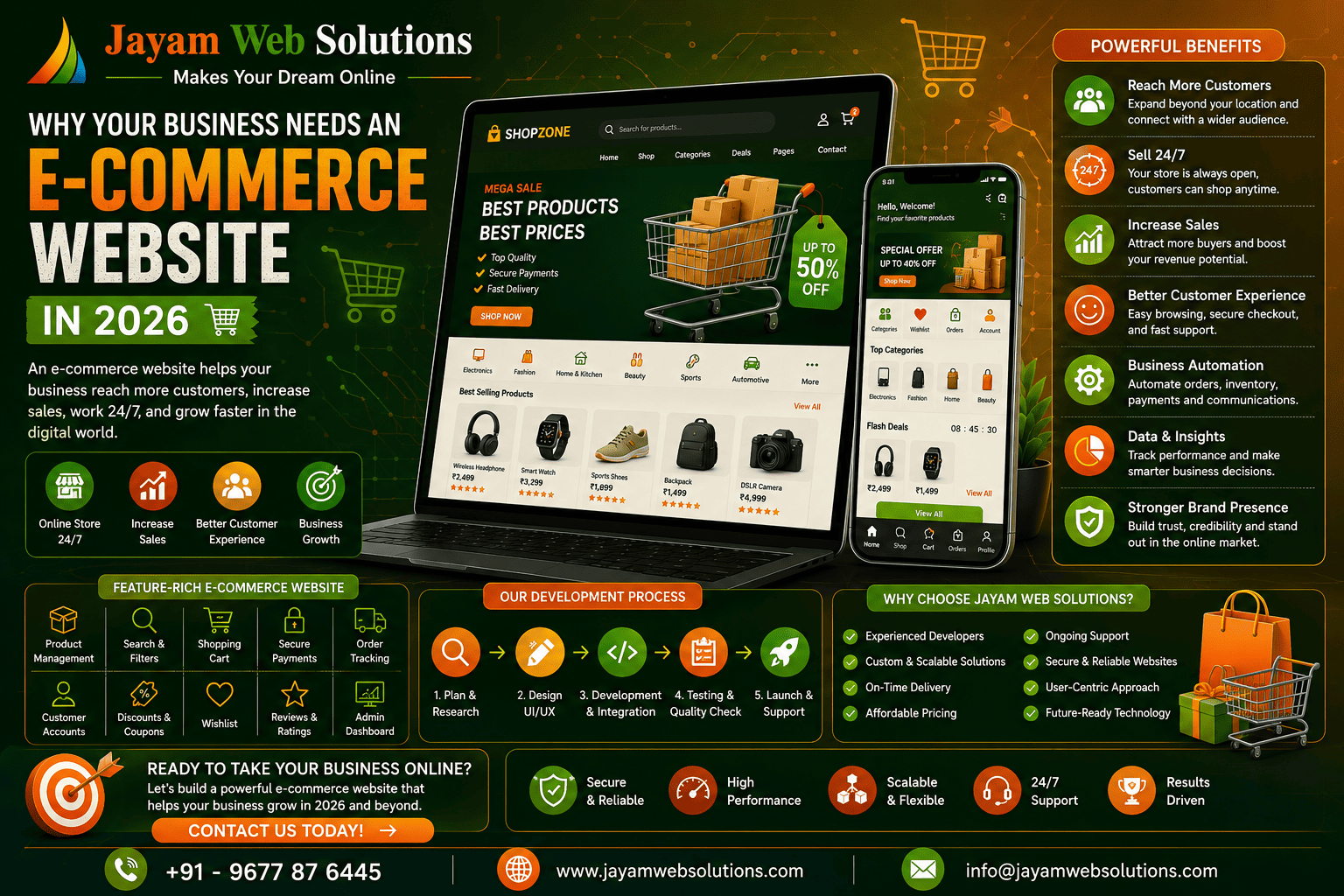
Introduction
The way customers discover, compare, and purchase products has changed significantly. Businesses are no longer limited to selling through physical stores or traditional sales channels. With customers increasingly using digital platforms for their shopping needs, having a strong online presence has become an important part of modern business strategy.
In 2026, an e-commerce website can provide businesses with much more than an online product catalogue. It can function as a complete digital sales platform where customers can explore products, compare options, make payments, place orders, and receive updates from anywhere.
Whether you operate a retail store, manufacture products, run a wholesale business, or are starting a new venture, an e-commerce website can help you create new opportunities and reach customers beyond your physical location.
What Is an E-Commerce Website?
An e-commerce website is an online platform that allows a business to display and sell products or services through the internet.
Customers can typically use an e-commerce website to:
- Browse products
- Search for specific items
- View product information
- Compare products
- Add items to a shopping cart
- Make online payments
- Place orders
- Track purchases
Contact customer support
On the business side, an e-commerce system can help manage products, customers, orders, inventory, payments, discounts, and reports from a centralized platform.
Why Does Your Business Need an E-Commerce Website in 2026?
1. Reach Customers Beyond Your Local Area
A physical store primarily serves customers who can access its location. An e-commerce website removes much of that geographical limitation.
Customers from different cities, regions, or markets can discover your products through search engines, social media, advertisements, and other digital channels.
This creates an opportunity for businesses to expand their customer base without opening a physical branch in every location.
2. Your Business Can Sell Around the Clock
A physical store operates according to specific business hours. An online store can remain available to customers throughout the day.
Customers can visit your website, explore products, and place orders at a time that is convenient for them.
This provides businesses with a continuous digital sales channel and gives customers greater flexibility.
3. Customers Expect Online Convenience
Modern customers value convenience. They want to find product information quickly, compare options, check prices, and complete purchases without unnecessary steps.
A well-designed e-commerce website can provide a smooth shopping journey from product discovery to checkout.
Features such as search, filters, product categories, secure payment options, order tracking, and customer accounts can make the purchasing process easier.
4. Build a Strong Digital Presence
Your website is an important digital asset for your business.
While social media platforms can help attract attention, your e-commerce website gives you a dedicated platform where you control your products, content, customer journey, and business information.
A professional online store can also strengthen your brand image and give potential customers a central place to learn about your products.
5. Increase Sales Opportunities
An e-commerce website can create additional opportunities to generate sales.
Businesses can use product recommendations, promotional offers, discount codes, related products, seasonal campaigns, and personalized experiences to encourage customers to explore more products.
The website can also be connected with digital marketing campaigns to turn online visitors into potential buyers.
6. Make Mobile Shopping Easier
Mobile devices play an important role in online shopping. Customers may discover products through their smartphones and complete purchases without using a desktop computer.
Therefore, an e-commerce website should be designed to work smoothly across smartphones, tablets, laptops, and desktops.
A mobile-friendly website should provide:
- Simple navigation
- Fast-loading pages
- Responsive layouts
- Easy product browsing
- Mobile-friendly forms
- Convenient checkout
- Touch-friendly buttons
A poor mobile experience can make customers leave before completing a purchase.
7. Accept Online Payments
One of the biggest advantages of e-commerce is the ability to accept digital payments.
Depending on the target market and payment provider, businesses can offer options such as:
- Credit and debit cards
- UPI
- Net banking
- Digital wallets
- Other supported payment methods
A simple and secure checkout process can reduce unnecessary friction and make it easier for customers to complete their purchases.
8. Manage Products and Orders Efficiently
An e-commerce website can bring different business activities into one centralized system.
Through an admin dashboard, businesses can manage:
- Products
- Categories
- Prices
- Stock
- Customer details
- Orders
- Discounts
- Shipping information
- Payment status
Instead of managing every order manually, businesses can use digital workflows to make everyday operations more organized.
9. Understand Customer Behaviour
An online store can provide valuable information about customer interactions.
Businesses can analyze information such as:
- Popular products
- Frequently visited pages
- Customer searches
- Conversion rates
- Cart activity
- Traffic sources
- Sales performance
These insights can help business owners understand customer interests and make more informed decisions.
10. Support Business Automation
E-commerce websites can be integrated with other business systems and services.
For example, an online store may connect with:
- CRM software
- Inventory systems
- Accounting platforms
- Payment gateways
- Shipping services
- Email marketing tools
- SMS platforms
- Customer support systems
These integrations can reduce repetitive manual tasks and help businesses manage their operations more efficiently.
11. Improve Customer Experience
A successful e-commerce website should not focus only on selling products. It should also focus on providing a positive customer experience.
Customers should be able to easily understand:
- What the product is
- How much it costs
- Whether it is available
- What features it offers
- How it can be purchased
- How it will be delivered
Clear product information, high-quality images, simple navigation, fast performance, and transparent checkout processes can contribute to a better shopping experience.
12. Strengthen Your Brand
An e-commerce website gives businesses more control over how their brand is presented online.
Businesses can create a consistent experience through:
- Brand colours
- Logo
- Typography
- Product presentation
- Website design
- Content
- Photography
- Brand messaging
A professionally designed website can help create a stronger and more consistent brand identity.
13. Improve Visibility Through SEO
Having an online store is not enough. Customers need to be able to find it.
Search Engine Optimization can help improve the visibility of product and category pages in search engines.
An e-commerce SEO strategy can include:
- Keyword research
- Optimized product descriptions
- SEO-friendly URLs
- Category page optimization
- Image optimization
- Internal linking
- Structured data
- Mobile optimization
- Website performance
When implemented properly, SEO can help businesses attract relevant visitors without depending entirely on paid advertising.
14. Create Personalized Shopping Experiences
Customers increasingly expect relevant experiences when shopping online.
Businesses can use customer behaviour and website data to provide relevant product recommendations, offers, and content where appropriate.
For example, a customer who regularly views a particular product category may be shown related products or relevant offers.
Personalization can make the shopping experience more useful and engaging.
15. Prepare Your Business for Future Growth
A business website should not only meet today's requirements. It should also be capable of supporting future development.
As your business grows, you may need:
- More products
- More customers
- Additional payment options
- New delivery locations
- Advanced integrations
- Customer loyalty features
- Mobile applications
- Advanced reporting
Choosing a scalable e-commerce development approach can make it easier to introduce new functionality as your business evolves.
Visit us at www.jayamwebsolutions.com to get started!
Kindly Reach us / Call us +91 9677876445