

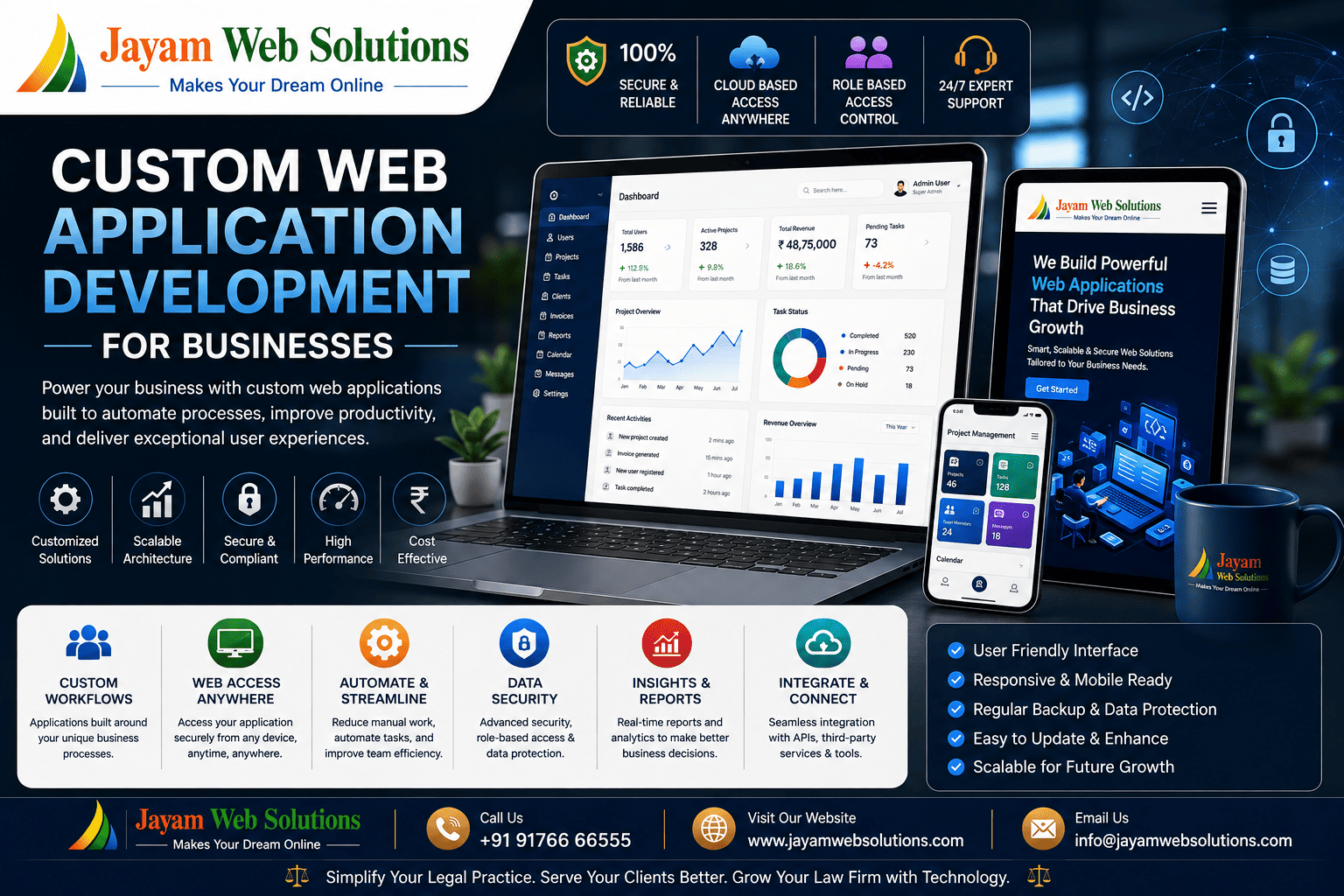
Custom Web Application: A Complete Guide for Modern Businesses
A custom web application can transform the way a business manages its operations, serves customers, and handles day-to-day processes. Unlike a standard website that primarily presents information, a web application is designed to perform specific business functions through an interactive and secure online platform.
From customer portals and booking systems to CRM platforms, ERP solutions, employee management systems, e-commerce applications, and SaaS products, custom web applications can be developed around the exact requirements of an organization.
What Is a Custom Web Application?
A custom web application is a software application developed specifically for the requirements of a particular business or organization. It operates through a web browser and can be accessed using computers, tablets, and smartphones without requiring users to install traditional desktop software.
Instead of adapting business processes to an existing software package, custom development allows the application to be designed around the organization's workflows, users, data, permissions, and operational requirements.
For example, a business may require a web application for:
- Customer management
- Online booking and appointment management
- Inventory tracking
- Employee management
- Project management
- Membership management
- Billing and invoicing
- School or institute management
- E-commerce operations
- Vendor and supplier management
- Business reporting
- Customer portals
- SaaS products
Why Businesses Choose Custom Web Applications
Every business operates differently. Ready-made software may provide general features, but it may not always support a company's specific workflow.
Custom web application development provides greater control over functionality and allows businesses to build only the features they actually need.
1. Designed Around Your Business
A custom application can be developed according to your existing processes. Instead of changing your workflow to match software, the software is created to support your workflow.
2. Better Scalability
As the business grows, new modules and features can be added. This makes a custom application suitable for organizations that expect their operational requirements to evolve.
3. Improved Automation
Repetitive manual tasks can be converted into automated workflows. This can reduce administrative effort and help employees focus on more valuable activities.
4. Centralized Data
A web application can bring information from different departments and processes into a centralized system. Authorized users can access relevant information according to their roles.
5. Better User Experience
The interface can be designed according to the requirements of administrators, employees, customers, vendors, or other users.
Custom Web Application vs Standard Website
A standard website generally focuses on presenting information about a company, its services, products, contact details, and other content.
A web application goes further by allowing users to interact with data and perform specific actions.
For example, a business website may display available services, while a custom web application could allow customers to register, book a service, make payments, track their requests, and access their account.
Common Types of Custom Web Applications
Custom web applications can be developed for almost any industry or business process.
CRM Applications
A custom CRM can help businesses manage leads, customers, communication, sales activities, follow-ups, and customer history.
ERP Applications
ERP applications can connect multiple business functions such as inventory, purchasing, sales, finance, HR, and reporting.
Booking Applications
Booking systems can manage availability, reservations, payments, cancellations, and notifications.
Customer Portals
Customer portals provide secure access to invoices, documents, service requests, orders, subscriptions, and account information.
SaaS Applications
Businesses can develop subscription-based software products that allow multiple customers or organizations to use the same application through separate accounts.
E-commerce Applications
Custom e-commerce applications can provide product management, customer accounts, cart functionality, payment processing, order management, inventory control, and reporting.
Essential Features of a Custom Web Application
The required features depend on the business model, but many applications include:
- Secure user registration and login
- Role-based access control
- Admin dashboard
- User management
- Data management
- Search and filtering
- Reports and analytics
- Notifications
- Payment integration
- API integration
- Document management
- Activity tracking
- Backup mechanisms
- Mobile-responsive interface
- Security controls
Technology Selection
The technology stack should be selected according to the application's requirements rather than simply following trends.
Modern applications can use technologies such as React.js for interactive interfaces, Node.js and Express.js for backend services, MongoDB or MySQL for data management, and Laravel for applications where PHP-based development is appropriate.
A suitable architecture should consider performance, security, maintainability, scalability, hosting requirements, and future expansion.
Security in Custom Web Applications
Security should be considered throughout the development process.
Important areas include:
- Secure authentication
- Password protection
- Role-based permissions
- Input validation
- Secure API communication
- Data encryption where appropriate
- Protection against common web vulnerabilities
- Secure payment integration
- Regular backups
- Monitoring and logging
- Controlled administrative access
A professional development process should include security testing before deployment.
Responsive Web Application Development
Today's users access applications from different devices. A custom web application should therefore provide a consistent experience across desktops, laptops, tablets, and smartphones.
Responsive interfaces allow users to perform important tasks without being restricted to a particular device.
API and Third-Party Integration
Many businesses already use external services. Custom web applications can integrate with APIs and third-party platforms such as:
- Payment gateways
- SMS services
- Email platforms
- Accounting software
- CRM systems
- ERP systems
- Shipping services
- Maps
- Social login providers
- Analytics platforms
Custom Web Application Development Process
A structured development process helps reduce project risks.
Requirement Analysis
The first stage is understanding the business requirements, users, workflows, goals, and expected outcomes.
Planning
The application structure, modules, user roles, integrations, technology stack, and development milestones are defined.
Development
Frontend and backend components are developed and connected to the database and required APIs.
Testing
The application is tested for functionality, usability, responsiveness, security, compatibility, and performance.
Deployment
After testing and approval, the application is deployed to the production environment.
Maintenance and Enhancement
Ongoing monitoring, updates, bug fixes, security improvements, and new features can be provided as the business evolves.
How Much Does Custom Web Application Development Cost?
There is no single price for custom web application development because the cost depends heavily on project complexity.
Factors that influence the cost include:
- Number of modules
- Number of user roles
- UI/UX requirements
- Backend complexity
- Database requirements
- API integrations
- Payment integrations
- Reporting requirements
- Security requirements
- Third-party services
- Mobile responsiveness
- Hosting infrastructure
- Testing requirements
- Maintenance requirements
Benefits of Working With an Experienced Development Company
An experienced development team can contribute beyond writing code. They can help analyze requirements, identify technical risks, recommend suitable architecture, plan integrations, perform testing, and provide post-launch support.
This can reduce the risk of building unnecessary features or choosing an architecture that becomes difficult to maintain as the application grows.
Is a Custom Web Application Right for Your Business?
A custom web application may be suitable if your business:
- Has unique workflows
- Needs automation
- Requires multiple user roles
- Handles large amounts of business data
- Needs integration with existing systems
- Wants greater control over its software
- Plans to scale operations
- Wants to develop a SaaS product
- Needs a customer or employee portal
If your requirements are very simple and mainly involve presenting company information, a conventional business website may be sufficient.
Conclusion
Custom web application development provides businesses with the flexibility to create software around their specific operational needs. From automating internal processes to creating customer-facing platforms and SaaS products, a well-planned application can become an important part of a company's digital infrastructure.
The key is to begin with clear requirements, select appropriate technologies, prioritize security and usability, and work with a development team capable of supporting the application beyond its initial launch.
For businesses planning a custom web application, Jayam Web Solutions can help transform business requirements into scalable, secure, and user-friendly web solutions tailored to specific operational goals.
Visit us at www.jayamwebsolutions.com to get started!