

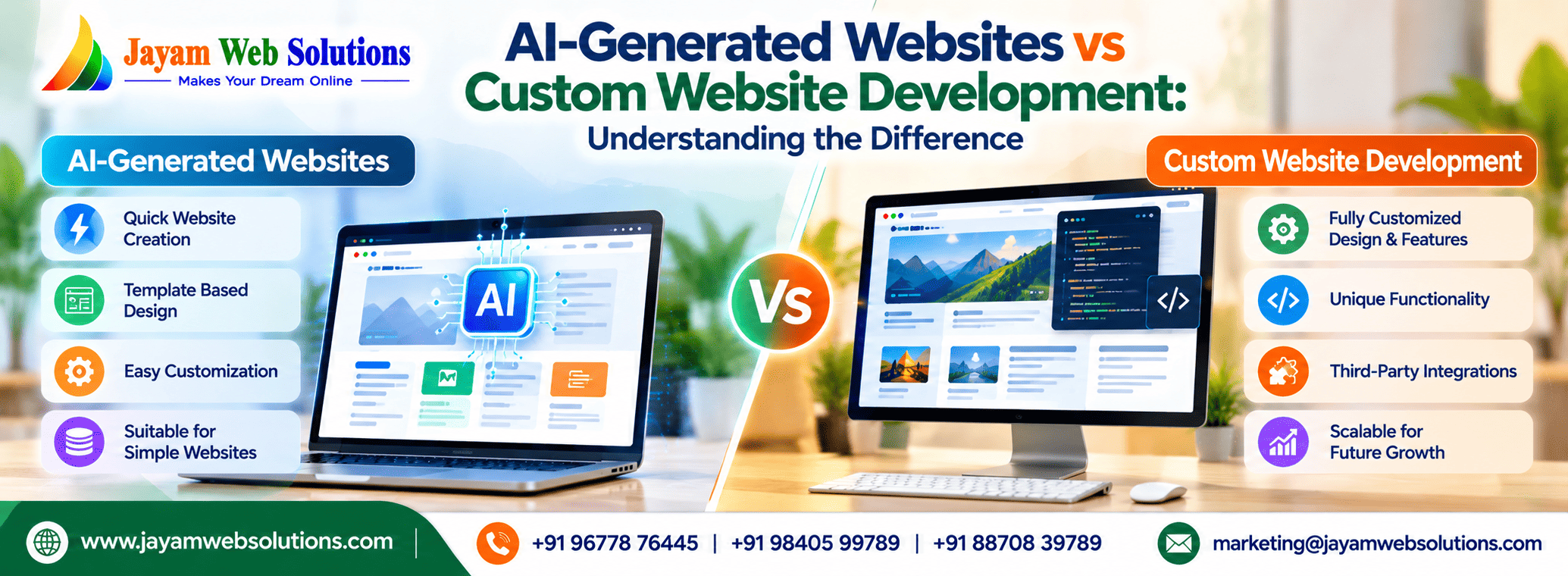
AI-Generated Websites vs Custom Website Development: Understanding the Difference
Artificial intelligence has changed the way websites can be created.
Today, a business owner can describe a website requirement in natural language and use an AI-powered website builder to generate pages, layouts, content and other website elements within a short time.
This has made website creation more accessible than ever.
But there is another approach that businesses have used for years:
custom website development.
With custom development, the website is planned around the company's specific requirements, business processes, users, integrations and long-term objectives.
So, what is the actual difference between an AI-generated website and a custom-developed website?
The answer is not simply about whether AI or a developer writes the code.
The bigger differences are usually related to control, flexibility, functionality, scalability, hosting, integrations, maintenance and long-term business requirements.
What Is an AI-Generated Website?
An AI-generated website is a website created partly or largely through an AI-powered website builder or development platform.
The user may provide information such as:
- Business type
- Company name
- Services
- Target audience
- Preferred design
- Required pages
- Brand colours
- Content requirements
The platform then generates a website based on the information provided.
Depending on the platform, AI may assist with:
- Page layouts
- Website content
- Images
- Navigation
- Design suggestions
- Forms
- Code
- SEO settings
- Mobile layouts
- Website structure
Modern AI website builders have become much more capable, and current 2026 coverage commonly describes them as useful for simple business websites, landing pages, prototypes and early-stage projects. PixelorCode
But an AI-generated website is not one standard type of technology.
The capabilities can vary significantly from one platform to another.
What Is Custom Website Development?
Custom website development starts with the business requirement rather than a predefined website template.
The development team first understands:
- Business objectives
- Target users
- Required features
- User journeys
- Business workflows
- Data requirements
- Integrations
- Security requirements
- SEO requirements
- Hosting requirements
- Future expansion plans
The website architecture is then designed around those requirements.
Depending on the project, custom development may use technologies such as:
- HTML
- CSS
- JavaScript
- React
- Next.js
- Node.js
- PHP
- Laravel
- MySQL
- PostgreSQL
- MongoDB
- Other frameworks and technologies
The technology stack should be selected according to the project's requirements rather than simply because it is popular.
AI Website vs Custom Website: The Basic Difference
The simplest way to understand the difference is:
AI Website Builder
Prompt → AI generation → Template/platform → Customise → Publish
Custom Website Development
Requirement → Planning → UI/UX → Development → Testing → Deployment → Maintenance
AI website builders focus heavily on speed and convenience.
Custom development focuses on requirements, flexibility and technical control.
Neither approach is automatically suitable for every business.
1. Speed of Website Creation
One of the biggest advantages of AI website builders is speed.
A business can provide a description of its requirements and receive an initial website structure quickly.
This can be useful when a business needs:
- A landing page
- A temporary campaign website
- A basic company website
- A prototype
- A simple portfolio
- A quick online presence
Custom development normally involves more stages because the website is designed specifically around the project.
The additional planning can take more time, but it also provides an opportunity to address requirements before development begins.
2. Customisation and Design Flexibility
AI website builders generally provide predefined structures, components or design systems.
You may be able to change:
- Colours
- Fonts
- Images
- Text
- Sections
- Layout elements
However, deeper changes can depend on what the platform allows.
Custom development starts from the business requirement.
The developer can create:
- Unique page structures
- Custom interactions
- Special navigation
- Complex forms
- Custom dashboards
- Unique user journeys
- Industry-specific workflows
This becomes important when a business does not want its website to behave like a standard template-based website.
3. Business Logic
A basic business website may only need:
- About Us
- Services
- Products
- Contact
- Blog
An AI website builder may be perfectly capable of supporting such a requirement.
But consider a company that needs:
Customer registration → quotation request → approval → payment → order processing → notification → invoice
This is no longer simply a website design problem.
It is a business application requirement.
Custom development allows the development team to design the workflow around the company's actual process.
4. Custom Integrations
Businesses often need their website to communicate with other systems.
Examples include:
- CRM
- ERP
- Accounting software
- Payment gateways
- Shipping platforms
- SMS providers
- Email services
- Booking APIs
- Inventory systems
- WhatsApp integrations
- Third-party databases
AI platforms may support some integrations through built-in connectors or APIs.
However, businesses with unusual or highly specific integration requirements may need more technical control.
Custom development can be designed around the APIs and data structures of the systems involved.
5. Database Requirements
A simple company website may not require a complex database.
But consider:
- Ecommerce
- Membership systems
- LMS platforms
- Booking systems
- Customer portals
- Billing applications
- Inventory management
- SaaS applications
These systems can contain substantial amounts of structured business data.
Custom development allows the database structure to be designed around the application's requirements.
This can include:
- Customer records
- Product records
- Orders
- Transactions
- User roles
- Inventory
- Reports
- Business workflows
When using an AI website builder, businesses should understand how their data is stored and whether it can be exported if they later change platforms.
6. Source Code and Ownership
This is an important difference that is sometimes overlooked.
With an AI website platform, the business should ask:
Can I access the source code?
Can I download it?
Can another developer modify it?
Can I host it somewhere else?
Can I export my database?
These questions matter because a website can be available online without the business having complete technical control over its underlying implementation.
Custom development can be structured so that the business receives the agreed project source code, documentation and deployment access according to the development agreement.
The exact ownership and licensing arrangement should always be clearly defined in the project contract.
7. Hosting Flexibility
Some AI website builders combine:
Website Builder + Hosting + Platform Services
This makes publishing easy.
But it can also mean that the website depends on the platform's infrastructure.
Before selecting an AI platform, businesses should understand:
- Where the website is hosted
- Whether hosting can be changed
- Whether the website can be exported
- Whether the database can be moved
- Whether third-party services remain accessible
- What happens when the subscription ends
With custom development, the hosting environment can generally be selected according to the application's requirements.
The website may be deployed on:
- Shared hosting
- VPS
- Dedicated server
- Cloud infrastructure
- Managed hosting
- Private infrastructure
The appropriate option depends on the project.
8. Website Performance
Website performance is more than simply obtaining a high score from one testing tool.
Real-world performance can depend on:
- Page structure
- JavaScript
- Images
- Fonts
- Server response
- Database queries
- API calls
- Caching
- CDN
- Hosting infrastructure
Custom development provides greater opportunity to optimise the architecture around the specific website.
However, this does not mean every custom website will automatically be faster.
Poorly developed custom code can also perform badly.
Likewise, an AI-generated website can perform well when it is properly designed, optimised and hosted.
Google's current guidance recommends considering overall page experience, including Core Web Vitals, mobile usability and secure delivery, rather than treating one metric as the entire SEO strategy. Google for Developers
9. SEO Control
SEO should not be reduced to simply adding a meta title and meta description.
A business website may require control over:
- Page titles
- Meta descriptions
- URL structure
- Canonical tags
- XML sitemap
- Robots.txt
- Structured data
- Internal linking
- Heading structure
- Image alt text
- Page performance
- JavaScript rendering
- Redirects
- Content architecture
AI website builders increasingly provide basic SEO controls.
But businesses competing in more demanding search environments may require deeper technical control.
Google's current Search guidance places emphasis on helpful, reliable, original content and good page experience rather than content created primarily to manipulate rankings. Google for Developers
10. AI Search and Generative Search
Search is changing.
Users increasingly interact with search through:
- AI Overviews
- AI Mode
- Conversational search
- Voice search
- Image-based search
- Multimodal search
Google has also introduced reporting for web multimodal search in Search Console, including image-based search experiences such as Lens and Circle to Search. Google for Developers
This does not mean businesses need a special "AI website."
Instead, it reinforces the importance of having:
- Clear information
- Strong site structure
- Useful content
- Accurate business information
- Accessible pages
- Good technical foundations
- Original expertise
The underlying technology used to create the website is only one part of the equation.
11. Scalability
A website that works today may have very different requirements two years from now.
Initially, a business may need:
Home + About + Services + Contact
Later it may require:
Customer Login + Dashboard + Payments + CRM + Reports + API Integrations
An AI website builder may be sufficient for the first stage.
But if the platform cannot support the second stage, the business may eventually need to migrate or rebuild.
Custom development allows the architecture to be planned with future requirements in mind.
This does not mean every business needs a highly complex custom system from day one.
The right approach is to understand where the business is heading.
12. Maintenance and Future Changes
Every website needs maintenance.
This can include:
- Security updates
- Bug fixes
- Content updates
- Performance improvements
- New features
- API changes
- Server updates
- Database maintenance
With an AI platform, some maintenance may be handled by the platform itself.
With custom development, the business generally works with its developer or internal technical team for ongoing maintenance.
The advantage of custom development is that future changes can be designed around the actual business requirement.
13. Security and Control
Security is particularly important for websites handling:
- Customer information
- Payments
- Employee data
- Business records
- Documents
- User accounts
An AI-generated website should not be considered secure simply because AI created it.
It still needs:
- Input validation
- Authentication controls
- Authorisation
- Secure API handling
- Data protection
- Dependency management
- HTTPS
- Server security
- Regular updates
Custom development can provide greater visibility into how these areas are implemented, provided the development process includes appropriate security practices.
14. AI-Generated Website Does Not Mean AI-Managed Website
There is an important distinction between:
AI-generated website
and
AI-assisted website development.
An AI website builder may generate the website largely inside its own platform.
AI-assisted development is different.
A developer may use AI to help with:
- Code generation
- Debugging
- Documentation
- Testing
- Research
- Refactoring
- Development productivity
But the final application can still be custom-built and deployed using the company's preferred technology and hosting environment.
This hybrid model is becoming an increasingly discussed approach in 2026. SAM's AI Services
When Can an AI Website Builder Make Sense?
An AI website builder can be useful when the requirement is relatively straightforward.
For example:
Small Business Website
A company may simply need:
- Home
- About
- Services
- Gallery
- Contact
- Location
- Enquiry form
Landing Page
Useful for:
- Marketing campaigns
- Product launches
- Lead generation
- Events
Prototype
A startup may want to test an idea before investing heavily in development.
Early-Stage Business
A new business may want an online presence quickly while validating its market.
These are situations where speed and simplicity can be valuable.
When Should a Business Consider Custom Website Development?
Custom development becomes more relevant when the website itself is an important part of the business operation.
Examples include:
Ecommerce Platforms
With:
- Product management
- Inventory
- Customer accounts
- Orders
- Payments
- Shipping
- Offers
SaaS Applications
With:
- User accounts
- Subscription plans
- Dashboards
- Billing
- APIs
- Role management
Customer Portals
With:
- Login
- Documents
- Requests
- Status tracking
- Notifications
Business Management Systems
Such as:
- Billing
- Quotation generation
- CRM
- Inventory
- HR
- Booking
- LMS
Complex API-Based Projects
Where multiple external systems need to exchange data.
In these situations, the website is no longer just a digital brochure.
It becomes part of the company's business infrastructure.
What About Cost?
Cost should not be evaluated only by asking:
"How much does it cost to create the website?"
A better question is:
"What will the website cost to build, operate, maintain and change over its expected lifetime?"
An AI platform may have a low initial subscription cost.
But additional expenses may come from:
- Premium features
- Add-ons
- Higher traffic
- Additional storage
- Third-party services
- Advanced integrations
Custom development generally involves a larger initial investment but can provide a project specifically designed around the business.
The right comparison should therefore consider total cost of ownership, not just the initial development price.
What If a Business Starts With AI and Later Needs Custom Development?
This is an important scenario.
A business does not necessarily have to make the same technology decision forever.
A company might:
Start with an AI website → validate the business → grow → introduce complex requirements → move to custom development
The problem arises when the original platform makes migration difficult.
Therefore, even if you choose an AI website builder today, it is sensible to understand:
- Source-code access
- Data export
- Domain ownership
- Hosting options
- Database access
- Migration possibilities
Planning for the future does not mean overbuilding the website today.
A Third Option: AI-Assisted Custom Development
There is another approach that businesses should know about.
Instead of choosing between:
AI website builder and traditional manual development
developers can use AI as part of the custom development process.
For example:
Business requirements → Architecture → AI-assisted coding → Developer review → Testing → Deployment
AI can help developers produce code and documentation faster, while the developer remains responsible for:
- Architecture
- Business logic
- Security
- Testing
- Performance
- Integrations
- Deployment
- Maintenance
This can combine AI-assisted productivity with the control of a custom-developed application.
Current 2026 industry discussions increasingly describe this as a separate model from a hosted AI website builder. SAM's AI Services
How Should a Business Decide?
Before choosing a development approach, ask these questions:
1. What type of website do we need?
Is it a simple business website or a complete web application?
2. How unique are our requirements?
Can a standard platform provide everything we need?
3. Will we need custom integrations?
If yes, identify them before selecting the platform.
4. How important is source-code access?
Will another developer need to maintain the website?
5. How important is migration?
Could the company need to change hosting or platforms later?
6. How much control is required?
Consider design, database, APIs, business logic and hosting.
7. What happens as the business grows?
Think beyond the first version of the website.
The Most Important Question Is Not "AI or Developer?"
The technology discussion is sometimes presented as:
AI vs Developer
But that is an oversimplification.
The more useful question is:
What does the business actually need its website to do?
If the requirement is a straightforward online presence, an AI website builder may provide a practical way to get started.
If the website needs complex business logic, integrations, custom databases, advanced workflows or long-term technical control, custom development may be more appropriate.
And when developers use AI as a productivity tool, businesses can also benefit from AI-assisted custom development.
The important thing is to choose the technology based on the requirement—not simply on how quickly the first version can be generated.
Final Thoughts
AI-generated websites have made website creation faster and more accessible.
That is a significant change in web development.
But speed should not be the only consideration.
Businesses should also think about:
- Customisation
- Source-code access
- SEO
- Performance
- Security
- Integrations
- Database requirements
- Hosting
- Scalability
- Maintenance
- Migration
- Long-term ownership
For a simple website, an AI website builder may provide everything required.
For a complex business application, custom website development can provide a different level of flexibility and technical control.
And between the two, AI-assisted custom development is becoming an increasingly practical way to use AI while still building a website around the business's own requirements.
The goal is not to decide whether AI or developers are universally better.
The goal is to choose an approach that gives your business the functionality, control and flexibility it actually needs—today and as it grows.
🌐 www.jayamwebsolutions.com
📧 marketing@jayamwebsolutions.com
📧 jayamwebsolutionspvtltd@gmail.com
📞 +91 96778 76445 | +91 98405 99789 | +91 88708 39789