

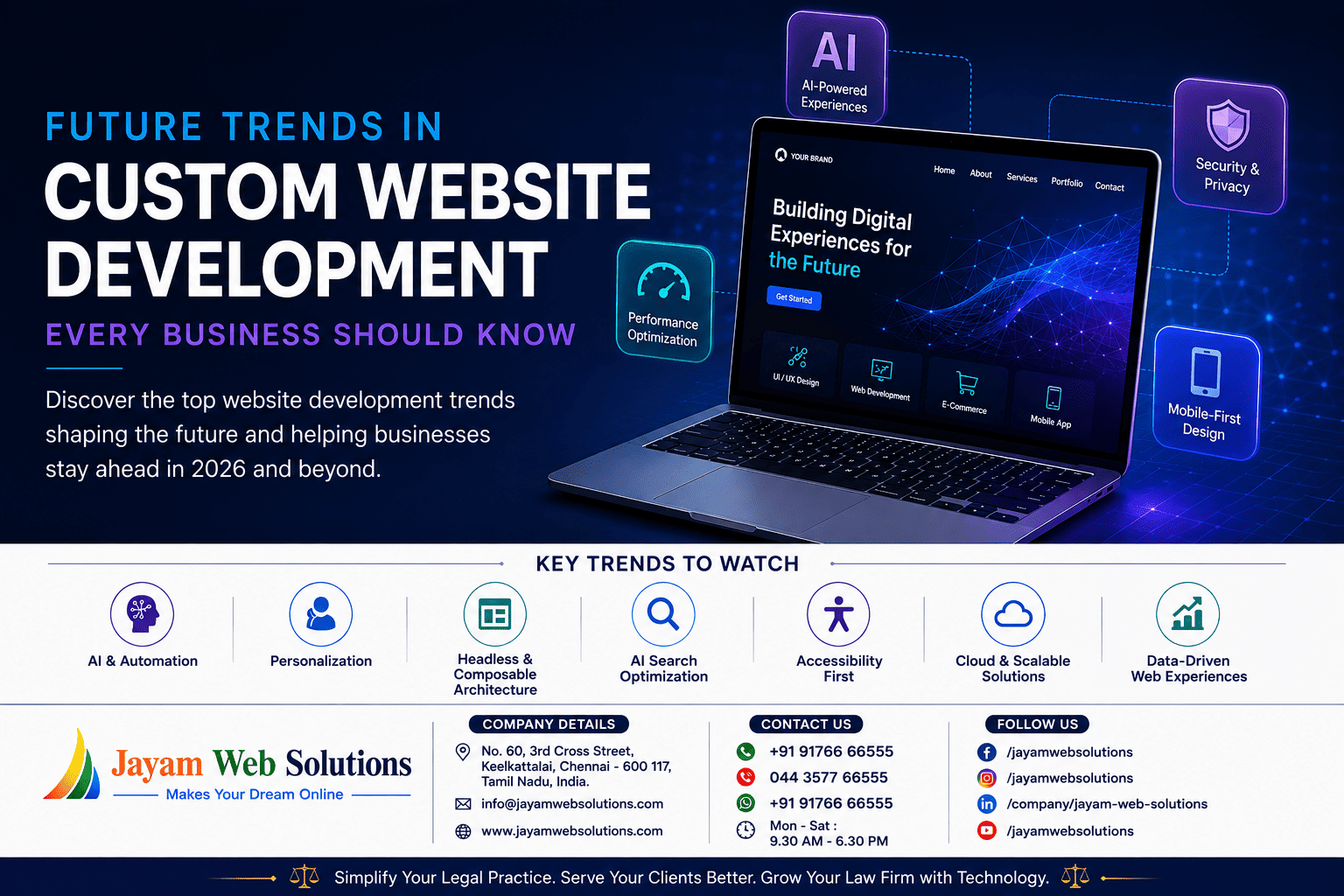
Future Trends in Custom Website Development Every Business Should Know
Introduction
Customers today expect websites to be fast, easy to use, mobile-friendly, secure, personalized, and capable of providing useful information immediately. At the same time, the way people discover businesses is changing as AI-powered search and answer engines become a larger part of the digital journey.
This is making custom website development increasingly important for businesses that need more flexibility than a standard template can provide.
In 2026, web development is moving toward AI-assisted workflows, better performance, personalized experiences, accessibility, flexible architecture, stronger security, and websites designed to work across both traditional search and AI-driven discovery.
So, what should business owners know about the future of custom website development?
Let's explore the major trends.
1. AI-Powered Websites Will Become More Practical
Artificial intelligence is becoming one of the most important developments in modern websites.
Earlier, businesses often added a simple chatbot to their website and considered that an AI feature.
That approach is changing.
AI can now be integrated into different parts of the customer journey, including:
- Website search
- Product recommendations
- FAQ assistance
- Lead qualification
- Appointment assistance
- Content recommendations
- Customer support
- Form assistance
- Internal business workflows
The important point is that businesses should not add AI simply because it is trending.
AI should solve a genuine business problem.
For example, an online service business could use AI to help visitors identify the right service before submitting an enquiry.
This can make the website more useful without making the experience unnecessarily complicated.
AI is also becoming part of the development workflow itself, helping developers with repetitive coding, testing, documentation, and other tasks. However, AI-generated output still requires appropriate human review, testing, and validation before production use.
2. Websites Will Be Designed for AI Search
Search is changing.
People are increasingly using AI-powered tools to ask questions and discover information instead of relying only on traditional search-result pages.
This creates a new consideration for businesses:
Can AI systems clearly understand what your business does?
A custom website should therefore have:
- Clear page structures
- Descriptive headings
- Well-organized content
- Clear business information
- Specific service pages
- Useful FAQs
- Authoritative content
- Structured information where appropriate
This does not mean abandoning traditional SEO.
Instead, businesses should think about creating content that is useful for people, search engines, and AI-driven discovery systems.
The growing focus on AI-oriented search optimization reflects this broader shift in how online information is discovered.
3. Website Performance Will Become a Business Priority
A beautiful website is not enough if it takes too long to load.
Slow websites can create frustration, especially for mobile users.
Custom website development is increasingly focused on performance from the beginning rather than treating speed as a final optimization step.
Developers can consider:
- Optimized images
- Efficient code
- Caching
- Content delivery networks
- Reduced JavaScript
- Server-side rendering where appropriate
- Modern image formats
- Lazy loading
- Performance monitoring
Performance is also closely connected with user experience and search visibility.
Core Web Vitals and other performance measurements continue to be important considerations when building modern websites.
4. Personalization Will Make Websites More Relevant
Traditional websites often show the same experience to every visitor.
The future is moving toward more personalized experiences.
Depending on the business and available data, websites can potentially personalize:
- Content
- Recommendations
- Offers
- Product suggestions
- Navigation
- Calls to action
- Customer journeys
For example, an e-commerce website could show recommendations based on browsing behavior.
A service-based business could present different information based on the visitor's selected service category.
However, personalization must be implemented responsibly.
Businesses should respect privacy and avoid making visitors feel that their activity is being monitored unnecessarily.
AI-driven personalization is becoming an important consideration for businesses looking to create more relevant digital experiences.
5. Mobile-First Development Will Remain Essential
Mobile-first development is no longer a special feature.
It is becoming the baseline for modern websites.
Business owners should expect their websites to work smoothly on:
- Smartphones
- Tablets
- Laptops
- Desktop computers
A mobile-friendly website should provide:
- Easy navigation
- Readable text
- Touch-friendly buttons
- Fast loading
- Simple forms
- Responsive images
- Mobile-friendly menus
The development process should consider the mobile experience from the beginning instead of designing only for desktop and adapting it later.
6. Accessibility Will Become a Standard Requirement
Website accessibility is becoming increasingly important.
A website should be usable by people with different abilities and assistive technologies.
Accessibility-focused development can include:
- Proper color contrast
- Keyboard navigation
- Screen-reader support
- Semantic HTML
- Accessible forms
- Alternative text for meaningful images
- Clear error messages
- Readable typography
Accessibility can also improve overall usability and website structure.
Modern web development increasingly treats accessibility as a foundation rather than an optional feature.
7. Headless and Composable Architecture Will Grow
Businesses are increasingly looking for websites that can evolve over time.
A traditional all-in-one system can sometimes make it difficult to change individual parts of a website.
Headless and composable architecture separates different parts of the system so businesses can have greater flexibility.
For example:
Frontend
↓
API Layer
↓
CMS / Database / Commerce System
This approach can allow businesses to reuse content and services across:
- Websites
- Mobile applications
- Customer portals
- E-commerce platforms
- Other digital channels
For businesses expecting future growth, this type of architecture can provide greater flexibility.
8. Websites Will Become More Like Business Applications
The difference between a website and a web application is becoming less obvious.
Businesses increasingly want websites connected to internal systems.
For example:
Website → CRM → Customer → Payment → Notification → Admin Dashboard
A custom website can integrate with:
- CRM
- ERP
- Payment gateways
- Email systems
- SMS APIs
- WhatsApp integrations
- Booking systems
- Inventory systems
- Customer portals
- Analytics platforms
This allows the website to become part of the company's overall digital workflow.
9. Stronger Website Security Will Be Essential
Cybersecurity should be considered from the beginning of development.
Businesses may collect:
- Customer information
- Contact details
- Payment information
- Documents
- Login credentials
- Business data
Therefore, custom development should consider appropriate security measures such as:
- HTTPS
- Secure authentication
- Role-based access
- Input validation
- Secure APIs
- Data encryption where appropriate
- Regular backups
- Access monitoring
- Software updates
- Security testing
The increasing use of AI-assisted development also makes code review and security validation important because generated code still requires human verification before production use.
10. Conversational Interfaces Will Expand
Users increasingly expect websites to provide direct answers.
Instead of searching through multiple pages, visitors may want to ask:
"Which service is suitable for my business?"
or
"How can I book an appointment?"
Conversational interfaces can help users find information more quickly.
These interfaces can be powered by:
- AI assistants
- Search systems
- Knowledge bases
- Structured FAQs
- Business databases
The key is to make the experience useful rather than simply adding a chatbot that provides generic answers.
11. Functional Motion and Interactive Design
Website design is also becoming more interactive.
Purposeful animations can help:
- Guide user attention
- Explain processes
- Highlight important content
- Improve navigation
- Make interfaces feel more engaging
However, animation should support the user experience rather than slow down the website.
The current design direction is moving toward purposeful motion combined with clean, structured layouts rather than adding animation everywhere.
12. First-Party Data and Privacy Will Matter More
Businesses are becoming more careful about how they collect and use customer information.
Instead of depending heavily on third-party tracking, businesses can build stronger first-party data strategies through:
- Customer accounts
- Enquiry forms
- Newsletter subscriptions
- CRM integrations
- Website analytics
- Consent-based personalization
Privacy should be considered while designing the data architecture.
Businesses should collect only the information they genuinely need and communicate clearly about how data is used.
13. Custom CMS Solutions Will Become More Flexible
Not every business wants to depend on a fixed content management system.
Custom CMS solutions can give businesses control over:
- Website content
- Products
- Services
- Blog posts
- Customer information
- Media
- Team profiles
- Locations
- Forms
A custom CMS can be designed around the company's actual workflow.
This is particularly useful for businesses with complex requirements.
14. Websites Will Need Continuous Improvement
Website development should not necessarily end when the website goes live.
A modern website should be monitored and improved over time.
Businesses can regularly evaluate:
- Website speed
- Search performance
- Conversion rates
- User behavior
- Security
- Accessibility
- Mobile experience
- Content performance
This creates a continuous cycle:
Build → Launch → Measure → Improve → Scale
This approach can help a website remain useful as customer expectations and technology change.
15. What Should Businesses Look for in Custom Website Development?
Before starting a custom website project, business owners should consider:
Business Goals
What should the website achieve?
Target Audience
Who will use the website?
Required Features
What functionality is actually necessary?
Integrations
Does the website need to connect with other business systems?
Scalability
Can the platform support future growth?
Security
How will customer and business information be protected?
Performance
Will the website remain fast as content and functionality increase?
SEO and AI Visibility
Can users and modern search systems easily understand the business?
Accessibility
Can different users navigate and interact with the website?
Maintenance
Who will manage updates and improvements after launch?
16. The Future of Custom Website Development
The future of custom website development is not about using every new technology.
It is about combining the right technologies to create better business outcomes.
The strongest websites of the future will likely combine:
AI + Performance + Personalization + Security + Accessibility + SEO + Flexible Architecture
A business website will increasingly become a central digital platform connecting customers, employees, marketing systems, business software, and data.
The companies that plan their websites with long-term scalability in mind can be better prepared to adapt as technology continues to evolve.
Conclusion
Custom website development is moving beyond traditional website design.
In 2026, businesses need to think about how their websites will perform, how customers will discover them, how AI can improve their workflows, how personalization can improve user experiences, and how security and accessibility can be built into the foundation.
AI-assisted development, AI-driven discovery, performance-first architecture, personalization, accessibility, flexible systems, and stronger security are among the trends shaping the next generation of websites.
For business owners, the most important takeaway is simple:
Don't build a website only for today's requirements. Build a digital platform that can grow with your business.
Visit us at www.jayamwebsolutions.com to get started!
Kindly Reach us or call us at +91 9677876445.