

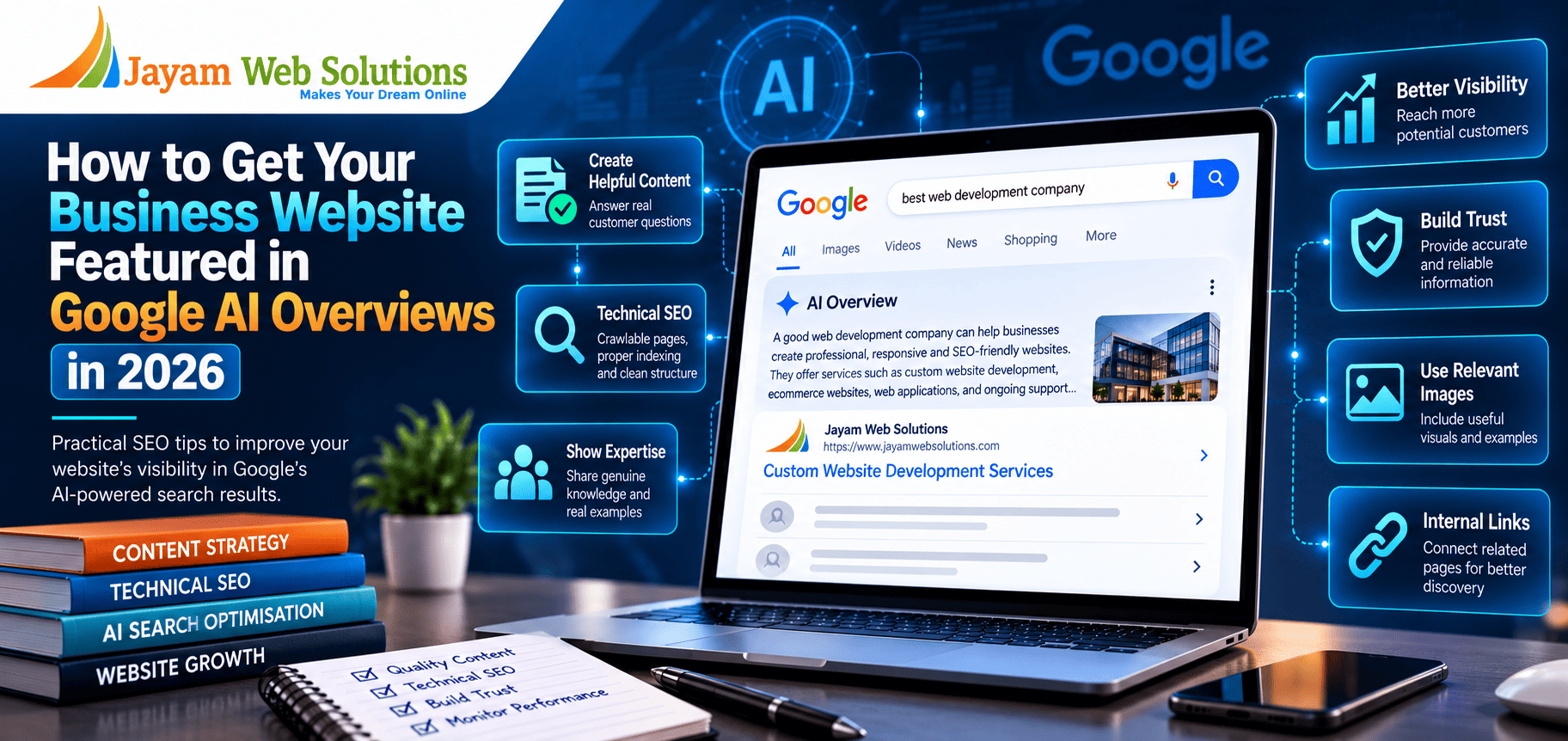
How to Get Your Business Website Featured in Google AI Overviews in 2026
Google Search is changing how people discover information online. For some searches, users may see AI-generated summaries that explain a topic and provide links to relevant websites. These summaries, called Google AI Overviews, offer businesses another potential way to reach people searching for information about their products or services.
For business owners, the important question is how to make their website a useful and relevant source for these search experiences.
There is no guaranteed method to get a website featured in Google AI Overviews. However, publishing valuable information, maintaining a technically accessible website and demonstrating genuine expertise can help build a strong foundation for search visibility.
This guide explains the practical steps businesses can take to prepare their websites for Google's AI-powered search experiences in 2026.
What Are Google AI Overviews?
Google AI Overviews are AI-generated summaries that may appear for certain searches. They bring together information to help users understand a topic and may provide links to websites where readers can explore the subject further.
For example, someone searching for the features needed on a business website might see an overview discussing mobile compatibility, contact forms, security, search optimisation and website performance.
A website that explains these subjects clearly may have an opportunity to appear as a supporting source.
However, AI Overviews are not displayed for every search. Their appearance and the websites linked within them depend on Google's systems and the query being searched.
Why Do AI Overviews Matter for Businesses?
Traditional SEO helps businesses reach people through organic search results. AI-powered search creates another potential route through which users may discover a company while researching a problem or comparing solutions.
Possible benefits include:
- Greater discovery opportunities: Your website may be shown as a source within an AI-generated summary.
- Brand awareness: Potential customers may encounter your company while exploring a relevant subject.
- Relevant website visits: Useful information may encourage interested readers to visit your website.
- Opportunity to demonstrate expertise: Detailed explanations can help readers understand your knowledge and services.
- Early customer engagement: Educational content can introduce your business before someone is ready to request a quotation.
Being included in an AI Overview does not guarantee website visits, enquiries or sales. The objective is to provide genuinely useful information and make the website accessible to search engines.
How Does Google Select Websites for AI Overviews?
Google does not offer a guaranteed formula for appearing in AI Overviews.
Its established search optimisation principles remain relevant to AI-powered search experiences. A page must be indexed and eligible to appear in Google Search with a snippet to qualify for consideration as a supporting link.
Businesses should pay attention to several areas:
- Content that answers the searcher's question accurately.
- A clear layout that makes information easy to follow.
- Original insights beyond general-purpose explanations.
- Website pages and links that search engines can access.
- A usable experience across mobile and desktop devices.
- Information that reflects genuine knowledge or experience.
Adding a particular keyword, schema markup or a special AI-related file cannot guarantee inclusion. The focus should remain on content quality, technical accessibility and relevance to the search.
Create Helpful, People-First Content
Useful content begins with understanding what potential customers want to know.
Rather than selecting topics solely to include keywords, identify the questions people ask when researching your products or services.
For example, a business owner planning a website may want to understand:
- How much does custom website development cost?
- How does a custom website differ from an AI-generated website?
- What features does an e-commerce website require?
- How long can website development take?
- How can a business website help generate enquiries?
Create articles that address these questions with accurate explanations and practical details.
How to make your content more useful
Explain technical subjects in straightforward language. Include relevant examples, discuss limitations and share genuine insights from professional experience.
Avoid publishing material that simply repeats information already available across many websites. Give readers something valuable, such as a practical checklist, a comparison of available approaches or an explanation of a common problem.
AI tools can assist with planning and drafting, but the published article should be checked for accuracy, originality and relevance.
The purpose is to help readers make informed decisions, not merely to increase the number of pages on the website.
Structure Your Content Clearly
A well-organised page helps visitors find the information they need without having to work through a confusing block of text.
For longer blog articles, use:
- One clear H1 heading for the main title.
- H2 headings for major sections.
- H3 headings for related subsections.
- Paragraphs that explain one main idea at a time.
- Numbered lists for processes and instructions.
- Bulleted lists for features, recommendations and checklists.
- Tables when they genuinely make comparisons easier.
- A direct explanation near the beginning when the article answers a specific question.
A table of contents can also make longer articles easier to navigate.
For example, a guide to e-commerce website development could include separate sections for essential features, payment gateways, security, costs and launch preparation.
Use headings to organise meaningful information rather than splitting every few sentences into a new section solely to influence AI search.
Strengthen Your Website's Technical SEO
High-quality content needs to be accessible to search engines. Technical problems can prevent important pages from being discovered or processed correctly.
Ask your development team to review the following checklist.
Technical SEO checklist
- Confirm that accessible pages return the appropriate HTTP status.
- Check that search engines are not unintentionally blocked from crawling important pages.
- Look for accidental
noindexdirectives. - Verify that canonical URLs point to the intended versions of pages.
- Ensure important content is available as readable text.
- Test the layout and functionality on mobile devices.
- Check that internal links can be crawled.
- Optimise images and ensure they are relevant to the page.
- Confirm that structured data accurately represents visible content.
- Include important, indexable blog URLs in the XML sitemap.
- Investigate loading problems and other issues affecting usability.
For JavaScript-based websites, verify that important page content and links can be processed correctly after rendering. Frameworks such as React and Next.js can support SEO when implemented appropriately.
A website does not need to change its entire technology stack simply to target Google AI Overviews. The priority is to ensure that its current setup works properly.
Demonstrate Expertise and Trust
Business websites should make it clear that their information is based on genuine knowledge and reliable details.
For a web development company, useful evidence may include:
- Real project examples shared with appropriate permission.
- Explanations of why particular technologies were selected.
- Honest information about costs, limitations and timelines.
- A useful About Us page.
- Relevant author or reviewer information.
- Accurate business details and contact information.
- Case studies explaining the original problem, the approach taken and the outcome.
Avoid fabricated testimonials, invented project results and claims that cannot be supported.
Visitors should be able to understand who is providing the information and why it is relevant to their needs.
Trust is built through accuracy, transparency and consistent quality—not through unsupported claims about expertise.
Use Relevant Images and Examples
Images and other visual material can make complicated subjects easier to understand when they add meaningful information.
Consider using:
- Original screenshots demonstrating software features.
- Website design examples.
- Diagrams showing a development process.
- Comparison tables for different solutions.
- Illustrations explaining step-by-step procedures.
- Relevant project photographs or videos.
Give informative images descriptive file names and meaningful alternative text.
For example, a screenshot showing a mobile-friendly online store could use the alt text: “E-commerce checkout page displayed on desktop and mobile screens.”
Choose visuals that support the article rather than using the same generic stock image across every blog post.
Image optimisation also matters. Keep file sizes reasonable and check that visuals display correctly on mobile devices.
Build Strong Internal Links
Internal links connect related articles, service pages and other useful resources within your website.
For example, a blog about Google AI Overviews could link to relevant articles covering:
- SEO for business websites.
- Custom website development.
- Technical SEO implementation.
- Website redesign services.
- Website speed and mobile usability.
Where appropriate, the article can also link to the company's relevant service page for readers who need professional assistance.
Use descriptive link text that tells readers what they will find after clicking. Do not add unrelated links simply to increase the total number of links on a page.
A sensible internal linking structure helps visitors discover additional information and helps search engines find important pages.
Common SEO Mistakes to Avoid
Some SEO practices waste effort or make website content less useful.
Avoid the following:
- Publishing large numbers of generic AI-generated articles without meaningful review or added value.
- Repeating the same keyword unnaturally throughout a page.
- Copying competitor content and changing only a few words.
- Creating numerous nearly identical pages for minor keyword variations.
- Adding unsupported statistics or unverified claims.
- Using a title that promises information the article does not contain.
- Adding unnecessary structured data or hidden content.
- Accidentally blocking important pages through technical settings.
- Assuming that FAQs or a table of contents guarantee AI Overview inclusion.
- Expecting every newly published article to rank immediately.
Focus on useful content and established SEO practices instead of shortcuts that promise guaranteed AI search visibility.
How to Monitor Your Website's Performance
After publishing a blog, review its search performance rather than assuming that it has been indexed or featured.
Step 1: Check Google Search Console
Use URL Inspection to investigate whether Google can access the page and review its indexing status.
Step 2: Review organic search performance
Monitor available metrics such as impressions, clicks, search queries and average position. These can help you understand how the article is performing in ordinary Google Search.
Step 3: Review AI search visibility where available
Check the current reporting features available in Google Search Console for your property. Google has introduced reporting for generative AI search performance, but the availability and presentation of specific reports may change.
Step 4: Improve the article based on evidence
If a page receives impressions but few clicks, consider whether its title and description clearly explain the value of the content.
If visibility remains limited, review indexing status, search intent, content quality, technical accessibility and internal links.
Do not assume that low traffic proves an article never appears in an AI-generated answer. Search results and reporting coverage can vary.
Make changes based on the available evidence and revisit performance periodically.
Frequently Asked Questions
Can any website appear in Google AI Overviews?
Websites of different sizes may be considered when their pages are indexed, eligible for search and relevant to the query. However, inclusion in an AI Overview is not guaranteed.
Do I need a special AI SEO plugin?
No special plugin, AI-only file or dedicated AI schema is required for inclusion in Google AI Overviews. Helpful content and sound technical SEO remain important.
Does using AI to write blog content prevent Google from indexing it?
Not automatically. Google's approach focuses on content quality, usefulness and compliance with its policies rather than simply whether AI was used. Producing large amounts of low-value content to manipulate search visibility can raise spam-policy concerns.
Do FAQs improve the chances of appearing in AI Overviews?
FAQs can answer genuine customer questions and improve the usefulness of a page. However, adding an FAQ section does not guarantee better rankings or inclusion in an AI Overview.
How long does it take to appear in Google AI Overviews?
There is no fixed timeline. Google may discover and index a page without ever selecting it as a source for an AI Overview. Continue monitoring performance and improving the page where necessary.
Is traditional SEO still important in 2026?
Yes. Established SEO practices remain relevant to Google's AI-powered search experiences. Website accessibility, useful content and compliance with search policies continue to matter.
Conclusion
Google AI Overviews provide another potential way for businesses to be discovered online, but there is no guaranteed technique for securing a place in an AI-generated answer.
A sustainable approach begins with useful, original information, a clear page structure, a technically accessible website and content that demonstrates genuine knowledge. Regularly reviewing search performance can help businesses identify where further improvements are needed.
For companies investing in their online presence, these practices provide a strong foundation for traditional search visibility and readiness for evolving AI-powered search experiences.
Planning a new business website or looking to improve your existing website?
Jayam Web Solutions provides custom website development and web application development services tailored to business requirements. A well-planned website can support useful content, technical SEO and long-term online growth.
Contact our team to discuss your website requirements.
Jayam Web Solutions — Makes Your Dream Online