

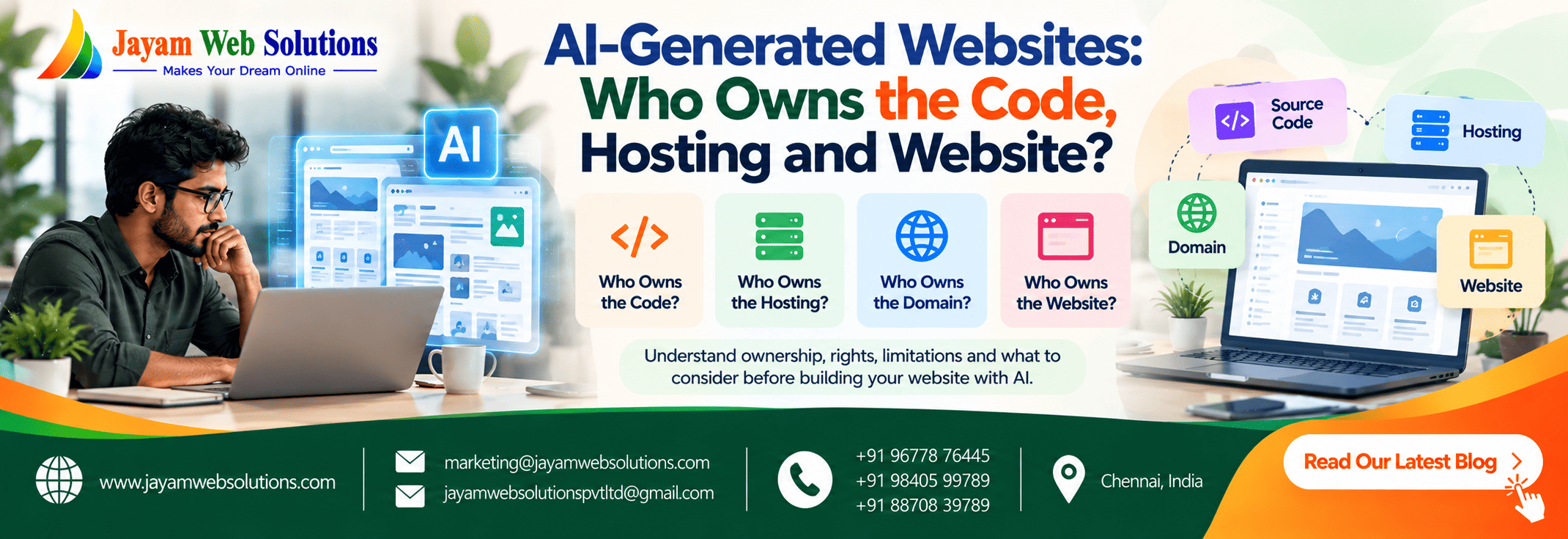
AI-Generated Websites: Who Owns the Code, Hosting and Website?
AI website builders have changed the way businesses create websites. A business owner can now describe what they need, select a design, and generate a working website without manually building every page.
But creating a website with AI is only one part of the decision.
For a business, an equally important question is: Who actually controls the website after it has been created?
If a website is built using an AI platform, the business should understand what happens to the source code, website content, domain, hosting, database, and other components. It is also important to know whether the website can be moved to another hosting provider if the business changes its plans in the future.
This is where AI-generated website ownership becomes an important consideration.
What Does Website Ownership Actually Mean?
When people say, "I own my website," they may be referring to several different things.
A business website can include:
- Domain name
- Website content
- Images and graphics
- Website design
- HTML, CSS, and JavaScript
- Backend source code
- Database
- Customer and business data
- CMS or website builder
- Hosting account
- Third-party integrations
- Plugins and software
- Email services
- Payment gateway integrations
These components do not necessarily have the same owner.
For example, a company may own its domain name and business content while using a third-party platform to host and operate the website.
Therefore, website ownership should not be treated as a single concept.
Who Owns an AI-Generated Website?
There is no universal answer.
The ownership arrangement depends on the AI website builder, its terms of service, the type of output generated, and the services used to operate the website.
Some platforms may give customers rights to use the content or generated output. However, the platform may still retain ownership or licensing rights over its underlying software, templates, components, systems, or technology.
This creates an important distinction:
Having rights to use the generated website does not necessarily mean having complete technical control over the platform that runs it.
Businesses should therefore read the specific terms of the AI website service before assuming that everything belongs to them.
Do You Own the Code Generated by AI?
AI can generate HTML, CSS, JavaScript, backend code, and other programming components.
However, there are two separate questions to consider:
1. Do You Have Rights to Use the Generated Code?
This depends on the agreement and terms of the AI platform.
2. Can You Actually Access and Take the Code With You?
This depends on whether the platform provides source-code access or an export facility.
These are not necessarily the same thing.
An AI platform may allow a customer to use the generated website while keeping the website within its own hosted environment. Another platform may provide downloadable source code.
Therefore, before selecting an AI website builder, businesses should specifically check:
- Is the source code available?
- Can the complete website be downloaded?
- Can the database be exported?
- Can the website run independently?
- Are there platform-specific components?
- Can the website be deployed on another server?
What Happens If You Stop Using the AI Website Platform?
This is one of the most important practical questions for a business.
Imagine that a company creates its website using an AI website builder and pays a monthly or annual subscription. After two years, the company decides to stop using that platform.
What happens next depends on the platform's terms and technical architecture.
Some platforms may allow the website or its content to be exported. Others may keep important parts of the website connected to their own infrastructure.
There may also be rules concerning:
- Website deactivation
- Data retention
- Account cancellation
- Export options
- Database access
- Downloading website files
- Reconnecting the domain
- Continued access after subscription cancellation
This is why businesses should check the platform's cancellation and data-export policies before building the website, rather than after the subscription has ended.
Can an AI-Generated Website Be Moved to Another Server?
The answer depends on how the website was created.
A website built using standard, exportable technologies may be easier to migrate.
However, some AI website platforms combine the website with their own:
- Hosting infrastructure
- CMS
- Database system
- Authentication system
- APIs
- Design components
- Backend services
- Platform-specific features
In such cases, moving the website may require additional development work.
Before choosing an AI website platform, ask:
Can I download the complete website and host it somewhere else?
Also check whether the export includes only the front-end files or whether it includes the backend, database, and other required components.
A website that can be downloaded is not automatically a website that can be moved without modification.
Who Controls the Domain Name?
The domain name is another important part of website ownership.
The domain should ideally be registered under the business owner's or company's control, rather than being dependent on an individual developer, employee, or third-party account.
The business should know:
- Which registrar holds the domain
- Which account controls it
- Who receives renewal notifications
- Who has access to the registrar account
- How the domain can be transferred
- Whether the business can change DNS records
This becomes particularly important when changing website developers, hosting providers, or technology platforms.
Even if the website itself is built using an AI platform, the domain should remain independently manageable by the business.
Website Ownership and Hosting Are Different
Another common misunderstanding is assuming that owning a website means owning the server where it is hosted.
These are different things.
For example:
Website Ownership May Involve:
- Website content
- Design
- Source code
- Database
- Business data
- Domain
Hosting Involves:
The infrastructure used to make the website accessible online.
A company may own its website while renting hosting infrastructure from a hosting provider.
This is similar to using an office building that you do not own. Your business operates from the premises, but the building itself belongs to someone else.
The same principle applies to website hosting.
What About Website Content Created by AI?
AI can generate:
- Text
- Product descriptions
- Images
- Layouts
- Code
- Marketing content
- Other website assets
The rights associated with these outputs can depend on the platform's terms and applicable intellectual-property laws.
Businesses should therefore avoid assuming that every AI-generated element automatically has the same ownership or copyright status.
There can be a difference between:
Contractual rights provided by an AI platform
and
Legal copyright or intellectual-property protection.
These questions can also vary depending on the country and the specific circumstances in which the material was created.
For businesses dealing with valuable intellectual property, legal advice may be appropriate.
Is AI-Generated Code Always Unique?
Not necessarily.
AI systems generate code based on patterns learned from large amounts of information. Generated code can sometimes resemble existing programming patterns or commonly used implementations.
This does not mean that every AI-generated website contains copied code.
However, businesses should understand that an AI platform may not guarantee that every generated output is completely unique or free from potential third-party intellectual-property concerns.
For commercially important software, businesses should have appropriate review and testing processes before putting the system into production.
What Should Businesses Check Before Choosing an AI Website Builder?
Instead of looking only at templates and AI features, businesses should examine the platform from a long-term ownership perspective.
1. Source Code Access
Find out whether the complete source code can be accessed.
2. Website Export
Check whether the website can be downloaded and deployed outside the platform.
3. Database Access
For websites with customer accounts, orders, or other business data, check whether the database can be exported.
4. Domain Control
Make sure the business has control over its domain registrar account.
5. Hosting Dependency
Understand whether the website requires the AI platform's hosting infrastructure.
6. Cancellation Policy
Read what happens to the website and data when the subscription ends.
7. Data Retention
Check how long the platform keeps website and customer data after cancellation.
8. Third-Party Services
Identify integrations that may stop working if the website leaves the platform.
9. Maintenance
Understand who will maintain the website after it has been generated.
10. Migration
Find out whether the website can be transferred to another developer or hosting provider.
AI Website Builder vs Custom Website Development
AI website builders can make website creation faster and more accessible.
They can be useful for businesses that need:
- Basic websites
- Landing pages
- Simple business websites
- Marketing pages
- Quick prototypes
- Early-stage website concepts
However, business requirements can become more complex over time.
A company may eventually need:
- Custom dashboards
- Customer portals
- Employee systems
- Product management
- Inventory management
- Payment integrations
- CRM integration
- ERP integration
- Custom APIs
- Advanced reporting
- Automated workflows
- Role-based access
- Custom databases
At that stage, the question is no longer simply "Can AI create a website?"
The more important question becomes:
"Can the technology provide the control and flexibility that the business requires?"
Custom website development can provide greater control over the application's architecture, database, integrations, hosting environment, and future development, depending on how the project is designed.
AI and Professional Developers Can Work Together
Choosing AI does not necessarily mean choosing AI instead of developers.
AI can assist developers with:
- Code generation
- Debugging
- Documentation
- Content creation
- UI concepts
- Testing
- Repetitive development tasks
- Development research
A professional developer can then review, modify, test, and integrate the generated output into a larger business system.
This approach can combine AI-assisted productivity with human technical oversight.
For businesses with more complex requirements, this can be different from relying entirely on a closed AI website-building platform.
Questions to Ask Before Building Your Business Website With AI
Before committing to an AI website platform, ask these questions:
-
Who owns the website content?
-
What rights do I receive over the generated output?
-
Can I access the source code?
-
Can I download the complete website?
-
Can I move the website to another hosting provider?
-
Can I export the database?
-
What happens when my subscription expires?
-
Can I continue using the website after cancellation?
-
Who controls the domain?
-
Can I change the DNS settings?
-
What happens to my business data if I close the account?
-
Are third-party integrations transferable?
-
Does the website depend on the platform's proprietary technology?
-
Can another developer maintain the website?
-
What happens if the platform changes its pricing or services?
Getting clear answers to these questions can help prevent difficult migration and ownership issues later.
Why Website Ownership Matters for Growing Businesses
A website may begin as a simple online presence.
Over time, it can become an important business asset.
It may contain:
- Customer information
- Product information
- Orders
- Leads
- Marketing content
- Business processes
- Integrations
- Analytics data
- Custom functionality
At that point, the ability to control, maintain, migrate, and develop the website becomes increasingly important.
A business should therefore consider not only how quickly a website can be created, but also how much control it will have over the website in the future.
Final Thoughts
AI has made website creation significantly more accessible.
However, generating a website and owning every part of that website are not necessarily the same thing.
Before using an AI website builder for a business website, carefully examine the platform's terms, source-code access, export capabilities, domain control, hosting arrangement, database access, and cancellation policies.
The key consideration is not simply:
"Can AI build my website?"
It is also:
"What control will my business have over the website after it has been built?"
For a simple website, an AI platform may provide everything the business needs.
For a website involving complex workflows, databases, integrations, or long-term business operations, understanding ownership, portability, and technical control becomes much more important.
A thoughtful decision at the beginning can make future website maintenance, development, and migration considerably easier.
Jayam Web Solutions
Makes Your Dream Online
📧 marketing@jayamwebsolutions.com
📧 jayamwebsolutionspvtltd@gmail.com
📞 +91 9677876445