

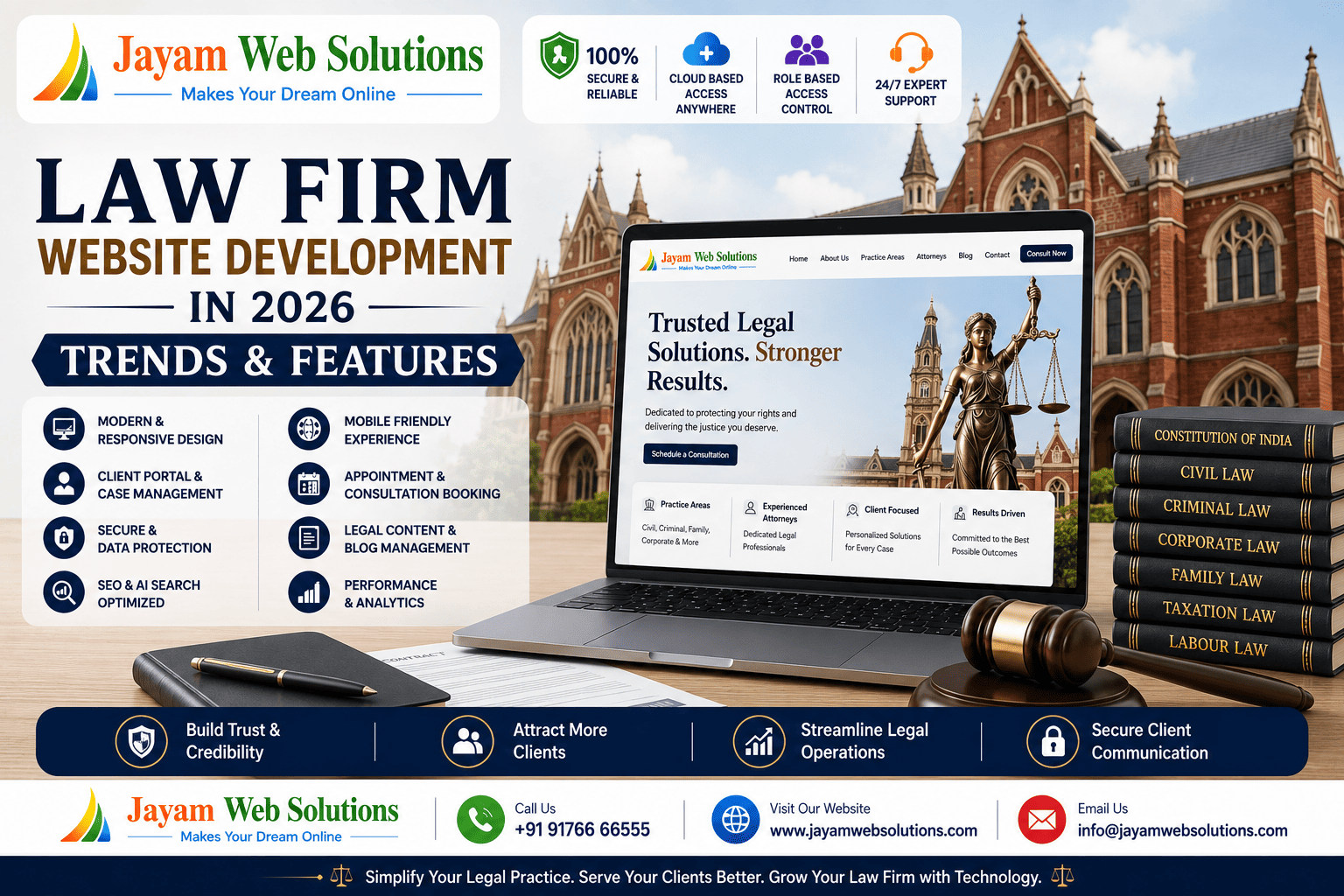
Law Firm Website Development in 2026: Trends, Features & Best Practices
Introduction
Today, potential clients may discover a law firm through search engines, maps, social platforms, AI-powered search experiences, online recommendations, or educational content before they ever contact the firm.
That makes Law Firm Website Development an important part of a modern legal practice's digital strategy.
A well-designed legal website should do more than look professional. It should communicate expertise, make practice areas easy to understand, provide useful information, support client enquiries, protect sensitive information, and make it easy for visitors to take the next step.
In 2026, law-firm websites are increasingly being evaluated around trust, usability, accessibility, technical performance, content quality, SEO, AI discoverability, and client-focused functionality.
What Is Law Firm Website Development?
Unlike a basic business website, a legal website may need to communicate complex information in a clear and trustworthy way.
Depending on the firm's requirements, a legal website can include:
- Practice area pages
- Advocate profiles
- Case-related information
- Consultation enquiry forms
- Appointment booking
- Client intake forms
- Secure client portals
- Document management
- Legal blogs
- News and updates
- Contact and location information
- Payment integration
- Notifications
- Admin management
- Search engine optimization
- Analytics and reporting
The exact functionality should be based on the firm's workflow and client requirements.
Why Do Law Firms Need a Professional Website in 2026?
1. Build Trust Before the First Consultation
Legal services are highly trust-driven.
Before contacting an advocate, a potential client may want to understand:
- Who the lawyer is
- What areas of law they handle
- Where the firm is located
- What experience they have
- How they can be contacted
- What type of clients they serve
- Whether useful legal information is available
A professional website can bring these details together in one place.
The goal is not to make exaggerated claims. Instead, the website should present accurate, clear, and useful information that helps visitors make an informed decision.
2. Make Practice Areas Easy to Find
A law firm may handle several areas of law, such as:
- Civil Law
- Criminal Law
- Family Law
- Corporate Law
- Property Law
- Labour Law
- Taxation Law
- Intellectual Property
- Arbitration
- Contract Law
- Consumer Law
Each important practice area can have a dedicated page.
This makes it easier for visitors to understand the firm's services and can also create more focused opportunities for search visibility.
3. Mobile-First User Experience
Many potential clients access websites using smartphones.
Therefore, a law firm website should work properly across:
- Smartphones
- Tablets
- Laptops
- Desktop computers
Important mobile features include:
- Easy-to-read content
- Simple navigation
- Click-to-call buttons
- Easy enquiry forms
- Fast page loading
- Accessible menus
- Properly sized buttons
A visitor should not have to zoom, scroll excessively, or struggle with navigation to find basic information.
4. AI Search and Online Discoverability
One of the major changes in 2026 is the way people discover professional services.
The American Bar Association notes that generative AI tools such as ChatGPT and Gemini are increasingly influencing how people search for legal services, while law-firm websites can act as important sources of information for these systems.
This means law firms should think beyond traditional keyword ranking.
Their websites should clearly communicate:
- Who the firm is
- What services it provides
- Which practice areas it covers
- Where it operates
- Who its lawyers are
- What topics it has expertise in
Clear information architecture and useful content can make the firm's online presence easier for both people and search systems to understand.
5. Helpful Legal Content
A modern law firm website should not only contain service pages.
It can also provide educational resources such as:
- Legal guides
- Frequently asked questions
- Blog articles
- Case-law updates
- Legal news
- Practice-area explanations
- Video content
- Downloadable resources
Educational content can help potential clients understand legal topics before contacting a firm.
It can also demonstrate knowledge and build online authority.
Current 2026 law-firm website guidance emphasizes useful, client-oriented content rather than generic content produced simply to fill a blog.
6. Online Client Intake
A traditional contact form may ask only for a name, phone number, email address, and message.
A modern legal website can provide a more structured client intake process.
For example:
Visitor → Select Practice Area → Enter Basic Information → Submit Enquiry → Firm Reviews → Contact Client
The form can be customized according to the firm's requirements.
However, because legal enquiries may contain sensitive information, firms should carefully consider what information is collected through public forms and how it is stored and protected.
7. Secure Client Portal
A client portal can provide a dedicated space for authorized clients.
Depending on the system, clients may be able to:
- View case-related updates
- Access documents
- Check appointments
- Communicate with the firm
- View invoices
- Check payment status
- Receive notifications
The American Bar Association's 2026 guidance specifically highlights client portals, online payments, and electronic intake forms as ways websites can extend the client-service experience.
8. Document Management
Legal practices often work with large numbers of documents.
A digital system can help organize documents according to the firm's workflow.
Possible categories include:
- Client documents
- Case documents
- Agreements
- Court-related documents
- Evidence
- Invoices
- Reports
9. Appointment and Hearing Management
A legal website or connected legal management system can support scheduling functionality.
Possible features include:
- Consultation booking
- Appointment calendar
- Hearing dates
- Reminder notifications
- Lawyer availability
- Client appointment details
This can help reduce scheduling confusion and improve communication.
10. Online Payments and Billing
Depending on the firm's business model and applicable rules, online payment functionality can simplify certain billing processes.
A system may support:
- Invoice generation
- Payment status
- Online payment
- Transaction records
- Payment notifications
The payment process should be implemented using appropriate security and compliance practices.
11. Cybersecurity and Data Protection
Security is especially important for legal websites because law firms may handle confidential client information and sensitive documents.
A modern legal web application should consider:
- Secure authentication
- HTTPS
- Role-based access
- Strong password policies
- Multi-factor authentication where appropriate
- Secure API communication
- Data backups
- Access logging
- Secure document storage
- Regular security updates
Therefore, security should be considered during architecture and development rather than added only after the website is completed.
12. Accessibility Matters
A professional law firm website should be usable by as many people as reasonably possible.
Accessibility considerations can include:
- Readable typography
- Sufficient contrast
- Keyboard navigation
- Descriptive links
- Alternative text for meaningful images
- Accessible forms
- Clear error messages
- Logical page structure
13. SEO for Law Firm Websites
Search engine optimization remains important, but the approach is becoming broader.
A strong legal SEO strategy can include:
Technical SEO
- Fast loading
- Mobile responsiveness
- Crawlable pages
- Clean URLs
- XML sitemap
- Structured data where appropriate
On-Page SEO
- Clear page titles
- Relevant headings
- Useful content
- Internal linking
- Descriptive meta descriptions
Local SEO
For firms serving specific locations, local visibility can be particularly important.
The website should clearly communicate:
- Office location
- Service areas
- Contact information
- Practice areas
- Business identity
Authority Building
14. Local Search and Google Business Visibility
For many law firms, clients search for legal services using location-based queries.
For example:
"Advocate near me"
or
"Family lawyer in Chennai"
A law firm's website and online business profile should provide consistent and accurate information.
15. AI Features in Legal Websites
AI is becoming a major part of legal technology in 2026.
Current legal-tech developments show increasing adoption of AI for activities such as legal research, document work, summarization, and workflow support.
However, adding AI to a law firm's website should be approached carefully.
Possible website-related applications include:
- FAQ assistance
- Basic enquiry routing
- Document categorization
- Appointment assistance
- Internal knowledge search
- Content summarization
AI should not be treated as a replacement for professional legal judgment.
Law firms should also consider confidentiality, data protection, accuracy, human oversight, and applicable professional obligations before deploying AI features.
16. Law Firm Website Admin Panel
A good legal website can include an admin panel that allows authorized staff to manage website information.
Possible modules include:
Dashboard
View website activity and important enquiries.
Lawyer Management
Add and update advocate profiles.
Practice Area Management
Manage legal service categories.
Blog Management
Create, edit, and publish legal articles.
Client Enquiries
View and manage website enquiries.
Appointment Management
Manage consultation requests and schedules.
Document Management
Organize permitted documents.
User Management
Control employee and administrator access.
Reports
View enquiry, appointment, and website activity reports.
17. A Modern Law Firm Website Workflow
A simple client journey can look like this:
Google / AI Search / Social Media
↓
Law Firm Website
↓
Practice Area
↓
Lawyer / Advocate Profile
↓
Useful Legal Information
↓
Client Enquiry / Consultation Request
↓
Client Intake
↓
Law Firm Follow-Up
↓
Client Relationship
18. What Makes a Law Firm Website Successful?
A successful legal website should combine:
Trust + Content + UX + SEO + Security + Accessibility + Technology
It should answer three important questions quickly:
Who are you?
The website should clearly communicate the firm's identity and professional information.
What do you do?
Practice areas and legal services should be easy to understand.
What should the visitor do next?
The next action should be clear, such as:
- Contact the firm
- Request a consultation
- Submit an enquiry
- Call the office
- Book an appointment
19. Common Mistakes to Avoid
Using Generic Content
Legal websites should provide useful, specific information rather than large amounts of generic text.
Complicated Navigation
Visitors should be able to find practice areas and contact information quickly.
Ignoring Mobile Users
A website that works well only on desktop devices can create a poor client experience.
Weak Security
Legal information requires careful handling and appropriate security controls.
No Clear Call to Action
Visitors should know how to contact the firm or request the next step.
Publishing Without a Content Strategy
A large number of low-value blog posts is not necessarily better than fewer, genuinely useful resources.
Ignoring AI Search
20. Future of Law Firm Web Development
The future of legal websites is moving toward more connected digital experiences.
Websites are increasingly becoming connected to:
- Client portals
- CRM systems
- Case management software
- Appointment systems
- Payment platforms
- Document management
- Analytics
- AI-assisted workflows
- Communication tools
The objective is not to add technology simply because it is available.
The better approach is to select technology that solves a real problem for the firm or its clients.
Conclusion
Law Firm Website Development in 2026 is much more than creating an attractive website.
A modern legal website should communicate expertise, build trust, provide useful information, support client enquiries, work effectively on mobile devices, protect sensitive information, and remain discoverable across traditional and emerging search experiences.
AI visibility, client portals, secure intake, accessibility, technical SEO, high-quality content, cybersecurity, and streamlined client journeys are becoming increasingly relevant to modern law-firm websites.
For advocates and law firms planning a website or redesign in 2026, the priority should be simple:
Visit us at www.jayamwebsolutions.com to get started!
Kindly Reach us / Call us +91 9677876445