

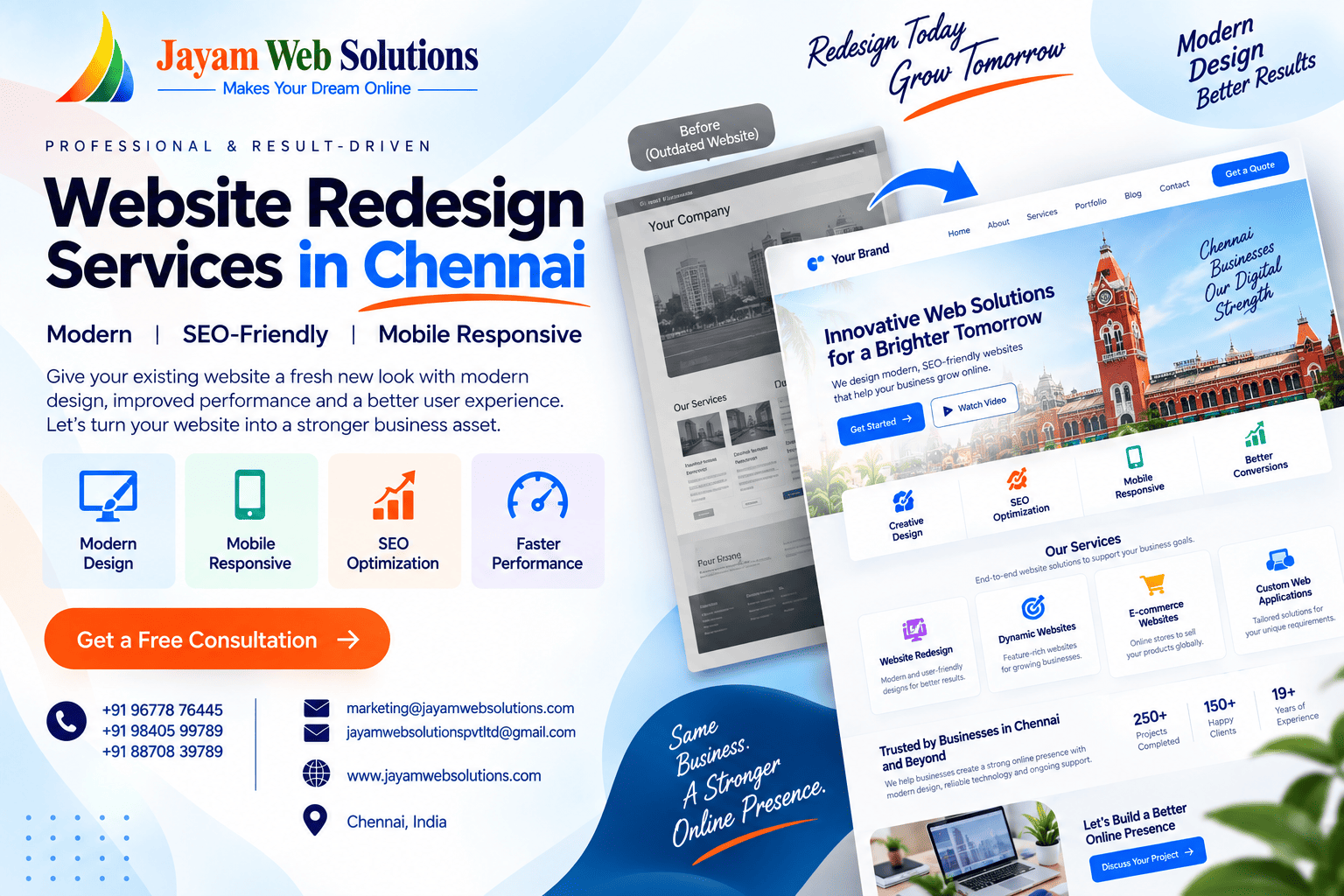
Website Redesign Services in Chennai: Build a Modern, SEO-Friendly Website
A business website is often the first place where potential customers learn about a company. If the website looks outdated, loads slowly, works poorly on mobile devices or makes information difficult to find, visitors may leave before taking the next step.
This is where website redesign services in Chennai can make a practical difference.
Website redesign is not simply about replacing old colours, changing images or giving pages a new appearance. A properly planned redesign can address the website's structure, user experience, mobile responsiveness, performance, content presentation, SEO, security and conversion journey.
For businesses with an existing website, redesigning the current platform can be an opportunity to improve the online presence without starting every aspect from scratch.
What Is Website Redesign?
Website redesign is the process of improving an existing website's visual design, structure, functionality and overall user experience.
Depending on the condition of the existing website, the work may involve:
- Updating the visual interface
- Reorganizing website pages
- Improving navigation
- Making the website mobile responsive
- Improving page loading performance
- Updating outdated content
- Improving SEO elements
- Reworking forms and enquiry sections
- Adding new functionality
- Improving security
- Connecting third-party services
- Rebuilding selected sections or the complete website
The scope depends on what the existing website needs and what the business wants to achieve from the redesign.
Why Do Businesses Need Website Redesign?
An old website may continue to function technically while becoming less effective from a business perspective.
For example, an older website may have been created when most visitors used desktop computers. Today, users may arrive through smartphones, search engines, social media, advertisements or direct links.
A redesign gives the business an opportunity to address these changes.
Common reasons for redesigning a website include:
- Outdated visual appearance
- Poor mobile experience
- Difficult navigation
- Slow page loading
- Outdated technology
- Weak website structure
- Poor conversion flow
- Difficult content management
- SEO limitations
- Security concerns
- Lack of modern functionality
- Inconsistent branding
A redesign should therefore begin by identifying what is not working well rather than simply changing the appearance.
Website Redesign Is More Than a Visual Upgrade
One of the common misconceptions about website redesign is that it only means creating a new-looking interface.
A modern redesign can involve several layers.
Visual Layer
This covers the appearance of the website, including:
- Typography
- Colours
- Images
- Layouts
- Buttons
- Banners
- Cards
- Icons
- Spacing
- Brand presentation
User Experience Layer
This focuses on how easily visitors can find information and complete actions.
For example:
Home → Services → Service Details → Enquiry → Contact
The navigation should guide users naturally instead of making them search through multiple pages.
Technical Layer
The redesign can also address:
- Website performance
- Mobile responsiveness
- Code structure
- Browser compatibility
- Security
- Integrations
- Content management
- Scalability
SEO Layer
Search visibility should also be considered while restructuring the website.
This can include:
- Page titles
- Meta descriptions
- Heading structure
- Internal links
- Image alt text
- Canonical URLs
- XML sitemap
- Structured data
- SEO-friendly URLs
- Mobile usability
- Page performance
Google provides documentation on structured data and explains that it can help search engines understand the content of a page. For local businesses, Google specifically supports LocalBusiness structured data with relevant business information.
Mobile-Friendly Website Redesign
A website should provide a usable experience across different screen sizes.
Visitors may access a business website using:
- Smartphones
- Tablets
- Laptops
- Desktop computers
A redesign can reorganize menus, buttons, images, forms and content blocks so that the interface remains practical on smaller screens.
For example, a desktop navigation menu may need to become a mobile menu, while large image sections may need different proportions on smartphones.
Responsive design is therefore an important part of a modern website redesign project.
SEO-Friendly Website Redesign
A redesign should not unintentionally damage the website's existing search visibility.
When pages are changed, SEO considerations should be included in the planning stage.
Important areas include:
Existing URL Review
Before removing or changing pages, the existing URLs should be reviewed.
Redirect Planning
If URLs are changed, appropriate redirects can help visitors and search engines reach the corresponding new pages.
Page Titles and Meta Descriptions
Each important page should have relevant search-focused metadata rather than repeating the same title across the website.
Heading Structure
Headings should clearly communicate the topic and hierarchy of the page.
Internal Linking
Relevant pages can be connected to help visitors discover related information and understand the site's structure.
Image Optimization
Images should be appropriately sized and optimized so they do not unnecessarily affect page performance.
Structured Data
Relevant structured data can help search engines understand specific types of content. Google notes that structured data can support richer search appearances, although using structured data does not guarantee that a rich result will be displayed.
Improving Website Speed During Redesign
A visually attractive website is not enough if visitors have to wait too long for important content to appear.
Website redesign can be used to review performance-related areas such as:
- Image file sizes
- Unnecessary scripts
- CSS and JavaScript resources
- Third-party integrations
- Server configuration
- Browser caching
- Content delivery
- Code structure
- Database queries where applicable
Performance requirements can vary depending on the technology and functionality used by the website.
Modern Website Design for Better User Experience
Modern website design is not necessarily about adding more visual effects.
Good design should make important information easier to understand.
For example, a business website can clearly present:
What the company does → Why customers should consider the service → Available solutions → Proof or portfolio → Enquiry/Contact
This gives visitors a logical path through the website.
Modern design may include:
- Clean page layouts
- Strong visual hierarchy
- Clear calls to action
- Well-organized content
- Consistent branding
- Professional typography
- Appropriate animations
- Easy-to-use navigation
- Mobile-friendly layouts
The objective should be clarity rather than filling every section with decorative elements.
Website Redesign for Better Lead Generation
For many businesses, the website is not just an online brochure.
It can contribute directly to enquiries and sales.
A redesign can improve the path from visitor to potential customer through:
- Enquiry forms
- Call buttons
- WhatsApp integration
- Service enquiry sections
- Product enquiry forms
- Quote request forms
- Appointment forms
- Contact information
- Strong calls to action
For example, instead of placing a generic “Contact Us” button throughout the website, a service page could use a more specific action such as:
Request a Quote
or
Discuss Your Requirement
This gives the visitor a clearer next step.
Redesigning an Existing Website Without Losing Important Content
Before redesigning a website, existing content should be reviewed.
Some older pages may still receive search traffic or contain useful information.
The redesign process can therefore include an audit of:
- Existing pages
- URLs
- Blog posts
- Images
- Search traffic
- Important landing pages
- Enquiry-generating pages
- Backlinks where relevant
- Existing SEO metadata
Pages that are still useful can be retained and improved rather than removed unnecessarily.
When Should You Redesign Your Business Website?
There is no fixed number of years after which every website must be redesigned.
Instead, businesses should look at how well the current website is performing.
A redesign may be worth considering when:
- The website looks significantly outdated
- Mobile users have difficulty navigating it
- Visitors cannot easily find important information
- The website is difficult to update
- The technology is no longer suitable
- Pages load slowly
- The website has security limitations
- The design no longer reflects the brand
- The enquiry process is complicated
- New business services need to be added
- SEO improvements require structural changes
Website Redesign Process
A structured redesign process can help avoid unnecessary changes and unexpected problems.
1. Existing Website Analysis
The first stage is to understand the current website, its technology, pages, functionality and limitations.
2. Requirement Planning
The business goals and new requirements are documented.
3. Sitemap Planning
The website's page structure and navigation are organized before development.
4. UI/UX Design
New layouts are created for important pages based on the brand and user requirements.
5. Development
The approved designs are converted into a working website.
6. Content Integration
Existing or newly prepared content, images and other information are added.
7. SEO Implementation
Important SEO elements are configured as part of the redesigned website.
8. Testing
The website is checked across different devices, browsers, forms and functional areas.
9. Deployment
After final approval, the redesigned website is published.
10. Post-Launch Monitoring
The website can then be monitored for technical issues, indexing problems, broken links and user behaviour.
How to Choose Website Redesign Services in Chennai
Choosing a website redesign company should involve more than comparing visual designs.
Businesses can evaluate the development partner based on:
- Previous website redesign projects
- UI/UX capabilities
- SEO understanding
- Mobile development experience
- Technical expertise
- Website performance knowledge
- Security practices
- CMS or custom development experience
- Testing process
- Communication
- Post-launch support
It is also useful to provide the existing website to the development team before finalizing the scope. This allows them to understand the current technology and identify areas that may require additional work.
Website Redesign for Chennai Businesses
A Chennai-based business may serve customers locally, across India or internationally.
Therefore, the website strategy should match the actual target audience.
For a business targeting customers in Chennai, local relevance can be incorporated naturally through:
- Service-area information
- Location details
- Chennai-focused service pages where genuinely relevant
- Google Business Profile alignment
- Local business information
- Relevant customer testimonials
- Location-specific content
Google supports LocalBusiness structured data for businesses and recommends providing relevant details such as business name, address, telephone number and URL where applicable.
However, simply adding the word “Chennai” repeatedly across every page does not create a strong local SEO strategy. The location should appear where it genuinely helps users understand the business and its service area.
Frequently Asked Questions
What is website redesign?
Website redesign involves improving an existing website's design, structure, functionality, performance and user experience.
Why should a business redesign its website?
A redesign may be considered when the existing website has outdated design, poor mobile usability, slow performance, difficult navigation, weak conversion paths or technical limitations.
Will website redesign affect SEO?
It can. Changes to URLs, page structures, content and navigation can affect search visibility. SEO should therefore be considered before and during the redesign rather than after the new website is launched.
Can an old website be redesigned without rebuilding everything?
In some cases, yes. The approach depends on the existing technology, code quality, CMS, database structure and new requirements. Some websites can be upgraded, while others may benefit from redevelopment.
Can a redesigned website be mobile responsive?
Yes. Responsive layouts can be created to provide a usable experience across smartphones, tablets, laptops and desktop screens.
How long does website redesign take?
The timeline depends on the number of pages, design requirements, functionality, content, integrations, technology and testing involved.
Is website redesign different from website development?
Yes. Website redesign generally starts with an existing website and focuses on improving or rebuilding it. Website development may involve creating a new website from the beginning.
Can SEO be improved during a website redesign?
Yes. A redesign provides an opportunity to review page structure, metadata, content organization, internal linking, URLs, performance and other SEO-related elements.
Conclusion
A website redesign should not be treated as simply giving an old website a new appearance.
When planned properly, it can improve the way visitors interact with the website, make information easier to access, strengthen mobile usability, support SEO requirements and create a clearer path toward enquiries.
For businesses looking for website redesign services in Chennai, the important step is to first understand what the existing website is lacking and then create a redesign plan around those requirements.
A modern website should not only look professional. It should also be easy to use, responsive, technically reliable, search-friendly and aligned with the business objectives.
Looking for Website Redesign Services in Chennai?
Jayam Web Solutions provides website redesign and custom website development services for businesses looking to modernize their online presence.
Our website solutions can include:
- Website redesign
- Custom website development
- Responsive website design
- SEO-friendly website development
- Dynamic website development
- E-commerce website development
- Business website development
- Custom web application development
- Website maintenance and support
Website: www.jayamwebsolutions.com
Email: marketing@jayamwebsolutions.com
Email: jayamwebsolutionspvtltd@gmail.com
Phone: +91 96778 76445 | +91 98405 99789 | +91 88708 39789
Jayam Web Solutions – Makes Your Dream Online